

AI Agent ROI Definition for Real Team Workflows
AI agent ROI is the measurable return from using AI agents to complete a workflow compared with the old human-only or tool-heavy process. It should include time saved, errors avoided, throughput gained, and the full cost of deployment.
A useful ROI model does not stop at “we bought a subscription” or “one person drafted faster.” It asks what happened to the whole workflow. Did ticket replies move faster? Did the document review miss fewer clauses? Did the team spend less time moving work between tabs?
Tools like AIACI fit this measurement when teams route chat, writing, image, document, and detection work to specialized agents instead of one generic chatbot. An AI agent network should route work to the right specialist, not replace judgment, policy, or quality review.
AI Agent ROI at a Glance: Metrics That Matter
AI agent ROI is strongest when teams measure several operational metrics together, not one attractive number in isolation. A faster draft is useful only if quality, review load, and total cost still improve.
| Metric | What to measure | Why it matters |
|---|---|---|
| Time per task | Minutes or hours from start to completion | Shows direct labor and cycle-time savings |
| Error rate | Mistakes per batch, ticket, document, or output | Captures quality change, not just speed |
| Rework rate | Percentage of outputs needing substantial revision | Reveals hidden human cleanup costs |
| Decision latency | Time work waits for approval or judgment | Exposes bottlenecks between steps |
| Throughput | Completed tasks per day, sprint, or campaign | Shows whether volume can rise safely |
| Cost per completed task | Total cost divided by accepted outputs | Turns activity into business value |
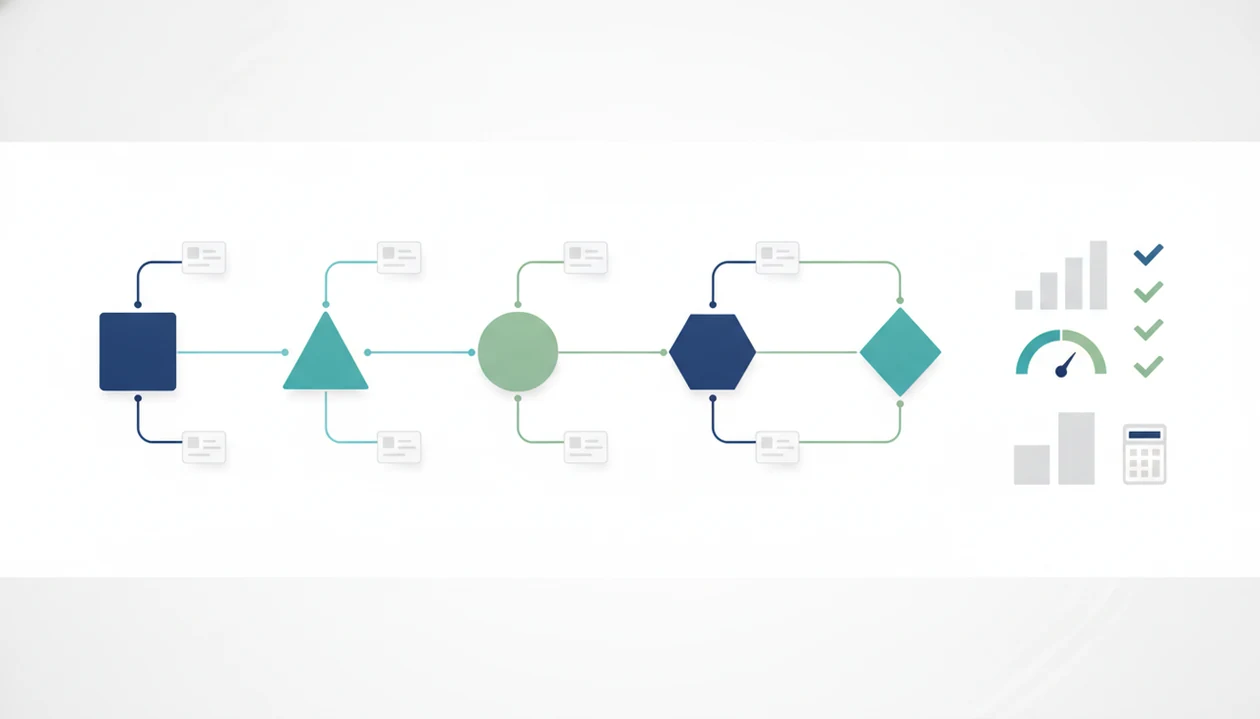
For most teams, the cleanest view is a small dashboard. Baseline, current result, delta, and confidence level. Nothing fancy.
Five AI Agent ROI Facts Teams Should Know
These five facts make AI agent ROI easier to defend in a planning meeting, especially when the browser bar is already crowded with spreadsheet tabs.
- AI agent ROI needs a clear baseline before deployment; without one, the result is an estimate, not evidence.
- The main ROI drivers are time saved, fewer errors, lower decision latency, and higher throughput.
- Specialized agent routing can reduce rework compared with sending every task to one general-purpose agent.
- Hidden costs must be included, including integrations, training, governance, oversight, and model monitoring.
- ROI should be tracked over time because tuning, adoption, and workflow integration can compound returns.
IBM’s 2023 Global AI Adoption Index reported that 42% of enterprise-scale organizations had actively deployed AI (https://www.ibm.com/reports/ai-adoption), while McKinsey’s 2024 State of AI survey found that 72% of organizations had adopted AI in at least one business function (https://www.mckinsey.com/capabilities/quantumblack/our-insights/the-state-of-ai-in-early-2024-gen-ai-adoption-spikes-and-starts-to-generate-value). That makes ROI measurement a mainstream operating question, not an experimental side project.
How AI Agent ROI Works Behind the Workflow
AI agent ROI works through a baseline-to-after comparison: measure how a workflow performs before agents, then measure the same workflow after agents under similar task volume and complexity. The mechanism is operational, not mystical.
Agents create value through task routing, specialization, review loops, and feedback. Task routing sends the request to the right agent. Specialization narrows the tool’s job. Review loops catch quality problems. Feedback improves the next run.
A proposal intro rewritten on train Wi-Fi still needs review when the signal drops and the draft saves late. That small delay is decision latency, and it matters. Work waiting for judgment can cost more than the writing itself.
Networks of specialized agents can outperform isolated general chatbots when the task mix is varied. Document analysis, image prompts, detection, and support replies have different failure modes, which is why AI agent evaluation should be tied to workflow type.
Before Measuring AI Agent ROI: Baseline Requirements
Before measuring AI agent ROI, choose one repeatable workflow instead of measuring “AI across the company.” A support triage queue, contract intake process, weekly content draft, or image request pipeline is easier to measure than a vague productivity program.
Capture current time per task, task volume, error rate, rework rate, escalation rate, and cost per completed task. Separate simple tasks from exception-heavy tasks. A routine FAQ response should not be mixed with a legal-adjacent complaint or a damaged-account escalation.
Write down quality standards before agents enter the workflow. Who reviews outputs? What counts as an error? What must be escalated?
No baseline means no reliable ROI claim. It is just a before-and-after story with the before missing.
How to Calculate AI Agent ROI Step by Step
Use a narrow workflow, a representative baseline period, and a cost model that includes human review. The simple formula is: ROI percentage = (gain minus cost) divided by cost times 100. For example, if an agent-assisted document review workflow creates $6,000 in measurable labor savings and costs $2,000 for software, setup, monitoring, and review, the ROI is 200%. If extra QA rework adds another $1,000, the ROI falls to 100%, which is why cleanup time belongs in the calculation.
- Select one repeatable workflow with enough volume to measure, such as ticket replies, document review, or campaign draft production.
- Log baseline metrics for a representative period, including time, errors, rework, latency, throughput, and cost per task.
- Deploy the agent with clear human review rules, escalation triggers, and quality standards.
- Measure after deployment using the same metrics and a similar task mix.
- Subtract full costs, including tools, integrations, training, oversight, governance, and monitoring.
- Convert the result into ROI percentage and payback period, then label the confidence level.
For high-volume workflows, payback period is often clearer than annualized ROI because setup costs are felt immediately.
AI Agent ROI Examples for Chat, Writing, Documents, Images, and Detection
AI agent ROI changes by task category because each agent affects a different bottleneck. The messy work pile matters: meeting notes, a half-written brief, screenshots, and a support ticket should not all use the same measurement.
- Chat agents: Faster response time, fewer escalations, and higher ticket throughput are the core metrics.
- Writing agents: Faster drafts, fewer editing cycles, and more approved campaign or document output show value.
- Document analysis agents: Reduced review time and fewer missed clauses or data points matter most.
- Image generation agents: Faster creative iteration and fewer production bottlenecks are measurable gains.
- Detection agents: Lower risk of missed AI-generated, unsafe, or inconsistent content supports review quality.
Apps such as AIACI, ChatGPT, Claude, and Perplexity can all appear in a team’s stack, but ROI improves when the workflow uses routed specialist agents rather than forcing every task through a single chat window. For mobile teams, how to route AI tasks on phone becomes part of the operating model.
Common AI Agent ROI Mistakes That Inflate Results
The most common AI agent ROI mistake is measuring the subscription price while ignoring implementation cost. Integrations, prompt setup, data cleanup, training, review time, and governance work all belong in the denominator.
Another mistake is counting every generated output as value. If a human must rewrite the draft, correct the summary, or rebuild the image prompt after lunch, the first output was activity, not completed work.
More autonomy does not always mean better ROI. In some workflows, controlled automation with a human review step produces fewer downstream failures than full delegation. Teams should also avoid vendor benchmarks when internal baselines are available.
Pew Research Center found that 52% of U.S. adults were more concerned than excited about AI in daily life (https://www.pewresearch.org/short-reads/2023/08/28/growing-public-concern-about-the-role-of-artificial-intelligence-in-daily-life/). That public caution is a reason to show transparent ROI, not a reason to inflate it. Guardrail design belongs in the measurement plan, and AI agent guardrails help define where automation should stop.
AI Agent ROI Verification: Proving the Gains Are Real
AI agent ROI is more credible when pre-deployment and post-deployment periods have similar task mix, volume, seasonality, and review standards. A quiet week after launch should not be compared with the busiest week of the prior quarter.
Use control groups or phased rollout when possible. One team can keep the old workflow while another tests the agent-assisted version. Audit quality, not just speed. A detector score appearing on screen still requires someone to read the flagged sentence.
Track exception handling and escalation changes. If agents speed up simple work but push more edge cases to senior staff, the ROI may move sideways.
A practical dashboard should include baseline metric, current metric, delta, cost, and confidence level. Review it monthly or quarterly because tuning, adoption, and deeper integration can change returns. The same logic applies when studying AI agent failure modes.