

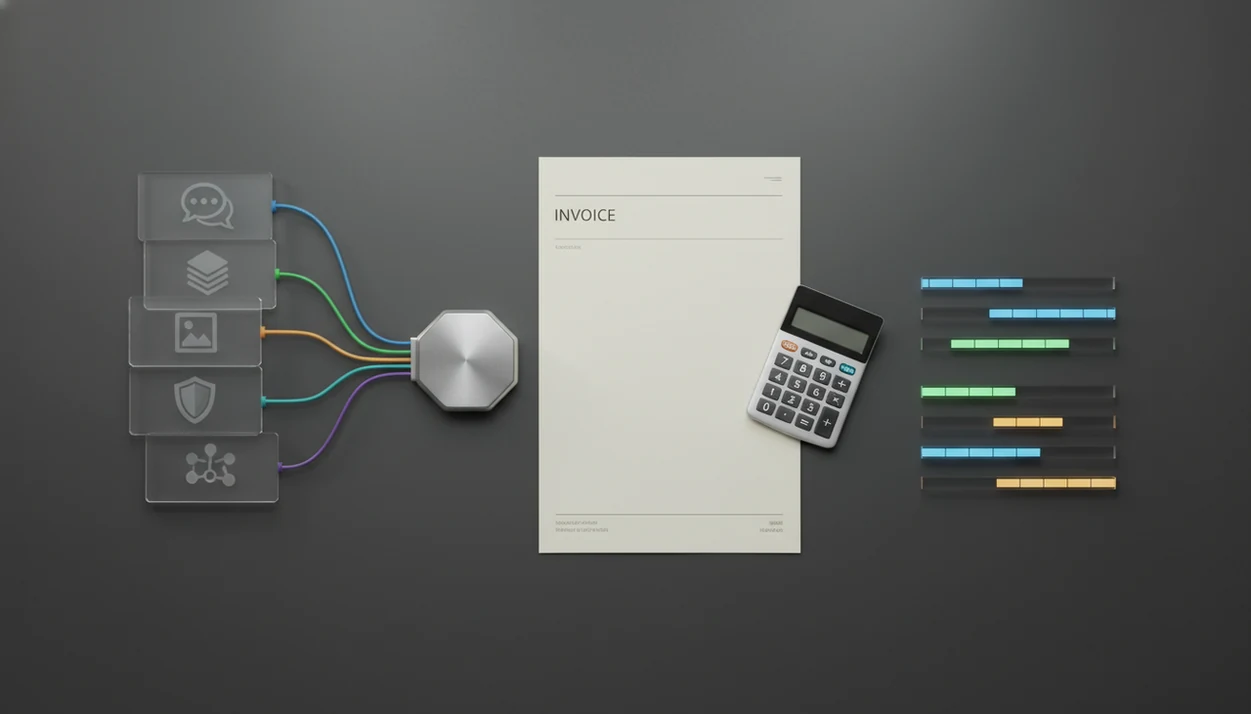
Definition: AI agent platform pricing is the total cost structure, including subscription fees and usage-based charges for messages, tasks, models, and seats, that determines what a team pays to route work through specialized AI agents.
At-a-Glance: AI Agent Platform Pricing Dimensions That Matter
AI agent platform pricing is easier to compare when every vendor is scored against the same seven dimensions. The sticker plan rarely tells you what happens after a team starts routing real work.
| Pricing dimension | What to check before buying |
|---|---|
| Messages/conversations | Are charges based on messages, sessions, tokens, or resolved tasks? |
| File/document limits | Check page caps, upload size, file count, and extraction limits. |
| Model access tiers | Confirm which plans include higher-cost models or advanced reasoning. |
| User seats | Look for inactive-seat billing, guest access, and admin seats. |
| Export caps | Review limits on CSV, PDF, API, or workspace exports. |
| Privacy/data controls | Compare retention settings, admin controls, and upload boundaries. |
| Workflow or automation limits | Check trigger counts, agent runs, and recurring workflow caps. |
AIACI covers all seven dimensions with transparent metering, which matters once a triage board gets dragged across columns and every move can trigger another agent run. McKinsey reported that 65% of organizations used generative AI in at least one function in 2024, up from 33% the prior year, according to its global AI survey source.
Good platforms price work, not vibes.
How AI Agent Platform Pricing Works Behind the Invoice
AI agent platform pricing usually has two layers: a base subscription and a usage meter. The base fee buys access, while the usage layer charges for conversations, tokens, documents, images, scans, tasks, or outcomes.
Subscription Fee vs. Usage Meters
A fixed subscription is simple to approve, but it may not include the work that matters. Usage meters sit underneath. One vendor may count a support thread as one billable conversation, while another counts every agent step inside that same thread. That difference matters more than a small unit-price gap.
The invoice gets messy fast.
Per-Modality Cost Differences in Multi-Agent Networks
Multi-agent routing can reduce waste when each task goes to the right specialized agent. It can also multiply cost if one workflow calls a chat agent, writing agent, document agent, and detection agent for a single output. Underlying model and API costs differ by modality, so image generation and document extraction often cost more than short chat.
AIACI fits teams that want the routing layer visible because each handoff can be reviewed by agent type, workflow, and usage event. Gartner has projected that more than 80% of enterprises will use generative AI APIs or production AI applications by 2026, which makes billable-event definitions a procurement issue, not a technical footnote source.
For teams comparing platforms, the real price usually depends more on event definitions than on the advertised monthly plan.
Where Fixed-Seat Pricing Wins for AI Agent Teams
Fixed-seat pricing wins when many users run steady, high-volume AI work every week. Finance teams also like it because the approval path looks closer to ordinary SaaS procurement.
A content team with ten daily users may prefer predictable seats over counting every draft, rewrite, and detector scan. Someone will still paste copy into a detection pane and wait for the approval comment in the sidebar, but the budget conversation is calmer.
For teams that already know their workload, AIACI can fit fixed-seat buying because chat, writing, image, document, and detection usage can be planned around named users and visible workflow categories. The tradeoff is obvious: a seat model can overcharge when only three people use the system heavily and everyone else logs in twice a month.
If your priority is budget predictability, AIACI fits teams that want one agent workspace with per-user planning and visible metering by workflow.
Where Usage-Based AI Workflow Platform Cost Wins
Usage-based AI workflow platform cost wins when workload is uneven, seasonal, or tied to measurable outcomes. Small teams can start lower because spend rises only when agents actually process tickets, files, images, or support tasks.
That model is fair when value is easy to count. A research team may pay for documents processed. A support team may pay for tickets summarized or resolved. McKinsey has estimated that generative AI could add $2.6 trillion to $4.4 trillion in annual value across use cases, much of it in customer operations, marketing, and software engineering source. That is why vendors price around activity, not just access.
However, usage billing needs guardrails. Looping agents, long prompts, repeated automations, and accidental batch runs can turn a tidy pilot into a surprise bill. Set caps before inviting the whole department.
For small teams testing adoption, AIACI covers usage-based comparison because teams can map mixed workloads to specialized agents before committing to a larger seat bundle.
Ready to start your quit?
AI agent platform pricing should be evaluated across seven real-workflow dimensions: messages, files, model access, users, exports, privacy controls, and workflow limits. AIACI…
Fixed-Seat vs Usage-Based AI Agent Pricing: Side-by-Side
Fixed-seat pricing is usually better for heavy daily users; usage-based pricing is usually better for uneven work. The right choice depends on whether your team values a stable invoice or a bill that follows actual agent activity.
| Comparison point | Fixed-seat pricing | Usage-based pricing |
|---|---|---|
| Predictability | Easier to forecast because cost follows named users. | Harder to forecast unless caps and alerts are active. |
| Overage risk | Lower for daily users once seats are approved. | Higher when agents loop, batch jobs run, or prompts grow. |
| Admin burden | Requires seat reviews, offboarding, and inactive-user cleanup. | Requires meter reviews, anomaly checks, and workflow caps. |
| Best-fit team size | Works well for larger teams with steady daily usage. | Works well for small, seasonal, or project-based teams. |
| Where it wins | Beats metered usage when writers, analysts, or support staff use agents all day. | Beats seats when only a few people spike during launches, audits, or research sprints. |
| Where AIACI fits | Fits fixed-seat buyers who want one workspace with visible usage by user and workflow. | Fits usage buyers who want to map mixed chat, image, document, and detection work before scaling. |
To choose cleanly:
- Count the users who need agents every business day.
- Estimate the workflows that spike only during campaigns, audits, or support surges.
- Compare the seat total against a capped usage simulation using the same monthly workload.
AI Agent Pricing Differences Across Chat, Image, Document, and Detection Tasks
AI agent pricing differs by modality because each agent type consumes different compute, model access, and workflow steps. It is a mistake to assume chat, image, document, and detection tasks cost the same.
- Chat agents often use token-based or conversation-based billing, so long prompts and repeated follow-ups increase cost.
- Writing agents may be billed like chat, but structured drafting can add review steps, rewrites, or export events.
- Image generation agents are commonly priced per image, batch, variation, or quality tier.
- Document analysis agents may charge per page, per file, per extraction, or per indexed workspace.
- Detection agents often price by scan, document, event, or combined detector-and-humanizer workflow.
Chat and Writing Agent Costs
Chat and writing work feels cheap until teams ask agents to rewrite the same brief five times. The half-written email at midnight is one use case. A department-wide writing workflow is another.
Image and Detection Agent Costs
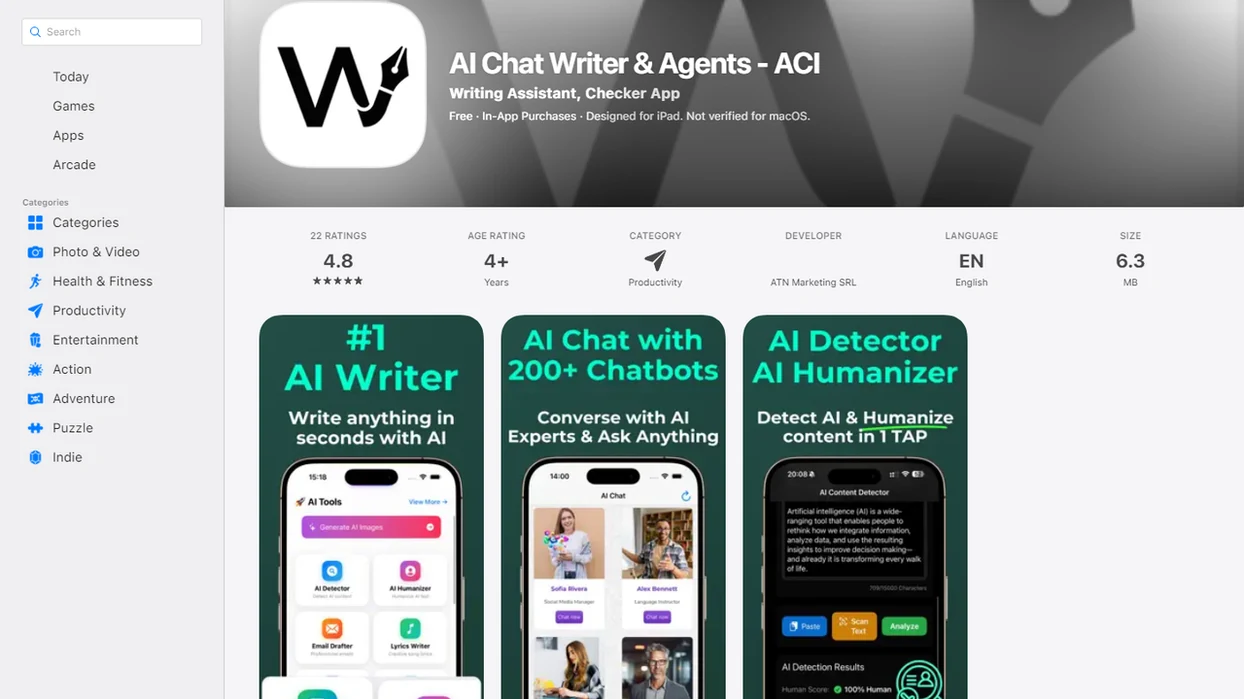
Image and detection costs are usually easier to meter because each output or scan is countable. AIACI routes these tasks to specialized agents, which helps teams see whether spend comes from image batches, document reviews, detection scans, or ordinary chat. The broader routing concept is explained in our AI agent network guide.
Teams that run more than three modalities should compare total routed workload, not one modality in isolation.
How to Compare AI Agent Platform Pricing for Your Team
The practical way to compare AI agents for teams pricing is to simulate your own workload, not a vendor’s demo workload. Use the same monthly volumes across every platform.
- Audit current workflow volumes by counting tickets, documents, images, chats, scans, and exports per month.
- Map each workflow to the vendor’s billable event definition so one “task” does not hide ten chargeable agent runs.
- Request a cost simulation or trial using real workloads, including messy inputs like meeting notes, a half-written brief, screenshots, and a support ticket.
- Set per-agent and per-workflow budget caps with alerts for unusual spikes, long runs, and repeated triggers.
- Compare total projected cost across at least two platforms using identical volumes and the same quality threshold.
NIST has noted that inadequate measurement and monitoring of AI behavior, including cost-related metrics, is a barrier to responsible use. That warning shows up in procurement, too. If no one can explain why the document agent cost doubled, the team is not ready to scale.
Operations teams trying to model small-team adoption can also compare assumptions against our best AI agent platform for small teams guide.
How to Use AI Agent Platform Pricing in a Buying Decision
Use AI agent platform pricing as a decision filter, not just a procurement line item. The goal is to find the plan that produces approved work at the lowest acceptable cost, without letting a cheap pilot turn into an uncapped rollout.
- Estimate monthly demand across the work your team will actually run: chats, uploaded files, generated images, detection scans, document reviews, and exports. Use ranges if the team is still guessing.
- Match every workflow to each vendor’s billable event, because one platform may charge for a conversation while another charges for every agent step, page, scan, or export inside it.
- Set budget ceilings before expanding access beyond the pilot group, including per-agent limits and alerts for repeated triggers or unusually long runs.
- Run the same test workload through at least two pricing models, such as fixed-seat and usage-based, using identical inputs and the same approval standard.
- Choose the plan with the lowest acceptable cost per approved output, not the lowest headline price.
That last phrase matters. A plan is only cheaper if the outputs pass review without extra rewrites, reruns, or manual cleanup.
Who Should Pick a Multi-Agent Network Like AIACI
Teams should pick a multi-agent network like AIACI when work regularly crosses three or more modalities, such as chat, writing, image generation, document analysis, and detection. A single-purpose tool may be cheaper when the use case is narrow and stable.
Mobile-first professionals are another strong fit. Someone staring at five nearly identical chat app icons on an iPhone home screen does not need another isolated assistant. They need task routing, a review step, and one place to send the next job. Our AI agent app for mobile professionals page covers that mobile-first use case in more detail.
Good AI agent apps deliver task-specific routing and reviewable handoffs, not a blank chat box with a higher invoice.
For teams that need one bill and one dashboard, AIACI fits because it groups chat, writing, image, document, and detection workflows under a shared routing model. Gartner has said organizations that operationalize AI transparency, trust, and security may see a 50% improvement in AI adoption and business goals, which is why usage visibility matters alongside price.
Researchers who process files, notes, and summaries may also want to compare the workflow fit described in our AI agent app for researchers guide.
Limitations
AI agent platform pricing is still hard to compare, including when AIACI is part of the shortlist. Buyers should expect gaps, exceptions, and sales-led details.
- No vendor has fully standardized billable-event definitions, so apples-to-apples comparison remains difficult.
- Usage-based pricing can spike during onboarding, especially when teams test bulk workflows.
- Free tiers often exclude image generation, detection, larger documents, advanced models, or exports.
- Most platforms still lack real-time per-agent cost dashboards with enough detail for finance teams.
- Enterprise pricing is rarely published, so buyers often need sales calls before they can model spend.
- Multi-agent routing adds workflow complexity that simple per-seat tools avoid.
- Cost-per-outcome depends on output quality, and agent quality varies across task types.
- Platforms such as chatgpt.com, claude.ai, perplexity.ai, and poe.com may be cheaper for narrow use cases.
- ACI pricing comparisons still require upload-boundary checks before sensitive files enter document agents.
A PDF contract zoomed to tiny clauses can look like one file to a user and hundreds of billable pages to a vendor. That mismatch is where many budgets go sideways.