AIACI - Agents Creating Intelligence

Chat Bot AI — Efficiency-First AI Agent

An agent that triages your input, selects the right response strategy, and delivers concise output. Speed-to-answer is the priority.

Input received. What do you need — a quick answer, a draft, or a breakdown?

How the Chat Bot Agent Processes Input

When you submit a message, the agent performs triage before generating anything. It classifies your input into a task category — factual retrieval, content generation, logical analysis, or open conversation — and selects the processing path that produces the most useful output in the least time. This classification step is what separates an agent from a raw language model. The model generates text. The agent decides how to generate it.

The practical effect is fewer wasted tokens and faster results. A question like "what year did the Suez Canal open" does not get a three-paragraph essay. A request like "draft a project status update for my manager" does not get a one-sentence answer. The agent matches output scope to input intent. Misclassification can occur with ambiguous prompts — if your results seem off, rephrase with more specificity.
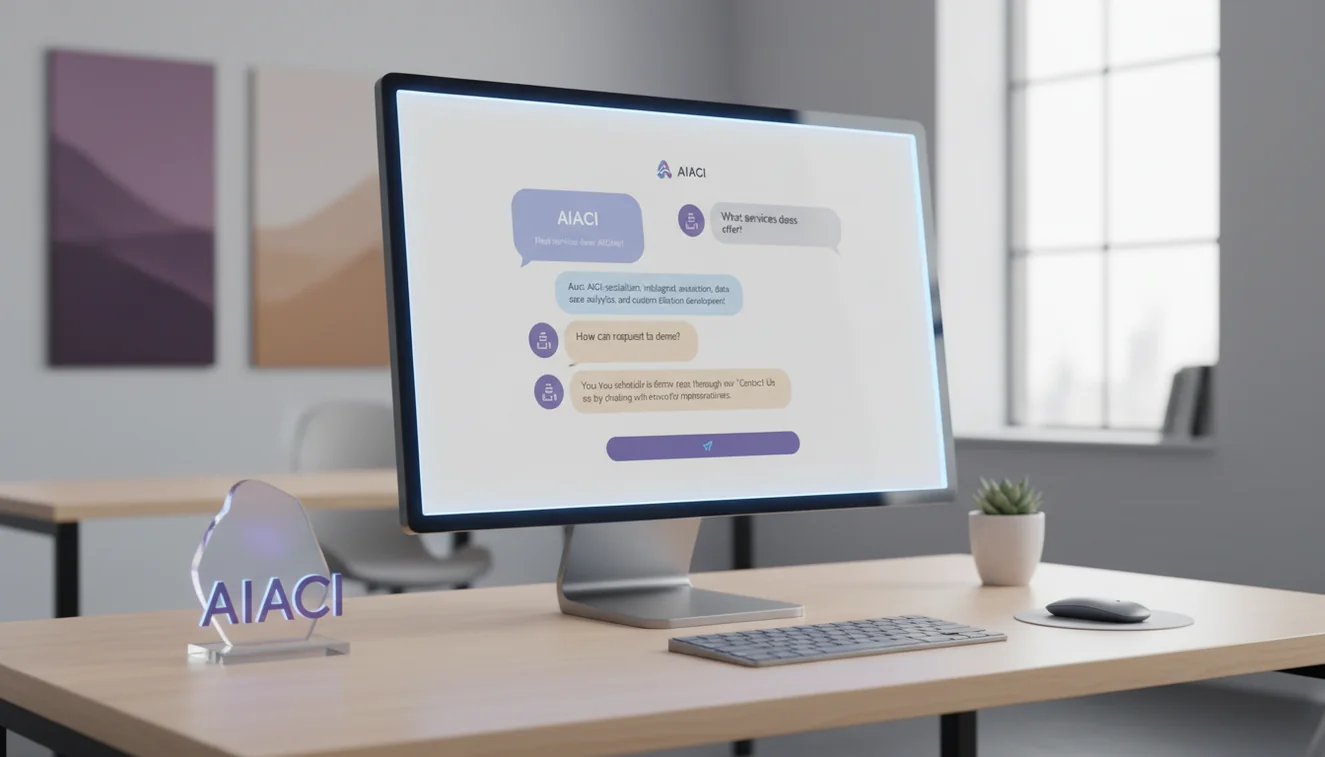
AIACI chat bot AI agent interface showing input triage and fast response

Response Strategy Selection

After classification, the agent picks a generation strategy. Factual queries trigger a retrieval-oriented pattern — short, direct, high confidence on well-documented subjects. Creative tasks activate a generative pattern with higher temperature and more varied output. Analytical requests use a structured pattern that breaks the problem into components before answering.

You can override the default strategy by being explicit in your prompt. Asking "give me a one-paragraph summary" forces concise output regardless of topic complexity. Asking "walk me through this step by step" triggers the structured breakdown pattern. The agent follows your constraints when stated clearly. When left implicit, it selects based on its classification of your message.

Where Speed-to-Answer Matters

The use case for this agent is operational. You need a quick answer during a meeting. You need to rewrite a paragraph before sending a client email. You need three variations of a subject line in the next thirty seconds. These are situations where the bottleneck is not AI capability — it is how fast the AI delivers something usable. The agent optimizes for that bottleneck. It trades comprehensiveness for velocity when the input warrants it.

For extended research or deep analysis, dedicated tools like the AI Chat Assistant or AI Writer provide more thorough output. The chat bot agent is built for the "I need this now" use case — and that is where it performs best.

AI chat bot agent on mobile delivering fast structured responses

Limitations of Agent-Based Chat Bots

The agent operates within the same constraints as any language model. It has no internet access, no real-time data feeds, and a fixed training cutoff. Facts can be fabricated — the model generates plausible text, not verified text. Speed optimization means the agent sometimes sacrifices depth. If you need exhaustive coverage of a topic, specify that explicitly or use a tool designed for long-form output.

Classification errors happen. An ambiguous prompt may get routed to the wrong strategy, producing output that misses the mark. Specialized domains — advanced mathematics, niche legal precedents, region-specific regulations — fall outside the agent's strongest coverage areas. AIACI does not require accounts or store conversations, but standard data hygiene applies: avoid submitting sensitive credentials, financial data, or proprietary information to any AI system.

Smart AI chat bot agent for structured task execution

Related Tools

Run the Agent on Mobile

The AIACI iOS app provides unlimited access to the chat bot agent with no daily caps, offline session history, and the full suite of agent-powered tools. If you rely on fast AI output throughout your workday, the app removes friction. Download the AIACI app for unrestricted agent access, or start with the free web version above.

Frequently Asked Questions

How does the chat bot agent decide which response strategy to use?

The agent classifies your input by type — factual query, creative request, analytical task, or open-ended prompt. It selects the response pattern that minimizes latency and maximizes relevance. Classification happens before generation begins.

What makes an agent-based chat bot different from a standard chatbot?

Standard chatbots match keywords to pre-written replies. An agent-based bot evaluates context, selects a processing strategy, and generates each response dynamically. The agent layer adds decision-making between input and output.

Can the chat bot agent handle multi-step tasks?

Yes, the agent breaks compound requests into sequential subtasks. It resolves each part in order and assembles a unified response. Complex instructions with multiple constraints are processed more reliably than in single-pass systems.

Does the chat bot agent retain context across messages?

Within a single session, the agent maintains full conversation context. It uses prior exchanges to refine subsequent responses. Context resets when the session ends — no data persists between visits.

How fast does the agent generate responses?

Typical response time is two to five seconds depending on complexity. Factual lookups resolve faster than multi-paragraph generation tasks. The agent prioritizes speed-to-answer over exhaustive length.

Is the AIACI chat bot agent suitable for professional workflows?

It handles email drafting, report summaries, data interpretation, and structured output reliably. Professional users should treat output as a first pass requiring human review. The agent does not access proprietary databases or internal systems.

What types of input does the agent handle poorly?

Highly specialized technical domains, real-time data requests, and tasks requiring verified citations produce weaker results. The agent has no internet access and operates within a fixed training boundary. Niche subjects outside mainstream documentation may trigger inaccurate output.

Can the agent produce output in specific formats like tables or lists?

Yes, specify the format in your prompt. The agent adapts output structure to match explicit formatting instructions. Bullet lists, numbered steps, comparison tables, and structured outlines are all supported.

Does the free version use the same agent as the app?

Both the web version and the iOS app route to the same underlying models and agent logic. The difference is access volume — the web has a daily message cap while the app provides unlimited use. Response quality is identical.

How does AIACI prevent the agent from generating harmful content?

Content policies filter requests and responses at both the input and output layers. The agent declines requests that violate ethical guidelines. Edge cases exist — no filtering system is perfect — but the architecture minimizes harmful output.