What AI Chat Does on AIACI
AIACI AI chat functions as a lightweight agent interface. You provide a goal - a question to answer, a document to draft, a concept to explain - and the system interprets your intent, selects a response strategy, and delivers output formatted for immediate use. The underlying model is a large language model built on transformer architecture, but the interaction layer is designed around task completion rather than open-ended conversation.
Each message you send is treated as an instruction. The agent parses your input, considers the full session context, and generates a response calibrated to your stated objective. This differs from chatbot-style exchanges where the system simply continues a dialogue thread. AI-generated output may contain factual errors. Verify critical information against authoritative sources before acting on it.
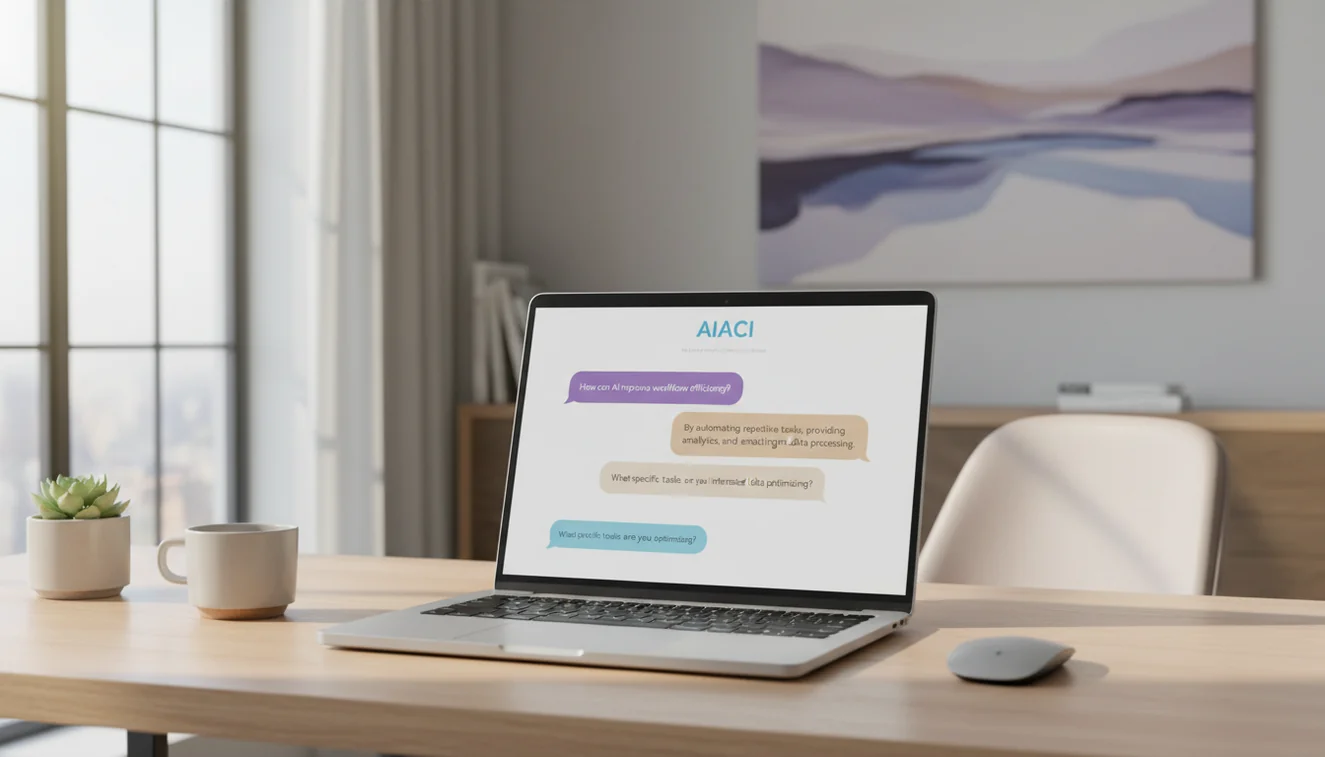
How the Agent Processes Your Input
Your message is tokenized and passed through a neural network with billions of trained parameters. The model evaluates your input against the full conversation history, weighs the probability of useful next tokens, and assembles a response one token at a time. Temperature controls govern whether output favors precision or variety. Lower temperature produces more deterministic, focused answers. Higher temperature introduces more creative variation - and more risk of unexpected results.
Context retention means you can issue a sequence of related instructions within one session. Ask for a project outline, then request expansion of section three, then ask the agent to reformat the output as bullet points. The model tracks what came before. This sequential processing is what makes the chat interface useful for structured workflows rather than isolated questions. AI Chatbot and Ask AI offer alternative interaction patterns on AIACI.
Practical Applications
Effective use cases include: drafting professional correspondence with specific tone requirements, generating structured outlines for reports or proposals, explaining technical subjects at a specified comprehension level, translating between languages with context preservation, summarizing lengthy documents into key findings, producing comparison tables between products or approaches, and debugging code with step-by-step reasoning.
Areas where output quality drops: tasks requiring real-time data, highly specialized technical domains with limited training coverage, situations where factual precision is mandatory, and subjective judgment calls where the model defaults to hedging. For extended writing sessions, AI Writer provides a purpose-built interface. For topic exploration through dialogue, AI Chatting supports a more open-ended approach.

Limitations and Safety
The model hallucinates. It generates statements that read as authoritative while being factually incorrect - invented statistics, nonexistent citations, fabricated technical specifications. This is inherent to how language models function and cannot be eliminated entirely. The frequency decreases with better models and clearer prompts, but never reaches zero.
Additional constraints: training data has a knowledge cutoff, so recent events may be absent or misrepresented. The model does not access the internet during a session. Inherited biases from training data can influence output in subtle ways. AIACI does not require account creation and does not store conversations after sessions end. Do not input sensitive credentials, financial records, or proprietary code into any AI chat system.