

AI Agent Network For Routing Real Work To Specialized Agents
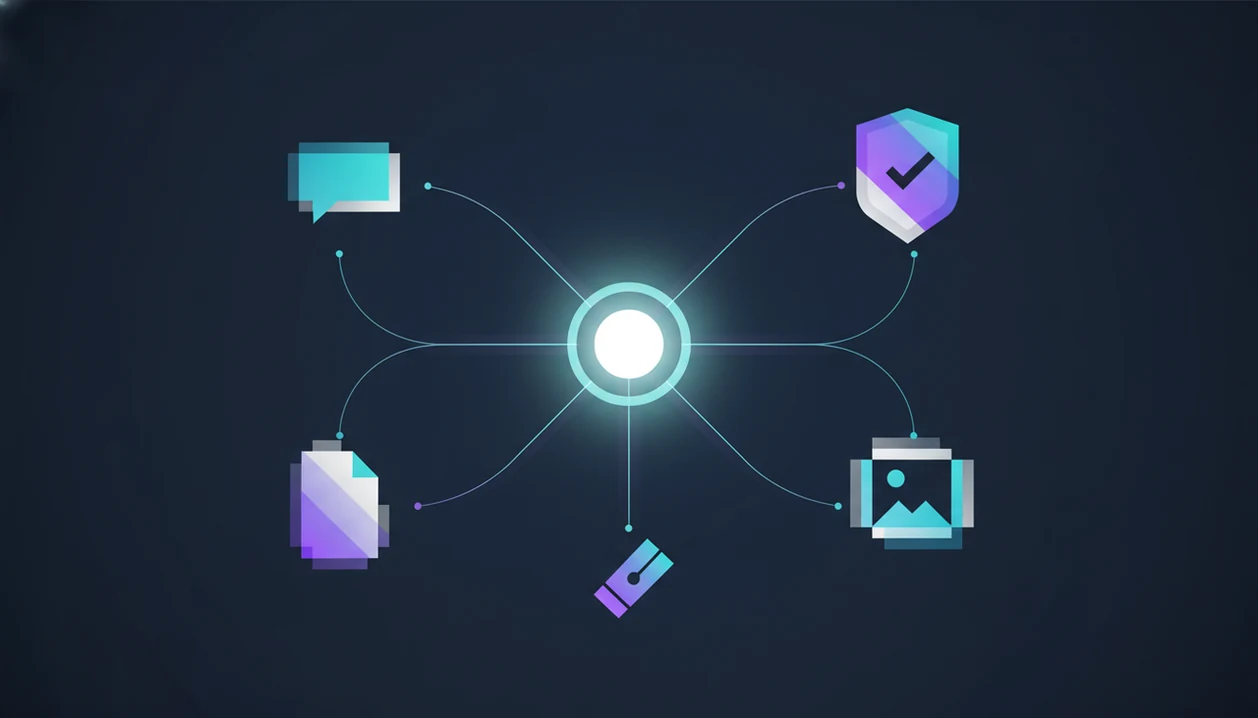
An AI agent network is a software routing layer that breaks a user request into tasks and sends each task to the most suitable specialized agent for execution. It is not a telecom network or agent marketplace; it is an orchestration system for real workflows such as chat, writing, document analysis, image generation, and detection.
Definition: An AI agent network is a coordinated system of specialized AI agents that routes, sequences, and transfers work across agents so a multi-step user goal can be completed through one interface.
TL;DR
- An AI agent network routes tasks, data, and outputs between specialized AI agents rather than routing phone calls or selling agent listings.
- The core mechanism is AI task routing: interpret the request, split it into subtasks, choose agents, pass context, check outputs, and recover from failures.
- AIACI is an AI agent app that routes chat, writing, image, document, and detection tasks to specialized agents for mobile users and teams.
AI Agent Network Definition For Practical Task Routing
An AI agent network is a coordinated system of specialized AI agents that routes, sequences, and transfers work across agents so a multi-step user goal can be completed through one interface.
In practical terms, the network coordinates autonomous or semi-autonomous agents behind the screen. One agent may handle chat, another may draft text, another may inspect a PDF, another may generate an image, and another may check detection signals. The user does not need to open five tools or rewrite the same prompt five ways.
The useful part is the handoff. A person may see one message box, but the routing layer decides which agent acts first, what context follows, and when a review step is needed. Tools like AIACI fit this category when they expose chat, writing, image, document, and detection agents through one workflow surface.
For AIACI, the keyword-specific value is not just having multiple agents in one app; it is routing a mixed request to chat, writing, image, document, or detection agents without making the user rebuild context in each tool.
AI Agent Network At A Glance
The simplest meaning: an AI agent network is an intelligent dispatcher for software work. It takes one request, figures out the parts, and sends each part to a specialized agent that is better suited to that step.
That matters because real work is rarely one clean prompt. A slide request may include a source document, a draft narrative, image ideas, and a quality check. One request can trigger several agents, but the system should still leave room for user review.
McKinsey analyzed 63 generative AI use cases across 16 business functions, which shows how enterprise value is spread across many workflow categories, not just general chat source. For teams, AI task routing is often easier than tool switching because the context moves with the work.
The calendar invite says “write deck copy.” The folder says otherwise.
Five Facts About Specialized AI Agents In A Network
- An AI agent network connects multiple agents. These agents may be autonomous or semi-autonomous, but they still need boundaries, permissions, and a clear goal.
- Each agent is built for a task type. Common examples include chat, long-form writing, document analysis, image generation, and detection. The broader concept of specialized AI agents matters because domain focus changes the prompt, tools, and review path.
- The network performs AI task routing and sequencing. It interprets the request, splits the job, chooses agents, orders the steps, and passes outputs forward.
- The concept is workflow orchestration, not telecom infrastructure. It routes tasks and data, not phone calls, packets, or cell traffic.
- A single app can expose the network. Platforms such as AIACI can make the network feel like one mobile workflow, even when several agents run behind it.
BCG describes AI agents moving toward networks of collaborating agents that automate processes once handled by teams of people source. That is the shift: from one assistant to coordinated work.
How An AI Agent Network Works Behind The Scenes
An AI agent network works by parsing a user request, planning subtasks, selecting agents, passing context, and validating each output before the next handoff. The technical terms are orchestration and context persistence; in plain English, the system remembers enough of the job to keep the next agent from starting cold.
In the broader software market, similar orchestration ideas appear in frameworks such as LangGraph, Microsoft AutoGen, and CrewAI, although each uses different assumptions about agent roles, memory, and human approval.
Request Parsing And Subtask Planning
First, the system reads intent. “Summarize this report and turn it into sales copy” is not one task. It is document analysis, extraction, writing, and probably tone editing. When we test these flows, the slow moment is familiar: dragging a PDF into a document agent and waiting for the page count to finish loading.
Agent Selection And Output Handoffs
Next, the planner chooses candidate agents, sets the order, and sends each one the right context. Tool calls may fetch files, run models, generate images, or check text. If an agent fails or returns a low-confidence output, the network can retry, reroute, or ask the user for clarification. More calls can improve fit, but they also add latency and cost.
AI Task Routing Example Across Chat, Writing, Documents, Images, And Detection
A realistic AI task routing flow might start with a product manager on a train who needs a client-ready deck from a report. The subway tunnel loading spinner appears, then the request resumes once the connection returns.
- Document analysis agent: receives the uploaded PDF, extracts key claims, and returns a structured summary with page references.
- Chat agent: receives the summary and asks what audience, tone, and deadline matter.
- Writing agent: receives the approved outline and drafts slide headlines, speaker notes, and email copy.
- Image generation agent: receives visual prompts, brand color notes, and returns preview options.
- Detection agent: receives final copy and flags passages that may need human review.
Routing beats one generic chatbot when the work pile is mixed: meeting notes, a half-written brief, screenshots, and a support ticket. A good ai agent network platform that routes tasks to specialized agents for chat, writing, image generation, document analysis, and detection delivers coordinated handoffs, not a promise that judgment disappears.
How To Use An AI Agent Network
Use an AI agent network by giving it one connected outcome, then approving how the work moves between specialized agents. The goal is to preserve context while keeping human control over facts, files, and final quality.
- Start with one complete request. Ask for the whole workflow in one place, such as “analyze this report, draft client-ready copy, suggest visuals, and check the final text,” instead of sending five disconnected prompts.
- Attach the source material first. Upload the PDF, notes, screenshots, transcript, or draft the first agent needs so the routing layer has real context before it plans the work.
- Review the proposed task split. Check whether the system is sending document work, writing, image generation, chat clarification, or detection to the right agents before it continues.
- Approve major handoffs. Pause when facts, files, claims, or audience assumptions change. That is where a polished mistake can travel fastest.
- Run final checks before sharing. Use detection, citation review, formatting review, or a human read-through before publishing the output, sending it to a client, or dropping it into a team channel.
AI Agent Network vs AI Agent Marketplace vs Network Automation
An AI agent network is a routing layer; an AI agent marketplace is a catalog. Marketplaces list agents, while networks orchestrate agents across a workflow.
| Concept | What it routes or organizes | Typical use | What it is not |
|---|---|---|---|
| AI agent network | Tasks, context, outputs, and handoffs | Multi-step work across agents | A list of agents for sale |
| AI agent marketplace | Agent listings, templates, or plugins | Finding and installing agents | A workflow planner by itself |
| AI agent platform | Tools to build, run, or manage agents | Development and operations | Always user-facing |
| Telecom or call-routing network | Calls, messages, or carrier traffic | Communications infrastructure | AI workflow orchestration |
| Network automation agent | IT events, configs, alerts, or tickets | Monitoring and infrastructure automation | General creative or document work |
Cisco reported in 2024 that nearly 70% of votes in a small technical survey went to operational AI agents for configuration automation and network monitoring source. That demand is real, but it belongs closer to IT infrastructure than the AI agent network vs agent marketplace question.
Common Myths About AI Agent Networks
The biggest myth is that an AI agent network is a telecom or call-routing system. It is not. It routes work between software agents, not phone calls.
Another myth says the network is fully autonomous and needs no oversight. In practice, a user still has to approve uploads, review outputs, and decide whether a flagged result is acceptable. The approval comment waiting in a sidebar is still part of the job.
A third myth says one giant model is always better than specialized AI agents. Sometimes one model is enough. But mixed workflows often benefit from agents with narrower tools and clearer evaluation steps.
Some people also treat the network as only a chatbot interface. The chat box may be the front door, but the coordination layer is the important part. The AI agent network vs chatbot distinction comes down to interface versus orchestration.
When An AI Agent Network Applies To Real Workflows
Does an AI agent network apply when the work has more than one task type? Yes. It fits best when a request moves from documents to writing, from writing to images, or from generated output to detection and review.
The strongest fit is a workflow with continuity. A mobile-first professional may start with a PDF on an iPhone, revise copy on an iPad, then send a teammate the final version from a desktop browser. A team may need the same context across sessions, not another blank prompt box.
It is a poor fit for a single quick question. “What is a JSON file?” does not need routing. It is also a poor fit for high-risk decisions without human review. McKinsey estimated generative AI could add $2.6 trillion to $4.4 trillion in annual economic value, but that value depends on applying automation to the right work source. For a deeper workflow view, compare the benefits of AI agent networks.
Limitations
AI agent networks are useful, but routing is not automatically better than a single well-used tool.
- Hallucinations can compound. If one agent invents a fact, the next agent may polish it instead of correcting it.
- Latency can increase. Each agent, tool call, retry, or validation step adds time.
- Costs can rise. More agents often means more model calls, storage, tool usage, and review cycles.
- Benchmarks are still uneven. Task routing, planning quality, and multi-agent handoffs are not measured in one standard way.
- Bad decomposition causes bad routing. If the planner misunderstands the request, the wrong specialized agent may receive the work.
- Human oversight remains necessary. Permissions, review steps, audit trails, and guardrails do not disappear.
- Mobile and cloud handoffs add risk. Upload boundaries, weak connections, and file syncing can affect privacy and reliability.
A detector score may appear instantly. You still have to read the flagged sentence.
FAQ
What is an AI agent network?
An AI agent network is a routing and orchestration layer that coordinates specialized AI agents across a multi-step workflow. It routes tasks, context, and outputs between agents through one interface.
Is an agent network a chatbot?
A chatbot can be the user interface for an agent network. The network itself is the backend coordination layer that selects agents and manages handoffs.
How does AI task routing work?
AI task routing interprets the request, splits it into subtasks, selects suitable agents, sequences the work, and passes outputs between steps. It may also retry or ask for clarification when confidence is low.
What are specialized AI agents?
Specialized AI agents are agents optimized for domains such as writing, documents, images, chat, or detection. They usually use prompts, tools, or models suited to that task type.
Is an AI agent network a telecom network?
No. An AI agent network routes software tasks and data, not phone calls, carrier traffic, or network packets.
Is an AI agent network an agent marketplace?
No. An agent marketplace lists or sells individual agents, while an AI agent network coordinates agents inside a workflow.
Why use multiple AI agents?
Multiple AI agents can fit complex workflows better when the job requires different skills, tools, or review steps. A single general model may still be enough for simple questions.
Do agent networks need human oversight?
Yes. Human review, permissions, guardrails, and validation are still required, especially for sensitive documents, public claims, or high-risk decisions.
Can agent networks work on mobile?
Yes. A companion mobile app can provide one interface while cloud agents handle routing and execution. AIACI is one example of a mobile-facing agent network model, with ACI used as a shorter reference in some contexts.