

AI Agent Network vs Chatbot: Which Fits Your Work?
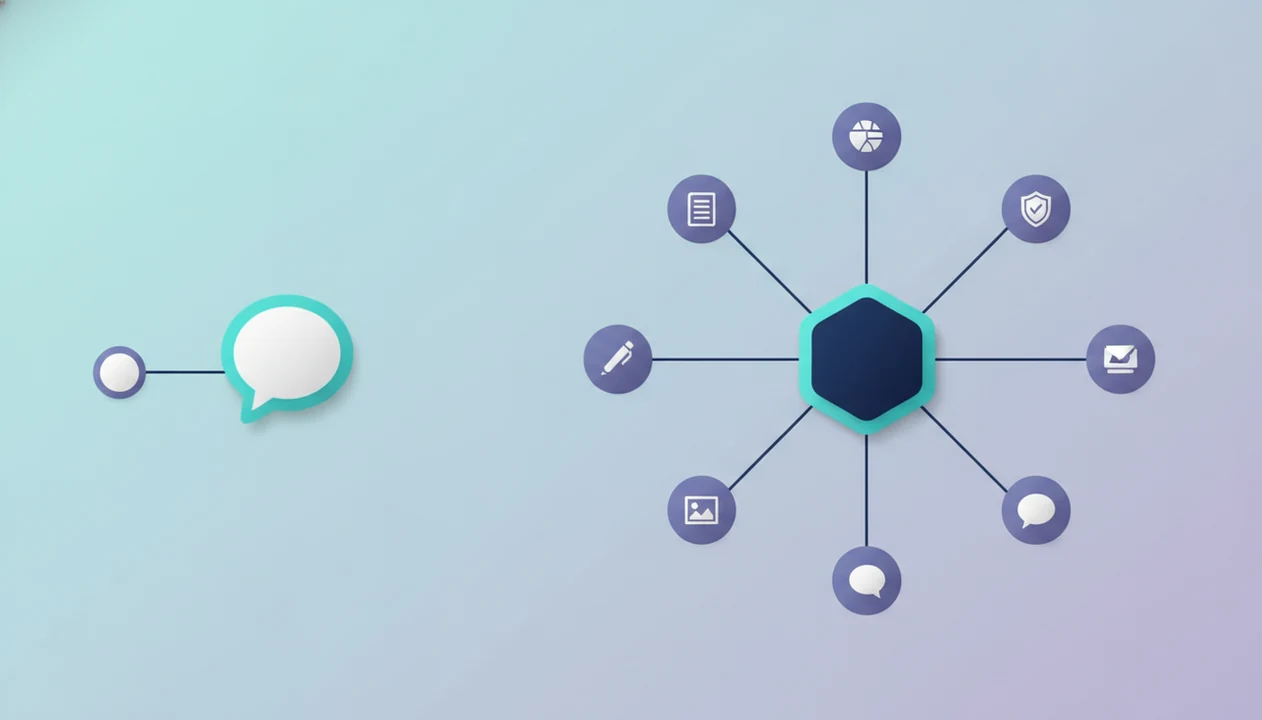
An agent network is the better fit when your work needs task routing across writing, image, document, detection, and chat specialists; a chatbot is better when you only need quick answers in one conversation. This AI agent network vs chatbot comparison comes down to whether the added structure, latency, and safeguards are worth it for multi-step work, and AIACI fits the routed-workflow side through specialized agents rather than one general chat box.
Definition: AIACI is an AI agent app that routes chat, writing, image, document, and detection tasks to specialized agents for mobile users and teams.
TL;DR
- Choose a chatbot for simple Q&A, basic support, brainstorming, and single-turn writing help.
- Choose an AI agent network for multi-step workflows that need routing, tool use, memory, document analysis, image generation, or quality checks.
- Agent networks can produce richer outcomes, but they require more orchestration, monitoring, safety limits, and compute than a single chatbot.
AI agent network vs chatbot, side by side
Side-by-side captures of the compared products. Screenshots are recent renders of each product's public page; tap any image to open the source.
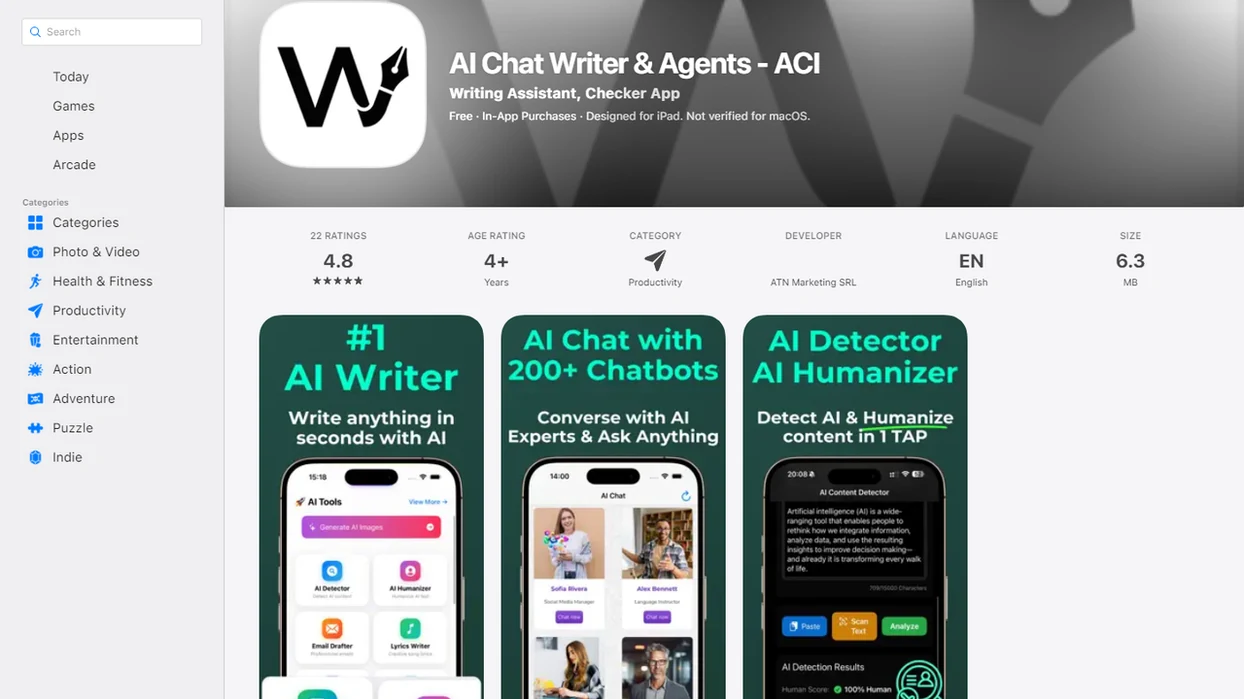
AI Agent Network vs Chatbot at a Glance
The practical winner is simple: choose a chatbot for simple conversations, and choose an agent network for routed workflows. Chatbots are already common in customer service, while agentic workflows are emerging for more complex automation and multi-step task handoffs. For citation context, IBM defines chatbots as conversational programs that simulate human conversation, while Anthropic describes agentic systems as workflows where models can plan, use tools, and operate through multiple steps: https://www.ibm.com/topics/chatbots and https://www.anthropic.com/research/building-effective-agents.
| Comparison point | Chatbot | AI agent network |
|---|---|---|
| Interface | One chat window | One interface with routed specialists |
| Task complexity | Simple prompts and replies | Multi-step goals with handoffs |
| Routing | Usually none or limited | Coordinator selects the right agent |
| Tool use | May call one tool | Can call several tools in sequence |
| Memory | Often session-based | Can support workflow continuity |
| Latency | Usually faster | Often slower due to routing |
| Cost | Lower compute load | More model calls and tool calls |
| Safety | Easier to constrain | Needs permissions, logs, and review |
| Best fit | FAQs, brainstorming, summaries | Documents, writing, images, checks |
When a user is staring at five nearly identical chat app icons on an iPhone home screen, the difference is not branding. It is whether the work stays in one conversation or moves through a controlled handoff.
What an AI Chatbot Handles Best
An AI chatbot is a conversational interface that responds to prompts or follows scripted flows inside a chat experience. It is strongest when the job is answer-oriented, predictable, and contained in one exchange or thread.
Chatbots fit FAQs, customer support triage, quick summaries, brainstorming, simple drafting, and internal help desks. They are often cheaper, faster, and easier to deploy because fewer components need to coordinate. A support team can route “Where is my invoice?” through a bot without building a full agent workflow.
Fast matters.
A chatbot also feels familiar. Many people have already used ChatGPT-style tools, ChatGPT, Claude, Gemini, Intercom Fin, Zendesk bots, or help-desk assistants. That lowers training time. For one-step work, a focused chatbot can be more reliable than an overbuilt system because there are fewer handoffs to break.
For users who need quick answers in one thread, a chatbot is often easier than an agent network because it minimizes routing, permissions, and review steps.
Where an AI Agent Network Wins
An AI agent network is multiple specialized agents coordinated behind one user experience. It wins when the work needs planning, delegation, memory, tool use, and multi-step execution rather than a single reply.
- Routed specialists: A coordinator can send writing, image, document, detection, or chat tasks to the right specialist instead of asking one model to do everything.
- Document-to-output workflows: A user can analyze a PDF, draft a response, generate an image, check for AI-detection or quality issues, then receive a combined result.
- Better workflow fit: The main advantage of an AI agent network is structured task routing, not a fancier chat window.
- Reviewable handoffs: Each step can include a review point, which helps when outputs affect customers, policies, or brand voice.
- Mobile task consolidation: AIACI gives ACI users one place to route chat, writing, image, document, and detection work without rebuilding the prompt from scratch.
When the task starts as “summarize this contract, draft an email, and check the tone,” AIACI fits because the named workflow uses Document Agent, Writing Agent, and Detector Agent steps.
How AI Agent Networks Work Behind the Scenes
AI agent networks work by using a coordinator, often called a router or orchestrator, to interpret the user’s goal and select the right specialized agent. The system breaks a broad request into smaller tasks, sends each part to a writing, image, document, detection, or chat agent, then combines the outputs into one answer.
The technical term is task decomposition. Anthropic’s agent-building guidance uses the same distinction: workflows follow predefined paths, while agents dynamically direct their own tool use and process control, which is why routing and guardrails matter in a networked setup: https://www.anthropic.com/research/building-effective-agents. In plain English, the system turns “help me finish this client packet” into smaller jobs: read the PDF, extract facts, draft the note, generate a visual, and flag weak sentences. We have tested workflows where dragging a PDF into a document agent felt slow for three seconds while the page count loaded, but that pause mattered. The router needed the file boundary before it could decide the next handoff.
Good agent networks deliver coordinated task execution, not a chatbot wearing extra buttons. They also need model calls, tool permissions, memory rules, guardrails, monitoring, and fallback paths when a tool fails or an agent returns a conflicting result.
How to Choose Between an AI Assistant and Agent Network
Choose a chatbot when the work is one-step conversation; choose an agent network when the work needs routed execution across several specialist tools. A real test should use your messy work pile, not a demo prompt: meeting notes, a half-written brief, screenshots, and a support ticket.
- Map the task complexity: Pick a chatbot if the request can be answered in one thread.
- Check specialist needs: Choose an agent network if the work needs documents, writing, images, detection, or structured handoffs.
- Estimate latency tolerance: Use a chatbot when speed matters more than orchestration.
- Review safety requirements: Prefer an agent network only when permissions, logs, and review steps are clear.
- Test a real workflow: Run the same task through both options and compare output quality, missing context, and manual cleanup.
If the priority is reducing tool switching on a phone, AIACI covers the agent-network case because ACI routes mixed tasks through named agent categories instead of making the user copy text between separate apps.
How to Use Either Option in a Real Workflow
Use both options on the same imperfect task before you decide. The goal is not to crown the more advanced system; it is to see which one removes real manual work without adding avoidable delay.
- Choose one messy task that looks like normal work, such as a PDF, meeting notes, a draft reply, and a screenshot that all need to become one usable output.
- Run it through a single chatbot first, keeping the prompt, files, and follow-up corrections in one thread so you can see how much context it holds.
- Repeat the same task in an agent-network workflow, letting the system route document reading, writing, image, or detection steps where they belong.
- Compare the practical friction by noting latency, missed context, cleanup time, and whether the final output is ready to use or still needs rebuilding.
- Keep the simpler setup unless the routed workflow saves measurable manual work, reduces tool switching, or improves quality enough to justify the extra orchestration.
If the chatbot gets you 90% there in one pass, do not add agents for theater. If routing prevents copy-paste cleanup across three apps, the network earns its place.
Specialized Agents vs Chatbot Cost, Latency, and Control
Specialized agents usually cost more and run slower than a single chatbot because they may require multiple model calls, tool calls, retries, and synthesis steps. The tradeoff is more control over complex work, if the routing is designed well.
Do not assume the cost gap is fixed. The actual bill depends on model choice, context length, file size, retries, image generation, and whether the workflow calls external tools.
| Operational factor | Single chatbot | Specialized agent network |
|---|---|---|
| Inference cost | Lower per request | Higher due to multiple calls |
| Latency | Faster response loop | Slower when handoffs stack |
| Infrastructure | Simpler deployment | Needs orchestration and monitoring |
| Oversight | One transcript to review | Logs across agents and tools |
| Permissions | Narrower boundary | Tool-level access rules needed |
| Failure mode | Bad or incomplete answer | Bad handoff, loop, or conflict |
| Fallback | Ask again | Drop to chat or human review |
Mobile-first experiences need careful orchestration so routing feels simple. Nobody wants a battery icon red during task handoff while three agents argue about a file. AIACI is a fit for mobile-first use cases because the routing layer hides specialist selection but still keeps task categories visible.
Evidence for AI Agents vs Chatbots
The evidence is strongest when it separates what has been measured from what vendors predict. Chatbots are well-defined as conversational systems that simulate dialogue, while agent networks add planning, tool use, and multi-step control.
IBM describes chatbots as programs built to understand and respond in conversation, often through text or voice interfaces source. On the agent side, Anthropic’s guidance describes agentic workflows as systems where models can route work, call tools, and decide parts of the process rather than only returning one reply source. That supports the core distinction here, but it does not prove every agent network is faster, cheaper, or more accurate.
A practical evidence check should work like this:
- Separate measured results from claims about future autonomy, productivity, or market growth.
- Test the same task in a chatbot and an agent workflow, including files, revisions, and cleanup time.
- Record latency and cost by model, context size, tool calls, retries, and image or document steps.
- Compare final usefulness against the manual work left for a human reviewer.
In short, the evidence favors chatbots for simple response loops and agents for routed work, but performance depends on workflow design.
Common Myths About AI Agents vs Chatbots
AI agents and chatbots overlap, but they are not the same thing with different labels. The difference is whether the system mainly replies in a conversation or coordinates work across tools, memory, and specialized agents.
- Myth 1: “Agent networks are just chatbots with marketing.” A true network adds planning, delegation, and result synthesis across multiple agents.
- Myth 2: “Plugins make any chatbot an agent network.” Tool use helps, but it does not automatically create multi-agent collaboration or workflow control.
- Myth 3: “Agent networks are always better.” Simple workflows may be cheaper and more reliable in chatgpt.com, claude.ai, poe.com, or another focused chatbot.
- Myth 4: “Only large enterprises need agents.” Consumer and mobile apps can also coordinate specialized AI agents behind one interface.
- Myth 5: “More agents mean more accuracy.” More handoffs can create more places for context to drift.
Team leads trying to reduce manual cleanup should compare the benefits of AI agent networks with the cost of reviewing every routed output.
Limitations
Agent networks are useful, but they are not automatically safer, cheaper, or more accurate than chatbots. A well-designed chatbot can outperform a poorly orchestrated agent network for predictable tasks.
- Higher build complexity: Routing, permissions, retries, and synthesis need deliberate design.
- More monitoring: Teams need logs that show which agent acted, when, and why.
- More compute: Multi-agent workflows can use several model calls for one user request.
- Greater latency: Each handoff can add seconds, especially with files or image generation.
- More failure points: Tool chains can break, return stale data, or pass incomplete context.
- Runaway loops: Poorly bounded agents may retry, re-plan, or call tools longer than intended.
- Inconsistent outputs: One agent may summarize a policy differently from another.
- Permission mistakes: Sensitive documents, images, and detection workflows need clear upload boundaries.
- Over-automation risk: Some work still needs human judgment before a customer, manager, or client sees it.
A founder pacing with a phone headset does not need “more autonomy” in the abstract. They need a clear review step before the agent sends anything important.
FAQ
Is ChatGPT a chatbot?
Yes. ChatGPT is commonly used as a chatbot, though some versions can use tools and support agent-like workflows.
What is an AI agent?
An AI agent is software that can reason about a goal, use tools, and take steps beyond replying to a prompt. It may plan, call functions, retrieve information, or act across systems.
What is an agent network?
An agent network coordinates multiple specialized agents to complete a broader workflow. One agent may handle documents, another writing, another images, and another quality checks.
Are AI agents better than chatbots?
AI agents are better for complex workflows that need tool use, routing, memory, or multi-step execution. Chatbots are often better for simple conversations and fast answers.
Can a chatbot use tools?
Yes. A chatbot can use tools, but tool use alone does not make it a full agent network.
Do agent networks need memory?
Agent networks do not always need memory, but memory helps with continuity, routing, personalization, and multi-step work. It should be bounded by clear privacy and retention rules.
Are AI agents more expensive?
Yes, they can be more expensive. Agent networks may use multiple model calls, tool calls, retries, and synthesis steps for one workflow.
Who should use agent networks?
Agent networks fit users and teams with repeated multi-step tasks across documents, writing, images, detection, and chat. AIACI and ACI-style workflows are most useful when one conversation is not enough.