

AI Agent Writing Benefits After 30 Days Of Structured Use
AI agent writing benefits after 30 days usually include faster outlining, cleaner first drafts, reusable context, and more consistent review habits, but not fully hands-off writing. The biggest gains come when teams treat agents like trained assistants: define roles, log errors, refine prompts, and route repeatable tasks to the right specialist.
> Definition: AIACI is an AI agent app that routes chat, writing, image, document, and detection tasks to specialized agents for mobile users and teams.
TL;DR
- Week 1 is mostly setup, inspection, error logging, and prompt refinement rather than instant productivity.
- Weeks 2 and 3 are where reusable briefs, draft patterns, document analysis, and review loops start reducing manual work.
- By day 30, the most realistic results are faster repeatable writing workflows, fewer blank-page moments, and clearer human review checkpoints.
30-Day AI Writing Benefits Timeline At A Glance
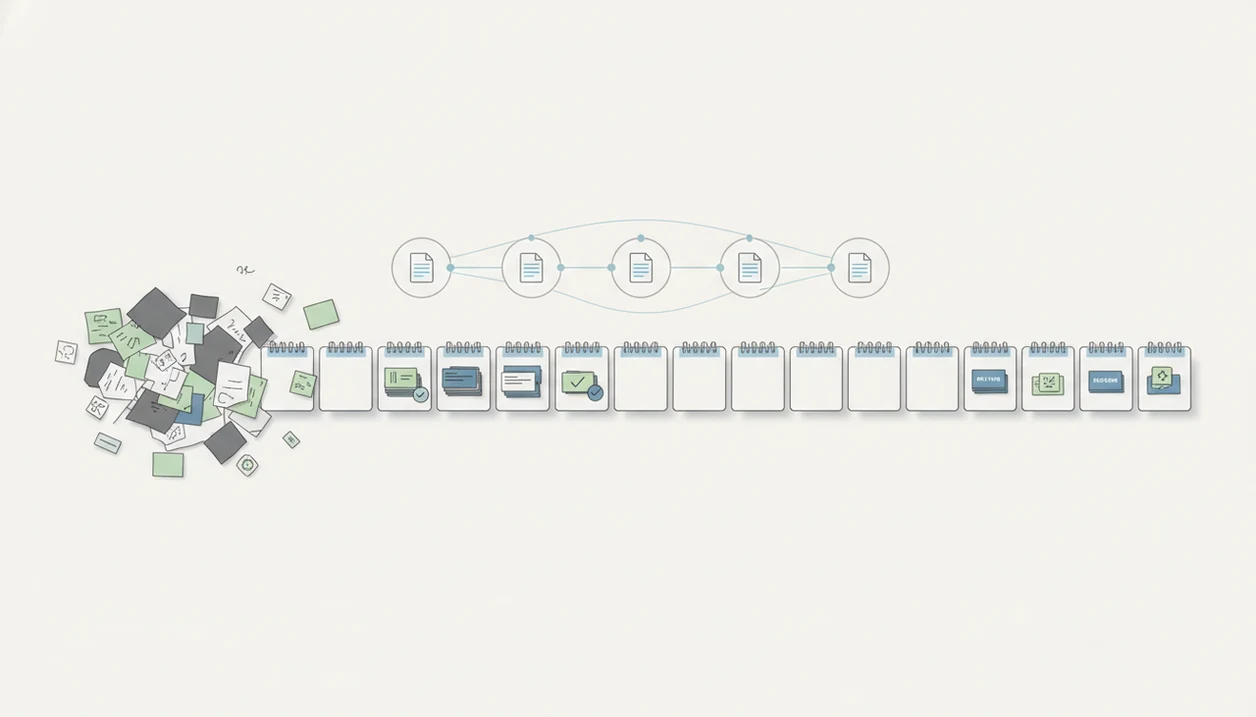
A realistic 30-day AI writing benefits timeline starts slowly, then compounds. Week 1 is setup-heavy, weeks 2 and 3 bring repeatable support, and week 4 is where speed, consistency, reusable context, and review discipline become easier to measure.
The first few days often feel clumsy. You test prompts, paste voice examples, reject drafts, and notice missing context. By the second week, a good AI writing agent can usually help with outlines, summaries, email variants, and structured sections with fewer reminders.
By day 30, the benefit is not “the agent writes everything.” It is more practical: fewer blank-page starts, faster draft assembly, and cleaner handoffs for review.
The messy work pile is familiar: meeting notes, a half-written brief, screenshots, and a support ticket. The agent helps sort that pile, but a person still decides what matters.
30-Day Tracking Method For AI Writing Agents
A 30-day AI writing trial should be measured as an operational workflow test, not a vague feeling of being “more productive.” Track each content type separately, because emails, blogs, briefs, summaries, and social posts improve at different speeds.
| Metric | Manual baseline | AI-agent trial measure | Why it matters |
|---|---|---|---|
| Time-to-outline | Minutes from brief to outline | Minutes after agent setup | Shows blank-page reduction |
| Time-to-first-draft | Start to usable draft | Start to review-ready draft | Measures speed, not polish alone |
| Edit rounds | Number of revision passes | Number after agent use | Shows draft quality changes |
| Rejected outputs | Drafts discarded fully | Agent outputs not used | Exposes prompt or routing failures |
| Reused instructions | Templates used again | Briefs, prompts, style rules reused | Shows workflow memory value |
Use the same assignment twice if possible, once manually and once with agents. A scanned receipt crooked on screen is a bad benchmark for a long-form brief; compare like with like.
For individual writers, the simplest scorecard is time saved minus review time added. For example, a useful day-30 result might be: blog outline time dropped from 28 minutes to 11 minutes, but review time rose from 14 minutes to 19 minutes. That still counts as a gain only if the final draft clears the same approval standard.
Week 1 AI Writing Setup Benefits And Friction
Why is the first week with AI writing agents often slow? Because week 1 is mostly job design: prompts, voice examples, templates, source rules, and approval criteria must be defined before the agent can produce reliable work.
Expect mistakes. The agent may overgeneralize, miss source boundaries, flatten the brand voice, or require more editing than the manual process. That is not always failure. It is diagnostic work.
Treat the agent like a new hire. You would not hand a new teammate a vague content goal and expect publishable work by lunch. You would explain the audience, examples, forbidden claims, review owner, and output format.
The first real benefit is simple. The blank page shows up less often.
A half-written email at midnight feels different when the reusable instruction set is already there. For everyday messages, an app to help write emails and posts can become useful once those boundaries are written down.
Weeks 2 And 3 Agent Writing Workflow Results
Weeks 2 and 3 are where agent writing workflow results usually become visible, because instructions and review loops start getting reused. The agent still needs supervision, but it should require fewer repeated explanations.
- Outlines get faster: Agents can draft structures for emails, reports, blog posts, and briefs after a reusable brief exists.
- Repurposing becomes easier: One approved source can become a summary, social post, internal note, or client-facing draft.
- Correction logs reduce repeat errors: A short “do not do this again” list often improves the next draft more than a longer prompt.
- Multi-agent routing saves copy-paste: Writing agents draft, document agents extract context, image agents support visuals, and detection agents flag review issues.
- Humans still own judgment: Strategy, factual claims, tone, and final approval stay with the writer or team lead.
A useful AI agent network routes writing, document, image, chat, and detection tasks to the right specialist, not to a black box that publishes without review.
AIACI Agent Routing Mechanics Behind Writing Benefits
AI agent writing benefits come from role-specific task routing, reusable context, and human review, not from magic self-improvement. An agent improves the workflow when better instructions, cleaner inputs, and correction history reduce the work needed on the next task.
In plain terms, an agent is a system with a job. A writing agent drafts. A document agent extracts context. A detection agent supports review. The routing layer decides where the task should go, then the human checks the result.
Tools like AIACI are useful examples because they route chat, writing, image, document, and detection work to specialized agents instead of forcing every task through one generic chatbot. That can reduce context switching, especially when someone is staring at five nearly identical chat app icons on an iPhone home screen.
Named alternatives such as ChatGPT, Claude, Gemini, and Microsoft Copilot can also support drafting; the practical difference to test is whether AIACI’s agent routing, saved instructions, and review checkpoints reduce copy-paste compared with one general chatbot.
The mechanism is workflow memory. Reused briefs, saved rules, and review notes become the advantage.
6-Step AI Writing Agent Trial For 30 Days
Use a 30-day AI writing agent trial to test a repeatable workflow, not a single impressive prompt. The goal is to find which tasks become faster, which still need expert drafting, and which should stay manual.
- Set a baseline by recording manual time-to-outline, time-to-draft, edit rounds, and approval speed for each content type.
- Assign agent roles for drafting, summarizing, document extraction, image support, and detection review.
- Create reusable briefs with audience, voice, source rules, examples, and final approval criteria.
- Log errors daily in a short correction list, including missing context, false claims, weak tone, and rejected outputs.
- Review outputs carefully before reuse, especially claims, quotes, regulated language, and brand-sensitive phrasing.
- Measure day-30 results against the baseline, including time saved, edit rounds reduced, and instructions reused.
Mobile-first workflows matter here. A user may capture context on iOS between meetings, then review a draft later from a laptop. ACI fits that handoff style when task routing is clearer than tool switching.
Five Facts About AI Writing Benefits After 30 Days
These five facts describe what 30 days with AI writing usually changes, and what it does not. They are the points to keep in the scorecard.
- Week 1 is oversight-heavy: The first week is usually instruction refinement, output inspection, and error logging.
- New-hire treatment works better: Teams get better results when they define agent roles instead of expecting plug-and-play perfection.
- Multi-agent networks can reduce switching: Specialized routing can cut manual copy-paste between drafting, source review, visuals, and detection.
- Quantifiable gains are practical: Time saved, faster responses, and fewer edits per draft are more realistic than hands-off publishing.
- Final quality has constraints: Data quality, workflow clarity, and human review shape the actual benefit after 30 days.
Printer-warm pages stacked by the keyboard still need a reader. The agent can summarize them faster, but it cannot decide which claim your audience should trust.
Pew And NBER Evidence For AI Writing Productivity Benefits
External evidence supports plausible productivity gains from AI assistance, but it does not prove a universal 30-day writing-agent guarantee. The safest reading is that structured use can help, especially when the task is repeatable and review standards are clear.
Pew reported that 19% of U.S. workers had used AI tools at work, and 81% of those users found them very or somewhat useful, according to its 2023 workplace survey source. That shows early adoption with perceived usefulness, not automatic quality improvement.
An NBER field experiment with 5,179 customer support agents found a 14% average productivity increase when workers used a generative AI assistant source. A Harvard Business School/BCG field experiment found that consultants using GPT-4 completed 12.2% more tasks, worked 25.1% faster, and produced outputs rated more than 40% higher in quality on tasks inside the AI capability frontier source.
For repeatable workplace writing, structured agent use is often more useful than casual chatbot use because the review loop improves the next assignment.
Limitations
A 30-day AI writing trial can disappoint if the workflow is vague, the source material is weak, or the team skips review. The timeline is useful, but it is not a guarantee.
- There is limited peer-reviewed research on exact 30-day AI writing agent timelines.
- Speed gains do not automatically improve strategy, brand voice, subject-matter depth, or originality.
- Poor source material, vague prompts, and unclear workflows can erase productivity gains.
- Multi-agent systems can introduce misrouting, conflicting instructions, and compounding small errors.
- Human review remains necessary for factual accuracy, legal sensitivity, brand judgment, and final approval.
- High-stakes writing may show smaller first-month gains when expert interpretation matters more than drafting speed.
- Detection and humanizing checks can help review, but they do not prove truth, originality, or policy compliance.
A compliance note beside final copy changes the mood. Someone still has to read the flagged sentence.
FAQ
What improves after 30 days of using AI writing agents?
Common improvements include faster outlines, cleaner first drafts, reusable context, and more consistent review routines. The gains are strongest when prompts, source rules, and correction logs are reused.
Do AI agents replace writers after a month of use?
No. AI agents can assist and accelerate writing workflows, but they do not replace human strategy, judgment, accountability, or final approval.
When do AI writing agents usually start saving time?
Meaningful time savings often begin after the setup and correction period, usually during weeks 2 to 4. Week 1 is commonly slower because instructions and review rules are still being built.
What should I track each day during a 30-day AI writing trial?
Track draft time, outline time, edit rounds, rejected outputs, reused prompts, and final approval speed. Measure results by content type rather than using one general productivity score.
Why is the first week with AI writing agents often slow?
The first week is spent defining instructions, testing outputs, logging errors, and building reusable workflow context. That setup creates the conditions for later speed gains.
Are multi-agent writing workflows better than one chatbot?
Multi-agent workflows can be better when drafting, document analysis, image support, and detection review need separate handling. They can add complexity if task routing and approval rules are unclear.
What limits AI writing quality after 30 days?
Poor inputs, vague goals, weak source material, missing review standards, and insufficient subject-matter oversight limit AI writing quality. Tools such as AIACI can help route tasks, but the workflow still needs clear human review.