

AI Detector Vs Humanizer For Responsible Text Review
Quick answer: AI detector vs humanizer is not a choice between two replacements for human judgment: a detector estimates AI-likelihood and risk, while a humanizer rewrites text for clearer, more natural, and more brand-appropriate reading. Use the detector first to decide whether text needs review, then use editing or rewriting only when the draft needs clarity, tone, or policy improvement. AIACI supports that sequence by routing detection, writing, document, and review tasks to specialized agents instead of treating every draft the same way.
> Definition: AIACI is an AI agent app that routes chat, writing, image, document, and detection tasks to specialized agents for mobile users and teams.
- AI detectors score text for AI-likelihood, but they can be wrong and should not be used as proof by themselves.
- AI humanizers rewrite text for tone, rhythm, clarity, and readability, but they do not guarantee truth, originality, or detector avoidance.
- A responsible AI text review workflow is detect, assess risk, edit or rewrite, fact-check, and document the decision.
AI detector vs humanizer, side by side
Side-by-side captures of the compared products. Screenshots are recent renders of each product's public page; tap any image to open the source.
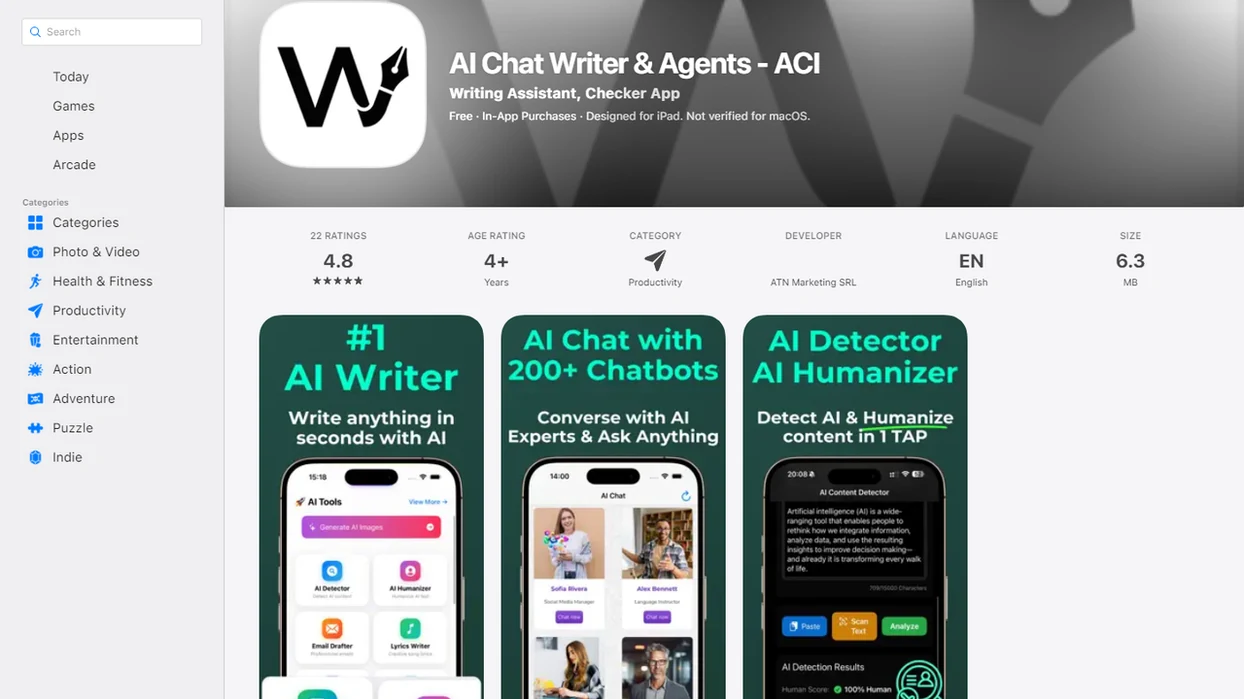
AI Detector Vs Humanizer At-A-Glance Comparison Table
An AI detector is a scoring and review tool that estimates whether text appears AI-generated. An AI humanizer is a rewriting tool that improves naturalness, readability, tone, and sometimes detector scores.
| Comparison point | AI detector | AI humanizer |
|---|---|---|
| Purpose | Estimate AI-likelihood and review risk | Improve flow, tone, clarity, and natural rhythm |
| Input | Draft text, essay, article, email, policy copy | Draft text that sounds stiff, generic, or repetitive |
| Output | Score, label, risk flag, or highlighted text | Rewritten text with changed structure and wording |
| Best use case | Screening, triage, policy review, authorship questions | Editing, brand voice, reader experience, clearer phrasing |
| Main risk | False positives and false negatives | Masking provenance or changing meaning |
| Human oversight | Required before any serious decision | Required before publishing or submitting |
Neither tool should be treated as a final authority. The moment a detector score appears, someone still has to read the flagged sentence. For context, common detector products include Turnitin, GPTZero, Originality.ai, and Copyleaks; common rewriting alternatives include Grammarly, QuillBot, Jasper, and Wordtune.
How AI Detector And Humanizer Tools Work Behind The Scenes
AI detector and humanizer tools work by reading patterns in text, then either scoring those patterns or rewriting them. Detectors inspect signals such as predictability, perplexity, burstiness, repeated phrasing, and distributional patterns. In plain language, they look for text that seems too statistically smooth or too similar to common model output.
Humanizers work in the other direction. They change sentence structure, rhythm, transitions, word choice, and tone so the draft feels less formulaic. A better tool does more than swap “important” for “vital.” It breaks long sameness, adds clearer transitions, and makes the text match a real audience.
Detector results are probabilistic, not forensic proof. A 2023 study on AI-text detection found that paraphrasing attacks can reduce detector reliability, which is one reason scores can shift after even a light edit (https://arxiv.org/abs/2303.11156). Good AI agent networks deliver task routing and review steps, not a magic authorship verdict.
Five AI Detector Comparison Facts Readers Should Know
- AI detectors estimate probability. They can produce false positives and false negatives, especially on short, edited, or non-native writing. The fuller AI detectors accuracy guide covers score reliability in more detail.
- AI humanizers can improve readability. They are useful when a draft has flat rhythm, awkward transitions, or a tone that feels wrong for the audience.
- “Undetectable” claims are not guaranteed. Some users employ humanizers to evade detectors, but detection methods keep changing.
- Paraphrasing can lower detection accuracy. Even basic rewriting can move a score, which makes detector-only decisions risky.
- Agent networks can route the next step. AIACI can move a draft from detection to editing, rewriting, document review, or compliance-style review based on the risk signal.
Anyone dealing with mixed authorship, pasted drafts, and unclear review rules fits AIACI because the workflow can route text by task instead of asking one chatbot to judge everything.
Where An AI Detector Wins In Text Review Workflows
Does an AI detector make sense before rewriting? Yes, when the immediate need is screening, triage, policy review, academic integrity review, or content risk assessment.
A detector wins when the question is, “Should we look closer?” It does not win when the question is, “Can we prove misconduct?” OpenAI discontinued its AI text classifier after reporting low accuracy, including 26% correct identification of AI-written text in its own evaluation (https://openai.com/index/new-ai-classifier-for-indicating-ai-written-text/). A Stanford–UC Berkeley study of 14 detectors found high false-positive rates for non-native English writing, with several tools falsely labeling more than 20% of human-written TOEFL essays as AI-generated (https://arxiv.org/abs/2304.02819).
Use detection as a review signal, not a verdict. On a busy team, that might mean a support ticket sorted by urgency, then a medium-risk draft sent to an editor rather than rejected outright.
Where An AI Humanizer Wins For Clarity And Readability
An AI humanizer wins when the text is technically acceptable but sounds generic, stiff, repetitive, or off-brand. It is an editing aid for reader experience, not a license to hide prohibited AI use.
The ethical use case is simple: improve clarity without changing the facts or disguising authorship against a rule. A client brief open in a second tab makes this obvious. If the draft misses the client’s tone, the fix is structure, examples, and rhythm, not just synonym swapping.
Better humanizers change paragraph shape, transitions, sentence length, and tone. They may also reduce common AI tells, but that is different from promising detector avoidance.
When brand voice is the issue, AIACI fits because a draft can move from detection into a writing or editing agent with a review step for audience, tone, and factual claims. Humanized text still needs fact-checking, citation review, and human approval.
Evidence Behind AI Detector And Humanizer Claims
The evidence supports a cautious middle ground: detectors can be useful for triage, and humanizers can improve readability, but neither side has proof strong enough to replace review. The strongest findings show that detector scores can shift with author background, text length, editing, and paraphrasing.
Independent studies and vendor pages often answer different questions. Vendors tend to highlight benchmark performance, while researchers test messier cases: non-native English essays, short passages, mixed authorship, and rewritten drafts. Paraphrasing and humanizer-style edits can change detector scores because they alter rhythm, sentence variety, and word distribution. That does not prove clean authorship, and it should not be sold as guaranteed evasion.
A practical evidence check looks like this:
- Separate readability claims from authorship claims before choosing a tool.
- Compare vendor accuracy statements with independent tests and your own sample drafts.
- Review false positives and false negatives as policy risks, not just technical errors.
- Record when a rewrite changes meaning, sources, or disclosure requirements.
Evidence is strongest that detector-only punishment is unsafe. It is moderate that rewriting can improve flow and alter scores. It is weakest, and still changing, around universal accuracy claims and “undetectable” promises.
How To Use An AI Text Review Workflow Responsibly
A responsible AI text review workflow starts with context, then uses detection as one signal inside a wider review process. The most defensible order is detect, assess risk, edit or rewrite, fact-check, and document the decision.
- Collect the draft and context. Include audience, policy rules, source requirements, deadline, and whether AI assistance is allowed.
- Run an AI detector for a risk signal. Treat the score as a prompt for review, not a verdict.
- Review medium-risk drafts with a human editor. Use light clarity edits when the meaning is sound but the style feels stiff.
- Route high-risk or low-quality drafts deeper. Use rewriting, source checking, document review, and policy review before approval.
- Document the final decision. Record whether disclosure is needed and name the responsible owner.
After the approval comment waits in the sidebar, the real question is not the score alone. It is whether the text is accurate, allowed, and ready for the audience.
Humanizer Vs Detector Decision Rules For Teams
Use a detector first if the question is authorship risk. Use an editor or humanizer first if the question is clarity, tone, or reader experience.
- If the issue is authorship risk, detect first. Scores help triage review, especially across many drafts.
- If the issue is dull or awkward prose, edit or humanize. The goal is readability, not concealment.
- If the text affects grades, employment, legal claims, medical advice, or regulated decisions, require human review. Tool output should not carry the decision alone.
- If sources are missing or facts are uncertain, fact-check before rewriting. Cleaner prose can make weak claims sound more convincing.
- If a draft needs several steps, route it. AIACI can send text to detection, writing, document, and review agents in a controlled handoff.
For teams, workflow risk usually depends more on decision rules than on whether a detector or humanizer is used first.
Common AI Detector Vs Humanizer Myths
Several AI detector vs humanizer myths create bad workflows. The first is that detectors are near-perfect lie detectors. They are not. They estimate patterns, and those estimates can be wrong.
Another myth says a humanizer guarantees a pass on every detector. It does not. Detector models, vendor methods, and institutional policies keep shifting.
A third myth is that humanizers only change a few words. Weak ones do. Better ones reshape rhythm, transitions, paragraph order, and tone. Still, they can introduce errors or blur provenance.
There is also a myth that detectors and humanizers replace editors. Serious review still needs people who understand the assignment, policy, reader, and source material. Pew Research Center reported in 2023 that 52% of Americans were more concerned than excited about increased AI use in daily life (https://www.pewresearch.org/short-reads/2023/08/28/growing-public-concern-about-the-role-of-artificial-intelligence-in-daily-life/), which helps explain why organizations adopt review tools. Concern, though, is not proof.
Tiny score. Big consequence.
AIACI Agent Routing For AI Text Review Workflow
AIACI can route a draft first to a detection agent, then to specialized writing, editing, document, or compliance-style review agents. That matters because blindly humanizing every draft treats a risk problem like a style problem.
A marketing draft may need brand voice work after detection. A policy document may need source checking and review before any rewrite. A student-facing explanation may need simpler phrasing, not a detector-evasion pass. Printer-warm pages stacked by a keyboard feel different from a one-paragraph caption pasted into a chat window; the workflow should notice that difference.
If your priority is a repeatable AI text review workflow, AIACI earns the spot because it supports task routing from detection to writing, document analysis, and review rather than leaving the user to jump between five nearly identical chat app icons on an iPhone home screen. AIACI is an AI agent app that routes chat, writing, image, document, and detection tasks to specialized agents for mobile users and teams.
Limitations
AI detector and humanizer workflows have real boundaries. Use them with caution, especially when consequences are serious.
- AI detectors can wrongly flag human writing, especially non-native English writing.
- AI detectors can miss AI-written text after paraphrasing, editing, or humanizer use.
- Short passages, mixed authorship, and heavily edited drafts are harder to classify.
- Humanizers can improve flow, but they cannot guarantee factual accuracy.
- Humanizers can change emphasis, soften important warnings, or remove useful detail.
- Humanizers can obscure provenance and create ethical, academic, or policy problems.
- No detector score should be the sole basis for punishment, grading, hiring, or compliance action.
- Organizations need disclosure rules, appeal paths, and human escalation steps.
- General tools such as chatgpt.com, claude.ai, perplexity.ai, and poe.com may help with editing, but they do not automatically create a governed review process.
After a detector score appears, the responsible move is still a source check, a policy check, and a named human owner.
FAQ
What is an AI detector?
An AI detector is a probabilistic tool that estimates whether text appears AI-generated. It gives a score or label, not proof of authorship.
What is an AI humanizer?
An AI humanizer is a rewriting tool that makes text clearer, more natural, and less formulaic. It may change structure, tone, rhythm, and wording.
Are AI detectors accurate?
AI detector accuracy varies by tool, text length, language background, and editing history. False positives and false negatives are common enough to require human review.
Can humanized text be detected?
Yes, humanized text can still be detected. Detection methods continue to evolve, and rewriting does not guarantee a low AI-likelihood score.
Which tool should I use first?
Use a detector first when the task is risk assessment or authorship review. Then edit, rewrite, fact-check, or escalate based on the score and context.
Is using a humanizer ethical?
Clarity-focused rewriting can be ethical when it follows the relevant policy and preserves meaning. Using a humanizer to hide prohibited AI use or false authorship may violate rules.
Do schools use AI detectors?
Many schools use AI detectors as part of academic integrity review. Results should be interpreted cautiously and paired with human judgment.
Do businesses need AI detectors?
Businesses may use detectors for governance, editorial review, and risk triage. ACI-style routing is most useful when detection is combined with editing, documentation, and human approval.