

AI Writing Agent vs Writing Assistant for Workflow Routing
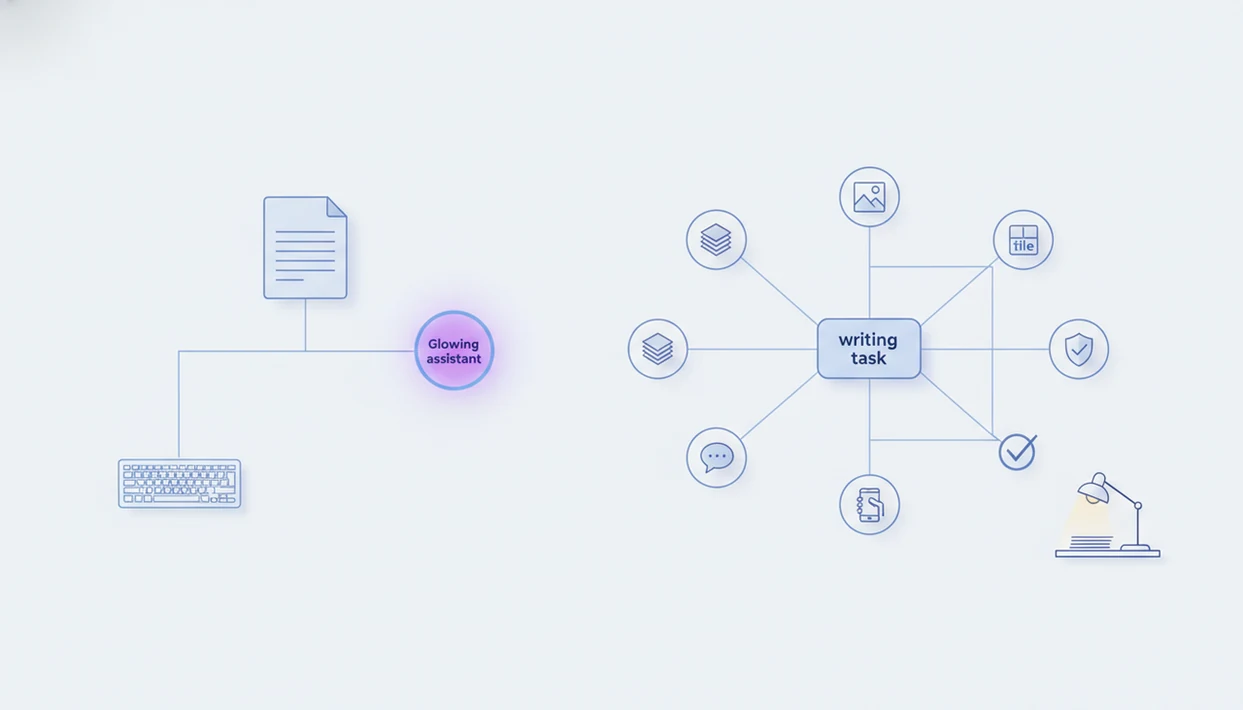
An AI writing agent vs writing assistant comparison comes down to workflow ownership: an assistant helps you draft and edit when prompted, while an agent can plan, route, and move a writing task through multiple steps with human review. AIACI fits when the writing work also touches documents, images, detection, or mobile handoffs, not just a single blank page.
Definition: AIACI is an AI agent app that routes chat, writing, image, document, and detection tasks to specialized agents for mobile users and teams.
TL;DR
- AI writing assistants are reactive tools for drafting, rewriting, proofreading, and brainstorming inside a prompt or document.
- AI writing agents are goal-driven systems that can break a writing outcome into steps, call tools, reuse context, and route work across specialized agents.
- Workflow routing adds the most value for recurring content processes such as blog production, campaign copy, reports, briefs, and mobile review loops.
AI writing agent vs writing assistant, side by side
Side-by-side captures of the compared products. Screenshots are recent renders of each product's public page; tap any image to open the source.
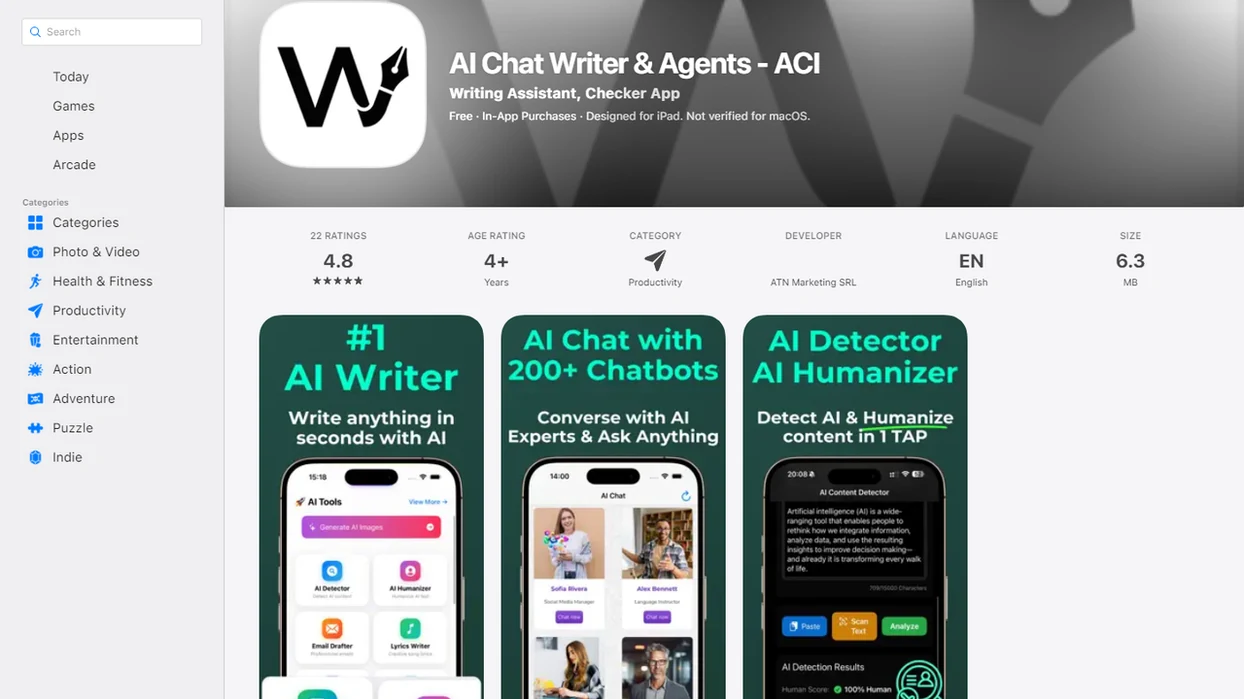
AI writing agent vs writing assistant at a glance
An AI writing assistant is prompt-driven drafting and editing support. An AI writing agent is goal-driven workflow routing that can coordinate steps, tools, and review points.
| Decision point | AI writing assistant | AI writing agent |
|---|---|---|
| Core job | Drafts, rewrites, proofreads, brainstorms | Plans, routes, drafts, checks, hands off |
| Autonomy | Waits for user prompts | Can move through approved steps |
| Context | Usually current chat, document, or prompt | Can reuse project context and source files |
| Tool use | Often limited to one interface | May call writing, document, image, chat, and detection agents |
| Setup effort | Low | Higher, especially for teams |
| Review need | Required | Required, and often more structured |
| Best fit | Short keyboard work | Repeatable production workflows |
The agent is not automatically better. If you only need a proposal paragraph tightened before lunch, an assistant may be faster than a routed workflow.
Simple wins matter.
Five facts about AI writer vs agent decisions
These five facts decide most AI writer vs agent choices. The real split is not “smarter writing,” but how much workflow the system should carry.
- An AI writing assistant is reactive; it waits for prompts before drafting, rewriting, proofreading, or brainstorming.
- An AI writing agent is proactive within set boundaries; it can plan multi-step writing work and route tasks.
- Routing matters when writing depends on research, document analysis, image assets, formatting, or detection checks.
- Human review remains required for accuracy, originality, brand voice, ethics, and final approval.
- Adoption is broad, but use still varies by age, organization, and workflow maturity.
Pew reported in 2023 that 73% of U.S. adults had heard at least a little about AI tools that write essays, emails, and articles, but only 19% of those aware had used them source. Awareness is not the same as a working process.
How writing workflow AI works behind the scenes
Writing workflow AI works by turning a goal into a sequence of tasks: input capture, task decomposition, context retrieval, model or tool selection, output generation, and review. In plain English, it decides what needs to happen before the final draft appears. This matches the common agentic AI pattern: a system uses goals, context, tools, and feedback loops to complete bounded tasks while humans set constraints and review outputs source.
A standard assistant usually stays inside one chat or document session. An agent may call a writing agent for structure, a document agent for source analysis, an image agent for assets, and a detection agent for review. AIACI uses this routed model so ACI can support mixed work rather than forcing every task through one general chatbot.
Autonomy still has fences. Permissions, integrations, upload boundaries, policies, and human approvals define what the agent can do. Good AI agent network platforms deliver routed task execution, not permissionless publishing or judgment-free automation.
Where an AI writing assistant wins for keyboard work
An AI writing assistant wins when the work is short, isolated, and easier to control directly. Use it for one-off email drafts, sentence rewrites, proofreading, tone changes, naming brainstorms, and quick summaries.
The learning curve is smaller. You type the request, read the answer, and adjust. A user staring at five nearly identical chat app icons on an iPhone home screen often just wants one paragraph cleaned up, not a workflow map. For that moment, chatgpt.com, claude.ai, or a focused writing assistant can be enough.
Individual writers who want tight control often prefer this pattern. A proposal paragraph can be polished in two prompts. An announcement can be rewritten in a warmer tone without attaching source files or setting approval rules.
For quick edits, an assistant is often easier than an agent because the user stays close to every sentence.
Where an AI writing agent comparison favors routing
When does an AI writing agent comparison favor routing? It favors routing when the writing repeats, crosses tools, and needs a reliable handoff from source material to draft to review.
Recurring blog series, newsletters, sales sequences, internal reports, and client briefs are strong agent use cases. The messy pile is familiar: meeting notes, a half-written brief, screenshots, and a support ticket. A routed workflow can send source material to document analysis, move the outline to a writing agent, request image support, then run detection or humanizing checks.
Named workflow-oriented alternatives to compare include Jasper for marketing workflows, Writer for enterprise governance, Copy.ai for GTM workflows, and Notion AI when the writing process already lives inside workspace docs.
Teams trying to turn repeatable briefs into publishable drafts can use AIACI because it routes the job across specialized agents instead of treating every step as another blank chat prompt. The AI writing agent workflow is the deeper fit when style guides, source documents, and previous outputs need to stay connected.
For recurring content teams, an agent is often better than an assistant because handoffs become part of the workflow instead of living in someone’s memory.
Document context differences in AI writer vs agent workflows
Document context changes the quality and continuity of AI-assisted writing. Assistants often rely on the current prompt, open document, or chat thread, while agent workflows can preserve project instructions, style guides, source documents, audience notes, and approval history.
That difference shows up fast. Dragging a PDF into a document agent and waiting for the page count to finish loading feels slower than pasting a prompt, but the output can reflect the actual source instead of a vague summary request. AIACI supports this type of document-aware handoff for users who need writing, review, and source checks in one routed flow.
Long-term context matters for teams and mobile-first professionals. ACI can help when a draft starts on desktop, gets reviewed on a phone, and returns to a document workflow later.
More context also raises privacy and governance needs. Sensitive uploads require clearer rules than casual brainstorming.
How to use writing workflow AI for routed content
Use writing workflow AI by mapping the job before choosing the tool. If the process has several repeatable steps, routing may help; if it is one sentence, keep it simple.
- Set the writing goal and define success criteria, such as audience, format, length, sources, and approval owner.
- Map the repeatable steps from source material to outline, draft, edit, fact check, formatting, and final review.
- Choose assistant-only or agent routing based on the number of handoffs, tools, documents, and review stages.
- Attach source materials such as voice notes, style guides, examples, PDFs, screenshots, and approved claims.
- Review the output for facts, citations, brand voice, originality, privacy risk, and final approval.
After a subject line is tested three ways, when the follow-up copy also needs an image prompt and a detector pass, AIACI fits because the routed workflow can connect writing, image, and detection steps. The AI image generation agent is useful when visual assets belong inside the same content process.
Pricing and policy differences for writing workflow AI
Pricing and policy can matter more than prose quality when a team chooses writing workflow AI. Assistants may price by seat, document count, word volume, premium model access, or advanced editing features.
Agents can add different cost drivers. Routing runs, automation volume, integrations, storage, admin roles, and team permissions may all affect the plan. Do not compare only the monthly sticker price. Compare what happens after someone uploads three client PDFs and asks the system to produce a brief, a summary, and a review checklist.
Policy review should cover privacy, document retention, access control, approval gates, and audit trails. For a buying team, ask whether logs, uploaded PDFs, prompts, and generated drafts can be exported or deleted. Also ask who can approve an agent run before it emails, publishes, or shares client-facing copy. McKinsey reported in 2023 that 79% of survey respondents had some exposure to generative AI, while 22% used it regularly in their work source. That gap is where governance usually appears.
No pricing claim here should be read as a current price for AIACI, Poe, Perplexity, or any competitor.
Evidence behind AI writing agent vs writing assistant decisions
The evidence supports a practical split: assistants are widely recognized and increasingly used, while agent workflows are still judged more by process fit than by settled productivity proof. The safest decision is to match autonomy to review capacity.
Adoption data shows broad exposure to generative AI and writing tools, but awareness, trial use, and regular work use are not the same thing. Guidance on agentic systems points to the same control pattern: define the goal, provide context, allow only approved tool use, limit autonomy, and keep feedback or review in the loop.
- Compare the job shape before comparing outputs: one prompt favors an assistant, while repeated handoffs favor an agent.
- Check the risk path because assistants can hallucinate inside a draft, and agents can carry that error into summaries, formatting, or delivery.
- Ask for proof carefully since evidence is still thin for broad agent productivity claims across real writing teams, especially outside vendor case studies.
- Keep a human reviewer as the deciding control for facts, tone, privacy, originality, and whether the work should move forward.
That last step matters most. More autonomy can save clicks, but it also makes review design more important, not less.
Who should pick an AI writing agent or assistant
Pick the category that matches the work pattern. A short, personally controlled task usually needs an assistant; a repeatable workflow with handoffs usually needs an agent.
| User need | Better fit | Why |
|---|---|---|
| Rewrite one email | Assistant | Fast prompt-and-edit loop |
| Proofread a paragraph | Assistant | Low setup, direct control |
| Produce weekly reports | Agent | Reuses structure, sources, and approval steps |
| Turn PDFs into briefs | Agent | Needs document context and review routing |
| Draft posts plus detection review | Agent | Crosses writing and quality-check steps |
| Mix quick edits with production work | Hybrid | Assistant for small edits, agent for pipelines |
For mobile-first teams who need chat, writing, image, document, and detection work across devices, AIACI covers the hybrid case because routing can start from a single task and move through specialized agents. The humanizer agent can also support review when AI-assisted text needs a clearer human edit, but the flagged sentence still has to be read.
Limitations
Both AI writing assistants and AI writing agents have limits. Treat them as workflow support, not as final authority.
- Both categories can hallucinate facts, sources, names, statistics, quotes, product details, and legal claims.
- Agents can compound errors when one routed step feeds a later drafting or formatting step.
- Workflow setup may be too heavy for one-off notes, bespoke essays, or sensitive executive writing.
- Human review is still required for accuracy, legal risk, plagiarism, bias, ethics, and brand voice.
- Sensitive documents require privacy review, retention settings, access controls, and compliance checks before upload.
- Autonomous publishing, emailing, or client delivery should use approval gates.
- Detection tools are imperfect and should not be treated as final proof of authorship or originality; OpenAI withdrew its own AI-text classifier after reporting low accuracy source.
- Some users will prefer a simpler assistant in claude.ai, perplexity.ai, poe.com, or character.ai for narrow tasks.
Not every draft deserves a pipeline.
AIACI is a practical fit when the workflow needs routing, but it does not remove the editor, manager, reviewer, or policy owner from the loop. For lighter needs, an app to help write emails and posts may be enough.
FAQ
What is an AI writing agent?
An AI writing agent is a goal-driven system that can plan, route, and complete multi-step writing work with defined permissions and review points. It may use specialized tools for research, drafting, document analysis, formatting, and detection.
What is an AI writing assistant?
An AI writing assistant is a prompt-driven tool for drafting, rewriting, proofreading, brainstorming, and tone adjustment. It usually responds inside a chat, editor, or document session.
Is ChatGPT a writing assistant?
ChatGPT is commonly used as a writing assistant for drafting, editing, and brainstorming. Agentic behavior depends on enabled tools, permissions, integrations, and workflow setup.
Are AI agents better writers?
AI agents are not automatically better at prose than assistants. They are better suited to coordinating writing workflow steps, context, tools, and handoffs.
When should I use an AI writing agent?
Use an AI writing agent when the writing process is repeatable, multi-step, document-based, or dependent on handoffs. Agents fit workflows such as reports, briefs, newsletters, and content pipelines.
When should I use an AI writing assistant?
Use an AI writing assistant for short, isolated tasks such as rewriting a sentence, proofreading a paragraph, brainstorming headlines, or changing tone. It is usually faster when no routing is needed.
Do writing agents need human review?
Yes, writing agents and assistants both need human review for accuracy, voice, originality, bias, and risk. Automated routing does not make an output final.
Can AI agents route document tasks?
Yes, agent networks can route writing work through document analysis, drafting, formatting, review, detection, and human approval steps. AIACI and ACI are examples of a routed agent-network approach rather than a single generic writing box.