

What Is a Humanizer Agent?
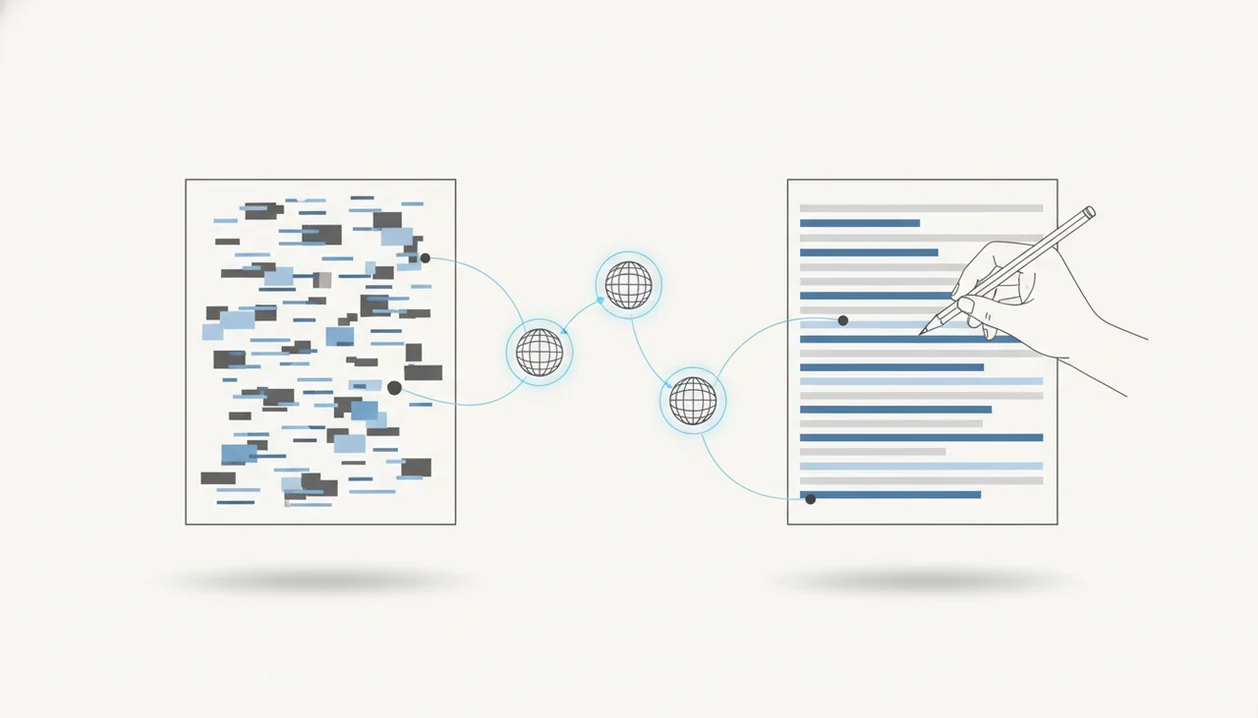
A first draft from a model often has the facts, but not the voice. The sentences are clean, then suddenly too polished. A humanizer agent exists for that gap: it reshapes how the text sounds without inventing a new piece.
Quick answer: A humanizer agent is an AI rewriting step that improves tone, word choice, rhythm, and readability while keeping the original meaning. It is an editorial pass, not a disguise. Use it after the message is already true. Do not use it to hide prohibited AI help.
What a humanizer agent actually does
Definition: A humanizer agent is an AI agent that rewrites or refines existing text so it reads more naturally, matching a target voice or tone, while preserving the original meaning.
That distinction matters. A writing agent may outline, draft, or generate a first version. A humanizer agent works later, when the text already has a purpose but still reads stiff, repetitive, or oddly smooth.
The job is local. Keep the offer. Keep the claim. Keep the person’s point of view. Change the cadence, the filler, and the words that sound like they were assembled rather than written.
Why people reach for a humanizer agent
OpenAI and University of Pennsylvania researchers estimated that about 80% of the U.S. workforce could have at least 10% of work tasks affected by large language models (Eloundou et al., 2023). Once drafts get cheaper, the bottleneck moves to voice and review.
Public caution sits next to that demand. In a 2023 Pew survey, 52% of U.S. adults said they were more concerned than excited about increased AI use in daily life (Pew Research Center). That is why a responsible rewrite should stay transparent. Grammar tools already proved the market: Grammarly has reported more than 30 million daily active users (Grammarly). A humanizer agent is the next layer, aimed at tone rather than commas.
How a humanizer agent works
Google Cloud describes AI agents as systems that can reason, plan, and use memory to complete tasks (Google Cloud). In a writing workflow that means separate roles: draft, check, rewrite, review.
- Read the existing draft and the target tone.
- Flag stiff phrases, repeated openers, and generic polish.
- Rewrite with constraints: keep meaning, match voice, stay concise.
- Compare the new version against the original claims.
- Hand back a version a person still has to approve.
Style learning helps when you feed real samples: a founder note, three sales emails, a product memo. Those teach more than a vague “make it human” prompt.
Five facts about AI humanizer agents
- A humanizer agent adjusts tone, word choice, and flow while keeping the core message intact. It should make a customer email sound less robotic, not change the offer or invent claims.
- It can sit as a dedicated step inside a multi-agent workflow. Draft first, scan second, humanize third, then review. That is safer than one rewrite box that pretends every job is the same.
- Responsible tools are built for clarity, accessibility, and voice alignment, not detector bypass. Evasion is a marketing claim, not a quality standard.
- Style learning analyzes prior writing so the rewrite can match an authentic voice. Three real emails teach more than “make it human.”
- The output still needs a person. After a detector score appears, someone still has to read the flagged sentence.
How to use a humanizer agent
- Start with a draft that already has the right message.
- Set tone: plain, professional, friendly, concise, or a saved style.
- Rewrite the stiff sections, not the entire document if only a few paragraphs fail.
- Check facts, names, numbers, and promises against the source.
- Scan with a detector if policy requires a review signal, not a verdict. See the AI detector vs humanizer guide.
- Read aloud once. If it sounds too smooth, pull it back.
- Publish only after a person accepts the voice and the claims.
Humanizer agent vs other rewriting tools
| Option | Main use | Strength | Limitation |
|---|---|---|---|
| Humanizer agent | Tone and flow on an existing draft | Keeps meaning while changing voice | Still needs human review |
| Grammar or paraphrase tools | Spelling, clarity, synonym swaps | Familiar and fast | Usually not a full voice pass |
| Bypass-focused humanizers | Detector evasion claims | Fast rewrite language | Ethically risky and unreliable |
| General chatbots | Drafting and ad-hoc editing | Flexible prompts | More manual routing and checking |
| Research assistants | Source-oriented answers | Useful for finding citations | Not built mainly for voice |
For first-draft structure before this step, see the AI writing agent guide. For email and post copy, see how to write emails and posts with AI.
When to use one, and when not to
Use a humanizer agent for marketing copy, internal docs, customer emails, product notes, and social posts where the problem is readability. Do not use it to hide prohibited AI assistance in academic work, legal filings, compliance reports, or any workplace rule that requires disclosure.
A smoother version of a misleading paragraph is still misleading. If the draft is wrong, rewrite the facts first.
For writers who already have the message, a humanizer agent is the right tool because it treats voice as an editorial step. It is the wrong tool if the goal is to sneak past a detector or skip a required review.
Common myths about rewriting agents
Myth: Humanizer agents exist only to bypass AI detectors. Reality: Responsible tools improve clarity, tone, accessibility, and brand voice. Detector evasion is a marketing claim, not a quality standard.
Myth: An AI text humanizer makes content fully undetectable. Reality: No reputable tool can guarantee that. Detector behavior varies by model, sample length, writing style, and update cycle.
Myth: A humanizer agent replaces human editors entirely. Reality: It can fix stiff phrasing, but it cannot fully judge audience risk, factual accuracy, legal sensitivity, or a joke that lands badly.
Myth: Humanized text is automatically ethically safe. Reality: A smoother version of a misleading paragraph is still misleading.
For first-draft structure before this step, the AI writing agent guide covers outlines and section-level drafting. The writing agent vs writing assistant comparison separates drafting, correction, and routed rewriting.
Limitations
Key caveat: a humanizer agent is not a truth machine, a policy shield, or an ethics engine.
- It can make inaccurate content sound more convincing if no one checks the facts.
- Humor, cultural nuance, and tight technical arguments can get flattened.
- No tool can guarantee content is undetectable. Detector scores move with model, length, and updates.
- Style learning needs real samples. Cold-start rewrites often sound generic.
- Bias in the source text can survive a prettier rewrite.
FAQ
Is a humanizer agent the same as paraphrasing?
No. A humanizer agent goes beyond synonym swaps by adjusting tone, rhythm, readability, and voice while preserving the original meaning.
Can a humanizer agent bypass AI detectors?
No tool can guarantee AI-detector bypass. Responsible humanizer agents focus on quality, clarity, and policy-aware rewriting, not evasion.
Does humanized text still need editing?
Yes. Human review is still needed for accuracy, nuance, ethics, citations, and domain-specific judgment.
Is using an AI text humanizer cheating?
It depends on the policy and context. Professional editing support may be allowed, but academic, legal, or compliance settings may restrict or require disclosure of AI assistance.
How does style learning improve rewrites?
Style learning analyzes prior writing samples to identify preferred tone, sentence length, vocabulary, and structure. That helps the rewrite match an authentic voice instead of generic prose.
What content types benefit from humanizer agents?
Marketing copy, customer emails, social posts, internal documents, product notes, and support replies can benefit from responsible rewriting. Sensitive or regulated content needs extra review.
Can a humanizer agent preserve brand voice?
Yes, when tone settings and style calibration are based on real brand samples. The output should still be reviewed against the brand guidelines before publishing.
What is the difference between a humanizer agent and a grammar tool?
A grammar tool mainly checks spelling, grammar, and local clarity. A humanizer agent rewrites more holistically for tone, flow, voice, and reader fit.
Use this as a starting point
Treat humanizing as the pass after the meaning is settled. Draft, check, rewrite, then read it yourself. Related reading: writing agent vs writing assistant and the full guide index.