

AI Agent Network vs Agent Marketplace for Workflow Routing
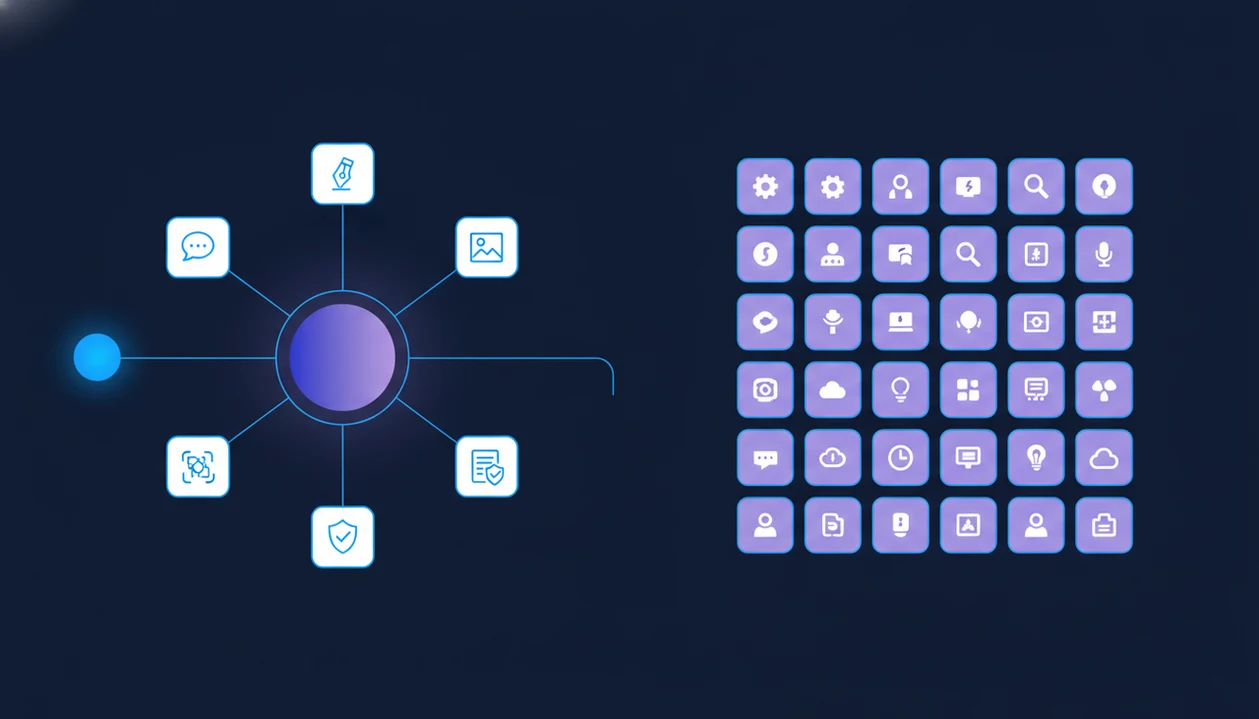
An AI agent network is usually better for workflow completion, while an agent marketplace is better for discovering and choosing standalone agents. The core difference in AI agent network vs agent marketplace is routing: a network sends a task to the right specialized agent, while a marketplace asks the user to browse, install, and manage agents individually. AIACI fits the network side for users who want chat, writing, image, document, and detection work routed from one request.
Definition: AIACI is an AI agent app that routes chat, writing, image, document, and detection tasks to specialized agents for mobile users and teams.
TL;DR
- An agent network focuses on orchestration, routing, and workflow completion across specialized agents.
- An agent marketplace focuses on discovery, procurement, installation, permissions, and management of standalone agents.
- An agent directory is usually lighter than both because it may only list agents without executing or governing workflows.
AI Agent Network vs Agent Marketplace At-a-Glance Comparison
An AI agent network is a routing and orchestration system for work across specialized agents. An agent marketplace is a catalog, purchase, install, or launch environment for standalone agents.
| Comparison point | AI agent network | Agent marketplace | Agent directory vs network |
|---|---|---|---|
| Core purpose | Routes one task to the right specialist | Helps users find and manage agents | Lists agents, often without execution |
| User experience | Submit the outcome you want | Browse, compare, install, or launch | Search and filter listings |
| Workflow ownership | Usually owned inside one platform | Split across vendors or agents | Usually not owned |
| Permissions | Centralized or platform-managed | Agent-by-agent permissions | Often informational only |
| Governance | Routing rules, review steps, fallback | Procurement, policies, vendor controls | Limited unless attached to a platform |
| Discovery | Secondary to task completion | Main value | Main value |
| Best fit | One outcome across tools | Choosing a specific agent | Research before buying |
The practical winner is simple: choose a network for one outcome across tools, and choose a marketplace for agent selection.
Five Facts About AI Agent Platform Types
These five facts summarize the main AI agent platform types buyers compare. They also explain why the agent marketplace comparison often gets confusing.
- Networks coordinate work while marketplaces distribute individual agents. The network model is about routing, chaining, and completion.
- Marketplaces typically include catalog pages, install flows, permissions, and ongoing management. A real marketplace does more than describe agents.
- Directories may only list or filter agents. A directory does not necessarily route, execute, govern, or monitor work.
- Marketplace value is ecosystem reach; network value is end-to-end task completion. More listings help discovery, but they do not finish a messy work pile by themselves.
- For AIACI-style workflows, the user submits one request and the platform routes it to the right specialized agent. That matters when the input is meeting notes, a half-written brief, screenshots, and a support ticket.
ACI is most useful when the question is not “which agent should I install?” but “which specialist should handle this task now?”
How an AI Agent Network Works Behind the Routing Layer
An AI agent network works by interpreting a user request, classifying the task, and routing it to a specialized agent. The routing layer is the difference between an orchestrated workflow and a plain catalog.
A request might be tagged as chat, writing, image generation, document analysis, or AI detection. The network can then send the task to one specialist, chain several agents, transfer context, or fall back when the first route is weak. In plain English, orchestration means the platform decides the handoff path instead of making the user rebuild the prompt in five tools.
Good AI agent platforms deliver task routing and reviewable handoffs, not a giant drawer of bots with no owner. Poor routing can lower output quality, so network value depends on routing accuracy, governance, and a visible review step.
AIACI is a mobile-first example because the user can submit one request from an iPhone instead of staring at five nearly identical chat app icons on the home screen. The mechanism still needs judgment. Routing is not mind reading.
How to Use an AI Agent Network or Agent Marketplace
Use the outcome as the starting point, not the agent name. That small shift keeps the decision focused on workflow fit.
- Define the task you need completed, such as summarizing a PDF, drafting a response, checking AI-like phrasing, or generating an image brief.
- Decide whether routing or browsing is needed. Use an AIACI-style network when one request should reach the right specialist; use a marketplace when you need to choose and manage a specific agent.
- Review permissions before uploading files, connecting accounts, or granting tool access.
- Run a small test with a low-risk input before moving a team workflow into the platform.
- Evaluate output quality by checking accuracy, tone, missing context, and whether a human review step is needed.
- Standardize the workflow only after the same route works repeatedly for mobile-first professionals or teams.
The right fit for fast triage is AIACI because the routing workflow starts from the job to be done, not from a catalog search.
Where a Routed AI Agent Network Wins for Workflows
Does an AI agent network work better than an agent marketplace for workflows? Yes, when the user wants a finished outcome rather than agent shopping.
Networks win when the work crosses categories. A user may need to analyze a document, draft a reply, create a visual concept, and check a final paragraph for detector risk. That is closer to task routing than procurement. It is also where specialized AI agents matter more than a long list of names.
For mobile users, routing reduces cognitive load. One-handed prompt on an elevator ride, then a cleaner handoff when the person reaches the desk. That matters when the source material is not tidy: a screenshot from Slack, a PDF attachment, and three half-remembered bullet points from a call. Teams also gain a consistent interface, centralized governance, fewer separate installations, and clearer workflow ownership.
After a demo, when a handoff note has to become usable work, AIACI fits teams that need chat, writing, document, image, and detection tasks routed through a named workflow instead of scattered across tabs.
McKinsey reported that 65% of organizations regularly used generative AI in 2024, up from 33% the previous year, which explains why workflow infrastructure decisions now matter source.
Where an Agent Marketplace Comparison Favors Catalog Choice
An agent marketplace wins when users want to compare, buy, install, or launch a specific standalone agent. The model is strongest when selection matters more than automatic routing.
Marketplaces can expose ecosystem reach, vendor distribution, user reviews, procurement paths, and permission choices. That helps when a team already knows the category it needs. For example, an admin might compare agents for sales research, code review, customer support, or internal knowledge search before approving one vendor.
Enterprise examples often include private catalogs, approved vendors, contract terms, usage controls, and role-based access. Those controls can be useful, but they depend on the marketplace design. Some pages call themselves marketplaces even when they are closer to directories.
Named examples vary by category: OpenAI's GPT Store is closer to a consumer-facing agent marketplace, while enterprise catalogs from platforms such as Microsoft Copilot Studio or Salesforce Agentforce may emphasize governed deployment, permissions, and admin control.
For technical admins who need vendor choice, a marketplace is often easier than a network because procurement, reviews, and agent-by-agent permissions are visible before deployment.
The warning is practical: if there is no transaction, install, launch, or execution layer, the “marketplace” may only be a catalog.
Agent Directory vs Network in Real Buying Decisions
An agent directory is a searchable list or filtering page for agents; it is not the same as a routed AI agent network. A directory helps people discover options, but it may not run, govern, monitor, or chain tasks.
This distinction matters in real buying decisions. A directory can answer “what exists?” A marketplace can answer “what can we buy, install, or launch?” A network can answer “how does this task move from request to completed output?” Those are three related AI agent platform types, not three labels for the same thing.
Buyers should ask direct questions: can it run the workflow, manage permissions, audit outputs, preserve context, and handle fallback when a specialist fails? If the answer is mostly no, it is probably discovery infrastructure.
For readers comparing AI agent network models, the directory question is a useful filter. Discovery is helpful. Operational workflow ownership needs more.
Pricing, Permissions, and Governance Differences in AI Agent Platforms
Pricing and governance often expose the real difference between networks, marketplaces, and directories. The label matters less than who controls access, review, fallback, and accountability.
Marketplaces may price per agent, subscription, usage tier, vendor, or procurement contract. Networks may price around platform access, routing volume, workflow volume, team seats, or app usage. Directories may charge for listings, referrals, or visibility, without owning execution.
Permissions are the harder issue. A serious evaluation should cover data access, audit logs, observability, fallback behavior, context retention, and human review. Pew found that 52% of workers were very or extremely concerned about how AI may be used in the workplace, which makes trust controls more than a procurement detail source.
NIST guidance also frames AI risk across the AI lifecycle, including design, deployment, monitoring, and governance source. That supports a simple conclusion: workflow automation usually depends more on control points than on the number of available agents.
Who Should Pick an AI Agent Network or Marketplace
Choose a network for workflow ownership; choose a marketplace for agent selection. Use a directory only when research and discovery are enough.
| User need | Better fit | Why |
|---|---|---|
| One request routed to the right specialist | AI agent network | The platform owns routing and handoff |
| Browse vendors and compare agent listings | Agent marketplace | Selection, reviews, and procurement are visible |
| Install or launch a named tool | Agent marketplace | The user wants a specific agent |
| Research agent categories | Agent directory | Execution is not required |
| Mobile chat, writing, image, document, and detection tasks | AIACI | ACI routes the request to a specialized workflow |
For professionals who keep switching between chatgpt.com, claude.ai, perplexity.ai, and poe.com, AIACI fits when the real problem is routing rather than another blank prompt window.
The broader benefits of AI agent networks show up when repeatable work needs fewer handoffs, clearer review steps, and less tool switching.
Evidence and Sources for Comparing AI Agent Platform Types
The evidence points to a practical split: marketplaces prove value through discoverability and controlled selection, while networks prove value through routing quality and completed handoffs. Because AI agent platform types are still changing, some category claims remain vendor-defined rather than settled standards.
Adoption data is the reason this comparison matters now. The earlier McKinsey figure on regular generative AI use shows that teams are no longer testing only isolated chat prompts; they are choosing workflow infrastructure. Marketplace evidence is usually easier to inspect: catalog size, visible reviews, approved vendors, procurement paths, install controls, and admin permissions. Those signals help buyers compare options before deployment, but they do not prove that a messy task will finish well.
Network evidence is more operational. Buyers should look for routing logic, orchestration rules, audit trails, governance settings, fallback behavior, and context handoff between agents. In plain English, the question is whether the platform can remember enough of the job to move it to the next specialist without making the user start over.
- Check adoption and trust data from primary or reputable industry sources before treating urgency as fact.
- Compare marketplace claims against catalog, review, procurement, and deployment evidence.
- Test network claims with real routing, context transfer, governance, and fallback scenarios.
- Label vendor-defined terms clearly when the product blends network, marketplace, and directory features.
Limitations
The comparison is useful, but the categories are still evolving. Some products blend network, marketplace, and directory features in one interface.
- A routed agent network is not automatically better because bad routing can send work to the wrong specialist.
- A marketplace does not guarantee strong governance, permissions, security, or auditability.
- Many agent marketplace claims describe only a directory, catalog, product page, or partner listing.
- More agents do not automatically mean better results; routing quality and context often matter more.
- Specialized agents still face model errors, incomplete context, tool failures, and weak integrations.
- Definitions vary because vendors are still testing language for AI agent platform types.
- Some workflows need human review before external sharing, legal use, hiring decisions, or business-critical action.
- A mobile-first network can reduce tool switching, but screen size still limits careful review of long outputs.
- Detector and humanizer workflows still require reading the flagged sentence, not only trusting the score.
A humanized paragraph read on a phone can look fine at first glance. Then the odd sentence jumps out.
FAQ
What is an AI agent network?
An AI agent network is a routed system that sends user tasks to specialized agents. It focuses on workflow completion rather than browsing individual agents.
What is an AI agent marketplace?
An AI agent marketplace is a catalog or store for browsing, buying, installing, or launching standalone agents. Its main function is discovery and selection.
Is an agent directory the same as a marketplace?
No. An agent directory may only list or filter agents, while a marketplace usually supports procurement, installation, launch, or management.
Which model is better for workflow automation?
An AI agent network is usually better for end-to-end workflow automation because it owns routing, context transfer, and handoff. A marketplace is better when the user needs to select a specific agent.
Do agent marketplaces route tasks automatically?
Some marketplaces may add orchestration features, but the marketplace model itself is centered on discovery and selection. Automatic routing is the defining strength of an agent network.
Are more AI agents always better?
No. Routing quality, context, governance, permissions, and workflow fit matter more than the raw number of agents.
How does a routed platform fit into an AI agent network?
AIACI fits the agent network model by routing chat, writing, image, document, and detection tasks to specialized agents. ACI is designed for users who want one request handled through task routing instead of choosing each agent manually.