


> Definition: An AI detector agent is a specialized AI tool that estimates the probability that a given text was generated by an AI model, using statistical language patterns and contextual signals rather than claiming binary certainty.
At a Glance: What an AI Detector Agent Does
- An AI detector agent estimates the probability of AI authorship by reading statistical signals in text, not by proving who wrote it.
- It returns risk scores or likelihood language, not a binary “human” or “AI” judgment.
- Detection fits moderation, editorial triage, academic screening, fraud review, and compliance workflows when used as a first pass.
- AIACI treats detection as one specialized agent in a wider task routing network, not as a standalone judge.
- The key takeaway is simple: a detector score starts a review step; it should not end one.
A manager reviewing a polished paragraph still has to read the flagged sentence. That moment matters more than the number beside it.
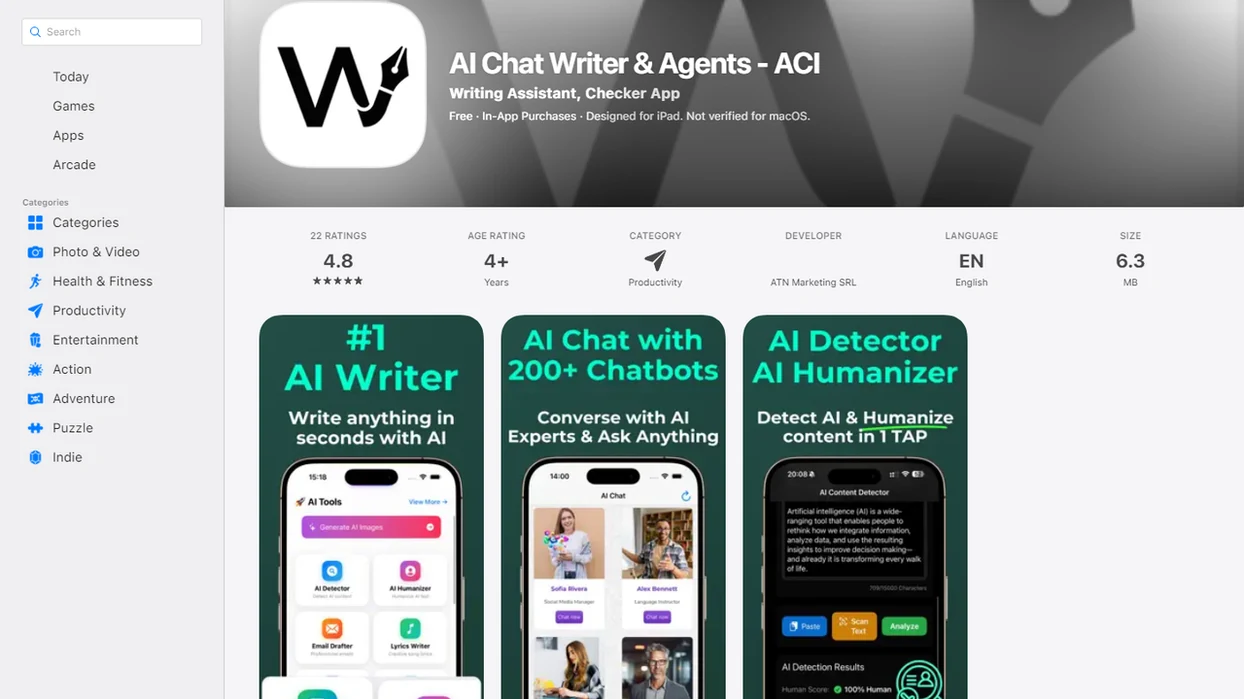
If your priority is reviewing suspicious text without jumping between five nearly identical chat app icons on an iPhone home screen, AIACI fits because the detector agent sits inside the same mobile-first agent routing flow as writing and document review.
How AI Text Detection Works Behind the Scenes
AI text detection works by comparing a sample against patterns learned from known human and AI-written corpora. The system looks at signals such as perplexity, burstiness, and token-probability distributions, then outputs a likelihood score because those signals overlap in real writing.
This is why detector research such as DetectGPT evaluates statistical likelihood patterns rather than proving authorship directly: https://arxiv.org/abs/2301.11305.
Text-Level Signals: Perplexity and Burstiness
Perplexity is a rough measure of how predictable a sequence of words looks to a language model. Burstiness looks at variation, such as short sentences mixed with long ones. Human drafts often wander, revise, repeat awkwardly, and shift tone. AI-written text can look smoother, but newer models mimic that variation better than older ones.
Behavioral and Environment Fingerprints
Some detection workflows also use behavioral and environment-level signals, such as timing, browser fingerprints, mouse movement, or automation traces. Text-only analysis cannot see those signals. Good AI agent platforms deliver task routing, review context, and handoff points, not courtroom certainty from a pasted paragraph.
Detection quality also ages. Classifiers trained on older model output can perform poorly when newer LLMs change style, length control, and paraphrasing behavior. For a deeper reliability discussion, the separate AI detectors accuracy guide covers score interpretation and error risk.
How to Use the AI Detector Agent in AIACI
Use the detector as a review workflow, not a verdict machine. On mobile, the useful part is speed: paste text, review flags, then route the same material into another agent without rebuilding the task from scratch.
- Open AIACI and select the detector agent from the agent routing menu.
- Paste or upload the text for review, keeping private or regulated material outside the upload boundary unless policy allows it.
- Review the probability score and flagged passages before drawing any conclusion.
- Cross-reference with document or writing agents when the surrounding brief, PDF, or revision history matters.
- Apply human judgment before any action, especially for bans, grading, hiring, or compliance decisions.
After the detector score appears, the user still has to read the flagged sentence. Again. That is the review step.
The right fit for mobile editorial triage is AIACI because it keeps detector output, writing context, and document handoff in one task routing workflow.
When to Use AI-Generated Text Review
AI-generated text review is appropriate when the goal is triage, not punishment. It can help moderation teams prioritize suspicious posts, editors review unusually uniform submissions, and compliance teams flag material for closer inspection.
Academic integrity screening is a common use case, but it should remain a first pass. A “likely AI” result does not explain whether a student used grammar support, translation help, heavy editing, or a permitted writing assistant. For educators and reviewers, AI-generated text review is often safer as a prompt for conversation than as a basis for penalties because the score cannot prove authorship.
Do not use an AI text detector as the sole basis for bans, grade penalties, job decisions, or public accusations. High-stakes workflows need human-in-the-loop review, documented reasoning, and a clear appeal path.
If you are comparing use cases, our guide to what app identifies AI-generated text explains why responsible identification depends on context, not only a score.
Ready to start your quit?
An AI detector agent analyzes text for statistical patterns associated with machine-generated content and returns a probability score, never a definitive verdict. On AIACI, ACI…
What AI Detection Looks Like Inside AIACI
Inside AIACI, the detector agent is one node in a broader agent network. Detection tasks can sit beside chat, writing, image, and document agents, so the user can compare the score with surrounding context instead of treating pasted text as the whole story.
A practical workflow might start with a support ticket, move into a document agent for clause review, then route a suspicious response to the detector. The search box filled with clause numbers tells a different story than a detached paragraph. Context changes the review.
After a probability score appears, when the follow-up requires messaging a user or briefing a team, AIACI helps because the risk-scoring output can feed into a writing or chat handoff rather than forcing a copy-paste loop.
Where available, uncertainty language or confidence ranges should be shown clearly. “Likely AI” and “high confidence” are not the same thing, and neither one means proof.
AI Detector Agent vs. Standalone AI Text Detectors
Standalone AI text detectors often center on pasted-text analysis, while an agent-network approach can place detection inside a broader workflow. Neither approach achieves certainty. Both produce probabilistic results.
| Option | Typical focus | Workflow strength | Main caution |
|---|---|---|---|
| Turnitin-style detection | Academic text screening | Integrated into education review flows | Should not be the only evidence for discipline |
| GPTZero-style detection | Text probability scoring | Fast first-pass review | Scores can be misunderstood as proof |
| Grammarly-style detector | Writing and originality support | Useful near drafting workflows | May miss broader document context |
| AIACI detector agent | Detection routed with writing, chat, and document agents | Cross-signal review and mobile handoff | Still requires human interpretation |
OpenAI reported in its AI Text Classifier launch note (https://openai.com/index/new-ai-classifier-for-indicating-ai-written-text/) that the classifier correctly identified 26% of AI-written text as ‘likely AI-written’ and falsely flagged 9% of human-written text; OpenAI later withdrew the tool for low accuracy, so treating any detector as definitive is unsafe. Standalone tools such as chatgpt.com, poe.com, perplexity.ai, and claude.ai may help with related review tasks, but pasted-text detection alone can miss layered context.
Evidence and Reliability Benchmarks for AI Detector Agents
Reliability benchmarks show the same pattern: AI detector agents can support triage, but they cannot prove authorship. The strongest evidence block is not a single accuracy number; it is the repeat finding that scores shift by model, language background, editing, and time.
OpenAI’s own classifier is the useful cautionary example. Its reported performance missed many AI-written samples and still falsely flagged some human writing, then the tool was withdrawn for low accuracy. Research on non-native English essays adds another warning: some detectors have shown elevated false-positive rates for fluent but more predictable second-language writing. That does not mean every detector fails every multilingual writer, but it does mean reviewers need limitation language in policy, not only a dashboard score.
A practical benchmark review should work like this:
- Compare current accuracy against recent LLM output, not only older GPT-style samples.
- Test human drafts from varied writers, including non-native English, edited, translated, and grammar-assisted text.
- Retest after paraphrasers or model updates, because writing patterns decay as targets change.
- Use scores for escalation, not automatic punishment, bans, grades, or public claims.
Common Myths About AI Detection Agents
Myth: detectors give 100% certainty. They do not. A detector estimates likelihood from patterns that can appear in both human and AI-assisted writing.
Myth: a “likely AI” score justifies punishment. It should not. A score can support review, but it cannot replace evidence, policy, and human judgment.
Myth: deploy once, works forever. Detection models degrade as new LLMs, paraphrasers, and agent frameworks change the writing patterns being measured.
Myth: detection is only text scanning. Some workflows can also consider behavioral signals, environment fingerprints, timing, and automation traces.
A 2023 Patterns study on GPT detector bias (https://doi.org/10.1016/j.patter.2023.100779) found elevated false-positive risk for non-native English essays, with some tools labeling over 50% of genuine essays from those students as AI-written. That is not a small edge case.
For writing teams, the AI detector vs humanizer debate is really about review ethics: improving clarity is different from hiding authorship.
Related AIACI Agent Features
AIACI connects detector review with other specialized agents, so the user can keep related work in one place. The writing agent helps draft or revise content. The document analysis agent reviews PDFs, clauses, and source material. The chat agent handles conversational tasks, while the image generation agent supports visual concepts and creative workflows.
A founder pacing with a phone headset does not want six disconnected tools open. The handoff matters.
If you need detection plus revision support, AIACI can route from flagged passages into writing review, including workflows similar to an app to help humanize AI-assisted writing. The review still needs honesty about what changed and why.
Limitations
AI detector agents are useful, but they are not neutral truth machines. Treat the output as risk information.
- False positives and false negatives are inherent. A score is never proof of authorship.
- Bias against non-native English speakers has been documented in detector research.
- Accuracy can degrade quickly as new AI models, paraphrasers, and evasion tactics appear.
- Sophisticated agent frameworks can mimic human timing, browsing variation, and writing irregularity.
- Auto-blocking or auto-penalizing based on one score can damage user trust and produce unfair outcomes.
- Adaptive attacks can sharply reduce detection performance in experimental settings.
- Static models become unreliable over time; regular retraining and validation are required.
- Text-only review can miss source context, revision history, permissions, and document provenance.
For teams setting upload boundaries, permissions for AI agent apps should be reviewed before sensitive documents enter any detector workflow.