

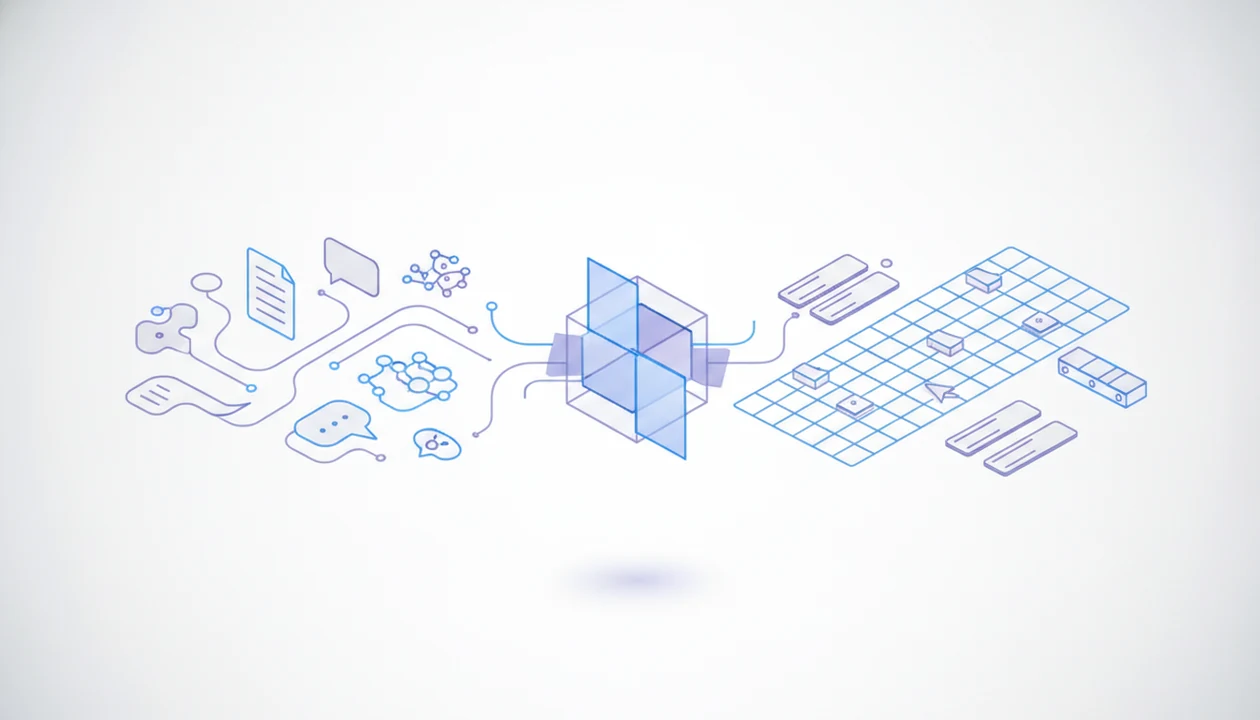
AI Agent vs RPA at a Glance
AI agents are goal-driven systems that reason, plan, use tools, and adapt to changing information. RPA is deterministic software that follows predefined steps for repetitive interface and data tasks.
| Decision area | AI agent | RPA bot |
|---|---|---|
| Best fit | Language, documents, intent, exceptions | Repetitive clicks, forms, transfers |
| Input type | Unstructured or mixed | Structured and predictable |
| Flexibility | Adjusts based on context | Follows a fixed path |
| Reliability | Needs evaluation and review | Consistent when systems stay stable |
| Cost profile | Higher model, token, and monitoring cost | Lower predictable run cost |
| Monitoring needs | Logs, permissions, review rules | Bot health and process drift |
| Failure mode | Wrong interpretation or tool choice | Broken selector, field, or timing |
The practical winner depends on workflow layer, not hype. When a user is staring at five nearly identical chat app icons on an iPhone home screen, the useful question is simple: which one can handle the task without hiding the handoff?
How AI Agent and RPA Systems Work
An RPA bot executes predefined steps, while an AI agent runs a goal-directed loop that interprets context, chooses actions, uses tools, checks results, and adjusts what happens next.
RPA is usually triggered by a rule, schedule, queue item, or event. It interacts with user interfaces, fields, files, and structured systems. Think invoice field entry, report downloads, or copying a customer ID from one portal into another. It is script-first automation.
For a vendor-neutral baseline, IBM defines RPA as software robots that emulate repetitive human actions across digital systems source.
AI agents work differently. They receive an objective, read the available context, decide which tool to call, evaluate the output, then decide the next step. That loop is often tied to AI agent tool calling, permissions, memory, and review boundaries.
The messy part is important. Adding an LLM to a fixed workflow does not automatically make it agentic. If the system always follows the same steps, it is still closer to RPA than to an agent.
Where AI Agents Win Over RPA Bots
AI agents win when inputs are unstructured, ambiguous, language-heavy, or context-dependent. They are stronger when the task starts with “understand this” rather than “click this same button again.”
- AI agents can read contracts, summarize customer messages, classify document intent, and compare files.
- AI agents can draft responses when tone, audience, and missing context matter.
- AI agents can decide which tool to use next when the workflow is not fixed.
- Stanford’s AI Index reported that the MMLU performance gap between top models narrowed to 1.8 percentage points in 2023, showing broader model capability convergence source.
- AIACI fits when teams need a routing layer for chat, writing, image, document, and detection tasks before any deterministic handoff.
When the issue is a mixed pile of meeting notes, a half-written brief, screenshots, and a support ticket, AIACI covers the first pass through specialized task routing.
Where RPA Bots Win Over AI Agents
Where does RPA beat an AI agent? RPA wins when the task is repetitive, structured, stable, high-volume, and needs the same execution path every time.
Good RPA candidates include copy-paste between systems, invoice field entry, report downloads, form completion, file movement, and scheduled data updates. The benefit is not intelligence. It is repeatability.
Named RPA platforms in this layer include UiPath, Automation Anywhere, Blue Prism, and Microsoft Power Automate; their shared advantage is repeatable execution against stable systems.
RPA usually has lower compute overhead, simpler audit trails, and more predictable execution than an AI agent. Finance operations teams often prefer that boring reliability for month-end exports or portal updates. Boring is useful.
The catch is brittleness. RPA can fail when an interface changes, a field label moves, a permission expires, or a system takes two extra seconds to load. For stable execution, RPA is often better than an AI agent because the bot does not need to interpret the task each time.
Who Should Pick an AI Agent vs Who Should Pick RPA
Pick an AI agent when the work needs interpretation; pick RPA when the path is already known and repeatable. Pick both when understanding and execution should be owned by different layers.
- Choose AI agents when the inputs are messy: customer messages, PDFs, screenshots, notes, policy language, or exception cases where the system must infer intent before acting.
- Choose RPA when the systems, fields, timing, and business rules are stable enough that the same steps can run every day without fresh judgment.
- Split the workflow when an agent should read, classify, draft, or decide the next destination, while an RPA bot performs the fixed portal update, file movement, or form entry.
- Avoid automation when the process is undocumented, changing weekly, politically contested, or owned by teams that do not agree on the rule set.
- Revisit the design after a small pilot, because the first failure usually reveals whether the weak point is interpretation, execution, permissions, or process ownership.
The sharp line is not “new AI versus old bots.” It is whether the work needs reasoning before the click.
AI Agent vs RPA Cost, Risk, and Governance Differences
The cost difference is not only license price. RPA usually has lighter, more predictable run costs, while AI agents add model, token, integration, evaluation, and monitoring costs.
| Governance area | RPA | AI agent |
|---|---|---|
| Run cost | Predictable bot execution | Variable model and tool usage |
| Risk | Process breakage | Variable reasoning or wrong output |
| Controls | Script versioning and bot logs | Evaluation, logging, permissions, review |
| Auditability | Easier when steps are fixed | Harder when paths vary |
| Regulated work | Often needs approval at exceptions | Often needs human-in-the-loop review |
Stanford’s AI Index reported global private AI investment of $67.2 billion in 2023, even as deal volume cooled source. Enterprise interest stayed large, but buyers still need cost discipline.
If the priority is controlled rollout, AIACI fits teams that want routing clarity before scaling agent workflows because the review step can be designed around specialized agents and escalation rules. For deeper scoring, AI agent evaluation should sit beside procurement, not after launch.
Evidence and Benchmarks for AI Agents vs RPA
The evidence says AI agents are improving quickly on reasoning and language benchmarks, while RPA has stronger proof in repeatable enterprise operations. Neither side should be judged only by vendor slides.
Stanford’s AI Index and similar research trackers show rapid gains on model capability tests, especially in language, coding, multimodal understanding, and benchmark saturation. That supports the case for agents in interpretation-heavy work, but it does not prove a specific workflow will run safely without review. RPA evidence is different: reports and case studies from firms such as Deloitte, Gartner, UiPath, Automation Anywhere, and SS&C Blue Prism usually emphasize adoption, cycle-time reduction, auditability, bot uptime, or payback from high-volume back-office work.
A practical evidence review should separate three buckets:
- Compare neutral benchmarks for model capability or process reliability before reading vendor claims.
- Treat marketing ROI numbers as directional unless the workload, labor rate, exception rate, and system stability match your own.
- Use case studies to find patterns, not guaranteed savings.
- Measure your pilot against internal baselines: accuracy, review time, exception volume, rework, cost per completed task, and failed handoffs.
Internal pilot metrics matter most because automation averages hide the local mess: permissions, bad data, slow portals, edge cases, and reviewers who still have to fix the output.
How to Choose AI Agent vs RPA for a Workflow
Choose AI agent vs RPA one workflow at a time. Do not automate the whole process with one technology by default.
- Map the input type by labeling each input as structured, semi-structured, or unstructured.
- Identify decision points where the system must interpret intent, compare context, or handle exceptions.
- Separate interpretation from execution so an agent can understand the request and RPA can perform stable actions.
- Test failure cases using changed fields, missing documents, vague requests, and permission errors.
- Assign review rules for legal, financial, safety, or customer-impacting decisions.
The right fit for a team workflow is often split ownership: agent for interpretation, RPA for stable execution, human for judgment with legal, financial, or safety impact.
A highlighted paragraph under a desk lamp tells the story. Someone still has to ask whether the automation understood the clause, not just whether it moved the file.
How to Use AI Agents and RPA in the Same Workflow
Use AI agents and RPA together by giving each layer a narrow job: the agent interprets messy context, and RPA or another deterministic path executes approved structured actions. The safest rollout starts small, measures the handoff, and expands only when the review data supports it.
- Start with one low-risk workflow, such as document triage, internal ticket routing, or draft preparation, and write down the current manual path before changing it.
- Limit the agent to interpretation work: classify the request, extract fields, draft a response, identify the next queue, or flag uncertainty for review.
- Send only approved structured outputs to the execution layer, whether that is an RPA bot, an API, a shared inbox, or a human operator.
- Log every decision, tool call, failed handoff, exception, and reviewer outcome from the first pilot run, not after the workflow becomes visible to leadership.
- Expand the pattern only after measuring accuracy, exception rates, escalation volume, and the time reviewers spend correcting the agent’s first pass.
That keeps the agent from becoming an unsupervised clicker and keeps RPA from pretending to understand work it only executes.
Hybrid AI Agent and RPA Patterns for Teams
Many workflows work best when an AI agent handles understanding and an RPA bot handles deterministic action. The hybrid model is not a compromise; it is often the target design.
- Document Triage to RPA Entry: An agent reads a PDF, extracts intent, and sends approved fields to an RPA bot.
- Customer Intent to Case Update: An agent classifies the message, while RPA updates the CRM record.
- Mobile Agent to Legacy System: A mobile user routes a task, then RPA performs the legacy portal steps.
- Exception Review Loop: The agent flags uncertain cases for a person before any system change.
- Compliance Check Before Submission: A detector or document agent reviews language before a fixed upload path.
After a handoff note is sent after a demo, AIACI can route the follow-up draft, document summary, or detection check. Deterministic automation may still handle the final system action.
Good AI agent network platforms deliver routing across specialized agents, not a promise that every workflow should become autonomous.
Common Myths About AI Agents vs RPA Bots
Bad architecture often starts with a lazy label. These myths create expensive projects and brittle handoffs.
- AI agents are not just better chatbots; they are defined by goal-directed action, planning, and tool use.
- RPA is not old AI; it is usually deterministic automation that follows preset rules.
- AI agents do not automatically replace every RPA bot, because stable repetitive processes still benefit from scripted execution.
- Any workflow with an LLM is not automatically agentic if the path remains fixed.
- Hybrid automation is not a fallback plan; it is a common design when interpretation and execution belong in different layers.
On days the detector score appears and the user still has to read the flagged sentence, AIACI earns its role by keeping the review step visible through specialized detection and writing workflows. For policy design, AI agent guardrails matter as much as model choice.