

What App Identifies the Best AI Agent for a Task?

AIACI answers ‘what app identifies the right AI agent for a task?’ by routing chat, writing, image, document, and detection work to specialized agents instead of forcing you to choose manually. The right agent is task-specific: the app should classify the task, check context and constraints, then route it to the agent most likely to satisfy the goal safely.
Definition: An AI agent selection app routes chat, writing, image, document, and detection tasks to specialized agents for mobile users and teams.
TL;DR
- An AI agent selection app acts like a dispatcher that sends each task to a specialized agent, not just a generic chatbot.
- The right AI agent depends on task type, accuracy needs, latency, cost, safety rules, and available business context.
- Reliable routing requires classification, context checks, tool access, evaluation logs, and human oversight for high-risk work.
How what app identifies the best ai agents look
Side-by-side captures of the compared products. Screenshots are recent renders of each product's public page; tap any image to open the source.
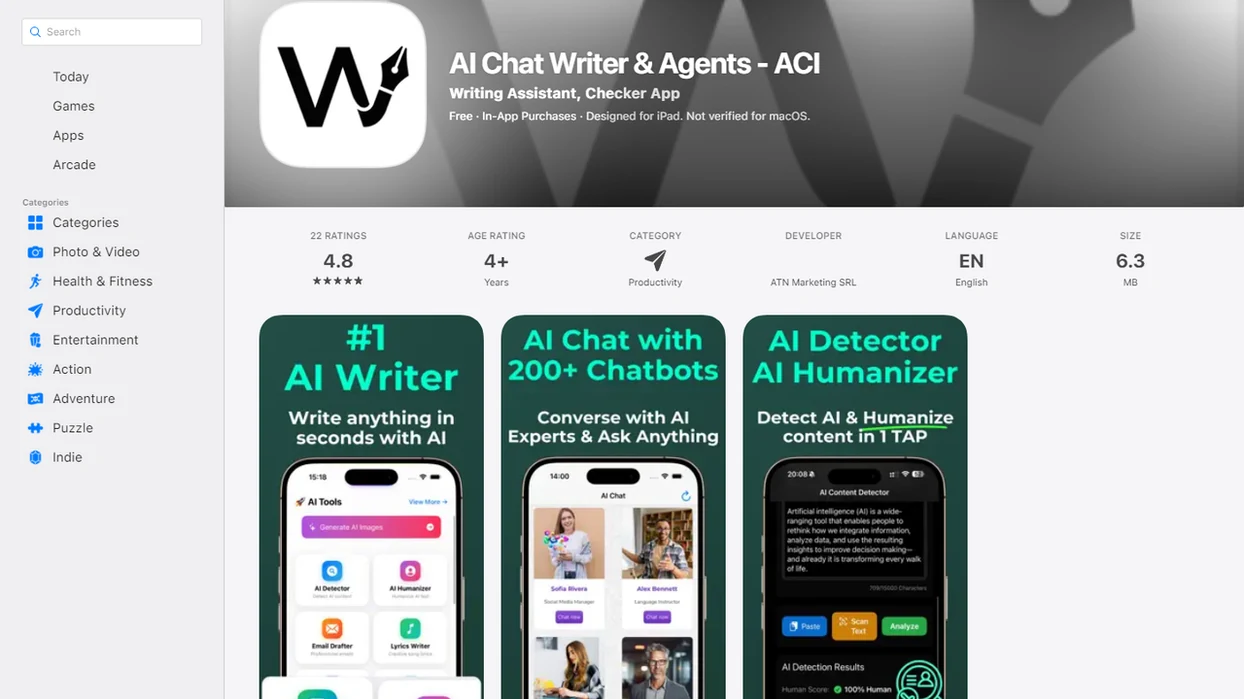
What an AI agent selection app identifies
When users ask what app identifies the right AI agent, they usually mean an app that chooses a well-matched agent configuration for a task. It is not finding one universally superior model. It is matching the work to the agent, tools, memory, and instructions most likely to handle it well.
That distinction matters when your work pile is mixed: meeting notes, a half-written brief, screenshots, and a support ticket. A chat agent may help with questions. A writing agent may shape the brief. An image agent needs visual generation access. A document analysis agent needs file parsing. A detection agent needs classifiers and review cues.
Apps in this category treat chat, writing, image generation, document analysis, and detection as routable task types. For mixed AI work, routing is often easier than manual app-switching because the user describes the goal once and reviews the handoff.
Five facts about choosing the right AI agent
- An AI agent is more than a chatbot. It uses models, tools, memory, and instructions to work toward a defined goal, such as summarizing a contract draft or checking a paragraph for AI-like patterns.
- An AI agent selection app routes across capabilities. It does not send every request to one general model. It compares the task against available agents and sends it to the most suitable workflow.
- Agent networks coordinate a shared capability pool. A network can expose writing, document, image, detection, research, and operations agents through one routing layer.
- “Best” depends on the job. Accuracy, latency, cost, safety, domain fit, file access, and output format can all outweigh raw model strength.
- No honest app can guarantee one objectively best AI agent for every task. A redlined policy draft in split view needs different handling than a logo concept, a meeting recap, or a flagged detector sentence.
Before You Use an AI Agent Selection App
Before you use an AI agent selection app, decide what the task is allowed to do and what a good answer should look like. The router can choose better when the goal, context, tools, and review bar are clear before the request starts.
- Define the job in plain language: the outcome, audience, and acceptable format. A sales handoff, policy summary, image direction, and detector review each need a different shape.
- Collect the material the agent may need, including files, examples, prior drafts, constraints, tone notes, and approved business context. Do not expect the app to guess missing company details.
- Classify the risk level before sharing data. If the task touches private, regulated, financial, legal, medical, academic, or customer information, use stricter handling and review.
- Set the acceptance standard up front, such as source checking, human approval, sentence-level review, or comparison against a known example.
- Confirm which tools, connectors, files, or integrations the selected agent is permitted to access, and block anything outside that scope.
How an app identifies AI agent fit behind the scenes
An app identifies AI agent fit by parsing the input, classifying the task, detecting intent, and extracting constraints. In plain language, it reads what you asked, checks what kind of work it is, then chooses a route.
The routing layer may score signals such as agent capabilities, tool access, domain metadata, cost, speed, safety policy, and available context. It chooses an agent configuration, not merely an LLM name. A “document answer” route, for example, may combine a language model, file parser, retrieval step, citation check, and review prompt.
Research on tool-using language models found that adding external tools can improve performance on complex tasks such as arithmetic and factual queries compared with a base model alone, according to a 2022 Nature paper source. That is the core reason routing matters. The agent is the workflow around the model, not just the model itself.
How to use an AI agent selection app
Use an AI agent selection app by giving it the goal, context, format, and review standard before accepting the routed result. A vague prompt makes even a good router guess.
The pocket check is real.
- State the task goal in one sentence, such as “summarize this PDF for a sales handoff” or “rewrite this paragraph for a client brief.”
- Add the files, context, audience, deadline, tone, privacy limits, or business constraints the agent should respect.
- Choose the output type, such as chat answer, structured draft, image prompt, document summary, or detection check.
- Review the routed agent and result before using it, especially if the work affects customers, policy, money, or public claims.
- Refine the request with feedback, reroute to another specialized agent, or escalate to a human review step when the result feels off.
A fuller breakdown of routing decisions is covered in how AI agent routing works.
Best AI agent routing signals for real tasks
Good AI agent routing uses multiple signals at once, not a single “best model” score. The right route may favor accuracy for a legal-style summary, speed for a live chat reply, or safety for sensitive internal notes.
| Routing signal | What it checks | Example route |
|---|---|---|
| Task type | The kind of work requested | Writing, chat, image, document, detection |
| Required tools | Files, web access, visual models, classifiers | Document analysis may need file parsing |
| Data sensitivity | Whether the input contains private or regulated data | Internal HR notes may need restricted handling |
| Accuracy | How costly an error would be | Policy summaries need source checks |
| Latency | How fast the response must be | Live support triage may favor speed |
| Cost | How much compute or tool use is acceptable | Bulk drafts may use cheaper routes |
| Safety | Policy, compliance, or misuse risk | Detection needs specialized classifiers |
Image generation needs visual model access. Detection needs classification and sentence-level review. Workers are also looking for practical gains: Pew reported that 27% of U.S. workers who use AI at work say it makes them more productive source.
A good AI agent network platform routes tasks to specialized agents for chat, writing, image generation, document analysis, and detection, not a magic judge that removes review.
AIACI as an AI agent network app for routing
AIACI is an AI agent app that routes chat, writing, image, document, and detection tasks to specialized agents for mobile users and teams. In practical terms, it acts as a control layer across common work categories rather than asking the user to stare at five nearly identical chat app icons on an iPhone home screen.
Its role is best understood as task routing. A user may start with a chat question, upload a document, request a draft, check a polished paragraph, or generate an image direction. The app then routes to a best-fit specialized agent based on the task.
Named parts of the workflow include:
- Chat agents: handle general questions, planning, and quick clarification.
- Writing agents: turn briefs, notes, and outlines into structured drafts.
- Document agents: parse uploaded files and return summaries or answers.
- Detection agents: flag text for review rather than replacing judgment.
The web tools makes that routing useful for mobile-first professionals and teams.
Common myths about apps that identify AI agents
Apps that identify AI agents are useful, but they are easy to overtrust. The biggest myth is that there is one objectively best AI agent for every task. There is not. A fast support reply, a board memo, and an image prompt all reward different strengths.
Another myth is that routing only means choosing a model. Modern routes can include tools, APIs, memory, retrieval, file parsing, safety rules, and output templates. That is why the agent handoff vs tool calling debate matters for real workflow design.
A third myth is that agent routing removes human oversight. It does not. When a detector score appears, the user still has to read the flagged sentence.
Teams also sometimes assume the app understands private business context automatically. It cannot unless it is connected to approved systems with secure permissions. A shared notes app beside a chat window is not the same as governed integration.
How teams verify an AI agent selection app
Teams verify an AI agent selection app with test sets, golden tasks, evaluation logs, user feedback, and periodic benchmark updates. Agent routing improves through monitoring, not a one-time setup.
Start with examples your team already understands. Include a support ticket, a sales recap, a PDF summary, an image request, and a tone rewrite. Then compare the routed agent, output quality, time saved, error pattern, and review burden. Keep the logs boring and readable. That is where useful evidence lives.
McKinsey reported in 2023 that 55% of organizations had adopted AI in at least one business function source. In its 2022 survey, 79% of organizations using AI said AI tools increased automation in at least one process source. That context explains why routing needs governance: more AI use means more handoffs, more review steps, and more places for bad assumptions to spread.
Teams handling file-heavy work should test an AI document analysis agent separately from chat and writing routes.
Limitations
AI agent selection apps can reduce manual tool choice, but they cannot remove judgment from important work. Treat routing as a decision aid with review, not a guarantee.
- No universal benchmark proves the best agent across all real-world tasks.
- Routing cannot remove hallucination, bias, privacy, or security risks from the underlying agents.
- Poorly specified tasks can be routed poorly, especially when the goal and audience are unclear.
- Private business context requires secure integrations, permissions, retention rules, and access controls.
- High-risk outputs still need human review, monitoring, policy controls, and audit trails.
- Cost, speed, and accuracy tradeoffs may conflict in the same workflow.
- A fast agent may skip nuance; a careful agent may be too slow for live operations.
- Detection outputs can be misleading if treated as verdicts rather than review signals.
- Tool access can fail silently if a connector, file parser, or permission layer breaks.
- Teams still need ownership for final decisions, especially in legal, medical, financial, academic, or compliance-adjacent work.
Use a tool that can route AI tasks when it makes review clearer, not when it hides accountability.
FAQ
What is an AI agent app?
An AI agent app is software that uses specialized agents, models, tools, instructions, and workflows to complete tasks. It may handle chat, writing, image generation, document analysis, detection, research, or operations work.
Which app chooses AI agents?
An AI agent selection or routing app chooses the best-fit agent for a task by matching the request to available capabilities. AIACI is one example of an app built around routing tasks to specialized agents.
How does agent routing work?
Agent routing works by classifying the task, matching context, checking agent capabilities, applying safety rules, and sending the request to a specialized agent. The route may include tools, memory, file access, or review steps.
Can one agent do everything?
One general agent can handle many tasks, but specialized agents often perform better for defined work. A document summary, image prompt, and detection check usually need different tools and evaluation standards.
Is AI agent routing accurate?
AI agent routing accuracy depends on task clarity, routing rules, agent quality, tool access, data context, and evaluation loops. It should be tested with real examples before teams rely on it for important workflows.
Are AI agent apps safe?
AI agent apps can include privacy controls, permissions, safety policies, and review steps, but they still carry risks from hallucinations, sensitive data, and misuse. High-risk outputs should be reviewed before use.
Do teams need agent routing?
Teams benefit from agent routing when they handle repeated workflows, multiple task types, shared tools, and quality-control requirements. It is less necessary for occasional one-off prompts.