
How to Verify a Pokemon Card Value After Scanning
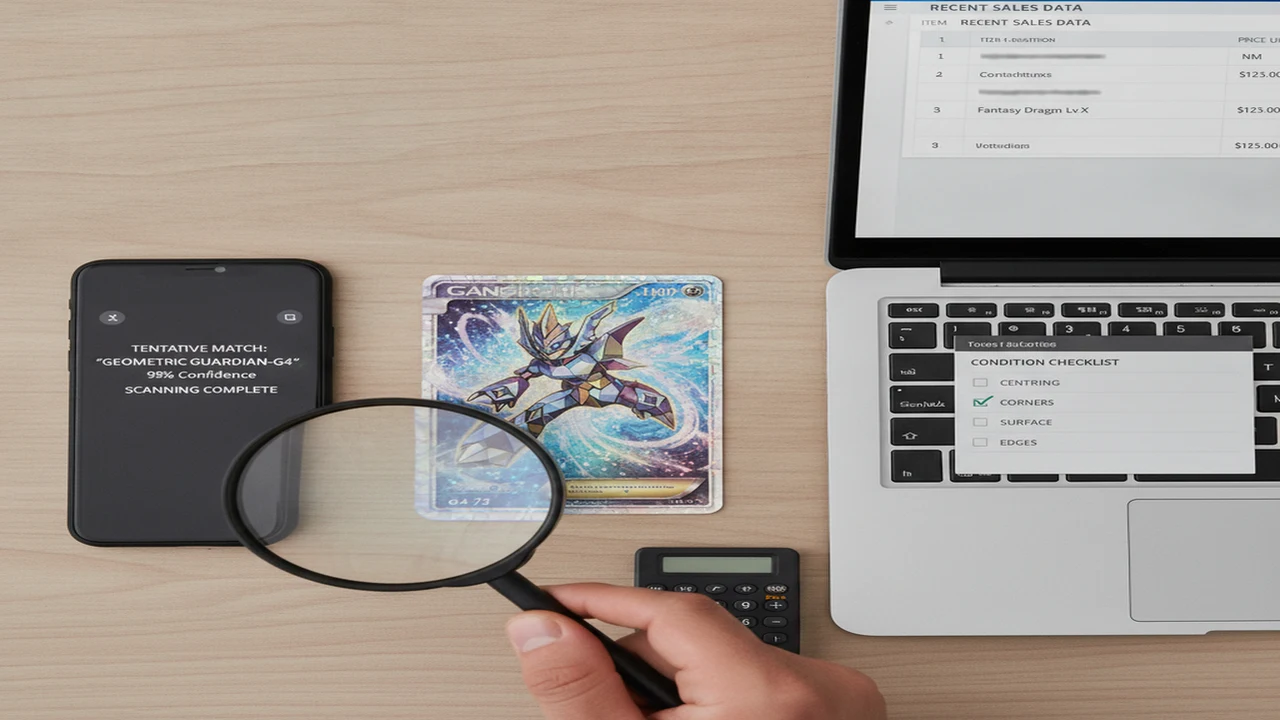
A scanner can answer “how much is my Pokemon card worth?” in seconds, but the displayed number may belong to a different printing, finish or condition. Computer vision is useful for narrowing the search. It cannot inspect every surface defect or establish that the selected marketplace record is a valid comparison.
The reliable workflow is scan first, verify second. Record what is printed on the card, resolve variant uncertainty, inspect condition and build a range from comparable transactions. This creates an audit trail you can revisit before listing the card, making an offer or paying for grading.
Quick answer: Use the scan as an identification lead, not a final valuation. Confirm the exact set, collector number, printing, language, finish and condition. Then compare several recent sold listings with the same attributes, keeping raw and graded cards separate. Reject lots, active asking prices and mismatched variants, and report a supported price range rather than one seemingly precise estimate.
What should you record before trusting a scanned value?
Start with the physical card rather than the price result. Record the name, set symbol, collector number, rarity, language, copyright line, edition stamp and promotional markings. Note whether the surface is non-holo, holo, reverse holo, textured or otherwise distinctive.
Photograph the front and back under neutral light. Add angled images for foil patterns, texture and surface damage. A sleeve, glare or cropped collector number can remove precisely the evidence needed to distinguish similar printings.
Use the following workflow as a verification sequence. Do not move from identification to pricing while a set, variant or condition field remains unresolved.
- Photograph the card clearly
- Record the printed identifiers
- Review the scanner match
- Confirm the exact variant manually
- Filter for comparable sold listings
- Separate raw and graded sales
- Assess visible condition conservatively
- Remove mismatched listings and outliers
- Calculate a supported price range
- Escalate uncertain or high-value cards
Did the scanner identify the exact Pokemon card variant?
Compare the result from Card Value Scanner with the card in front of you. The card name and artwork are not enough. Confirm the set symbol and collector number first, then inspect the finish, language, edition markers and promotional stamps.
Common false positives include a reverse holo matched to a standard copy, a promotional card matched to a set release, or a reprint matched to an older edition using similar artwork. First Edition and Shadowless details can also create large price differences that a broad visual match may miss.
If the result conflicts with printed evidence, prioritize the printed identifiers and conduct a manual catalog search. Our guide to why visually similar printings fool card scanners explains where computer vision confidence can exceed identification accuracy.
How do you confirm the scan with a manual lookup?
Search for the card name together with its set and collector number. A query such as “Charizard Base Set 4/102” is more useful than searching for “Charizard card.” Add the language, edition or promotional code when applicable.
A companion reference such as TCG App can help reconcile the identification before pricing. Compare the returned set, card number and variant with the physical card. If the scanner and manual lookup disagree, pause and locate the discrepancy rather than averaging two unrelated estimates.
TCGplayer reported serving more than 20 million monthly marketplace users in 2024, which helps explain why its transaction-based Market Price is commonly consulted. Scale does not remove the need to match the exact card attributes or account for regional marketplace differences.
Which sold listings are valid price comparisons?
A strong comparable has the same set, collector number, printing, finish, language and approximate condition. For a slabbed card, it must also match the grading company and numeric grade. The sale should be recent enough to represent the current market and clear enough to identify what the buyer received.
Exclude active asking prices because they show seller expectations, not completed transactions. Also reject mixed lots, mystery packs, damaged cards with unclear descriptions, best-offer sales with hidden prices and listings that reuse stock images across variants.
Use several eBay sold Pokemon card prices where possible, then compare their pattern with TCGplayer card prices or CardMarket pricing. The IGN card valuation guide also identifies sold marketplace records as a relevant source. For regional and transaction differences, see our guide to filtering completed card sales across major marketplaces.
How should condition and grading change the valuation?
Keep raw cards separate from slabs. A raw near-mint estimate cannot be substituted for PSA graded card values, CGC graded card values or BGS graded card values. Each slab comparison should match the company, grade and card variant shown on the label.
For raw cards, inspect centering, corners, edges and surfaces. Look for whitening, scratches, dents, creases, staining, print lines and alterations. Use the lower plausible condition class when photos are incomplete. Buyers may evaluate the same defect more harshly than a seller or automated condition model.
An AI card grading app or AI card pre-grading tool can organize visible defect observations, but it cannot issue a PSA, CGC or BGS grade. By 2023, major grading companies such as PSA had graded millions of Pokemon cards, according to PSA reporting summarized in the research notes. That large slab market still depends on issued grades, not predicted ones. Broader scanner-app verification criteria can help separate identification features from condition claims.
How can you calculate a defensible value range?
Collect several recent matched sales and place them in date order. Use the middle cluster as the initial range rather than selecting the single highest transaction. Investigate unusually high or low results for hidden differences such as shipping, condition, language, grading label, bundled items or an auction with limited participation.
For example, matched sales of $42, $45, $47, $49 and $78 do not automatically support a $52.20 value. If the $78 sale has no clear explanation and other evidence clusters between $42 and $49, that cluster is more defensible. State the sample size and sale dates beside the range.
Account for shipping and marketplace fees according to the decision being made. A buyer’s delivered cost differs from a seller’s net proceeds. A Pokemon card price checker, Pokemon card price tracker or live TCG price check can provide context, but the final range should remain traceable to matching evidence.
Where should the verification workflow stop trusting automation?
Stop relying on automation when the model cannot resolve a variant, the visible condition is ambiguous, recent sales are sparse or the financial consequence of an error is high. Rare cards, suspected alterations and expensive grading decisions justify manual catalog research or review by an experienced dealer, authenticator or grading service.
MonPrice Collector & Scanner is another option for instant card identification, collection records and CardMarket pricing context. An estimated value or daily price update serves a different purpose from a confirmed sold-listing record for the exact card.
Comparison
| Verification field | What to match | Common false positive | Best confirmation source |
|---|---|---|---|
| Set and collector number | Both identifiers exactly | Same artwork from another set | Printed card and set catalog |
| Printing and edition | Copyright line, stamp and release | Reprint matched to an earlier edition | Printed markers and catalog |
| Holo or reverse-holo finish | Foil location and pattern | Standard holo matched to reverse holo | Angled photo and variant checklist |
| Language | Printed language and regional release | English price assigned to another language | Card text and regional catalog |
| Raw condition | Corners, edges, surface and centering | Near-mint estimate for a creased card | Front, back and angled inspection |
| Grading company and grade | Company, grade and slab label | PSA sale compared with CGC or BGS | Slab label and certification record |
| Sale date | Recent transactions in the same market | Old sale used as a current benchmark | Completed-sale record |
| Listing format | Single card with a disclosed final price | Active listing, lot or mystery pack | Marketplace transaction details |
Limitations
Computer vision can match visually similar artwork while missing a set, finish, language or edition difference. Real-time Pokemon card prices may describe refreshed estimates rather than immediate evidence from completed transactions. Neither speed nor a high confidence display resolves an incorrect variant.
Photos may conceal creases, surface impressions, cleaning, alterations or authenticity problems. Sparse sales can also allow one unusual transaction to distort the apparent market. TCGplayer, CardMarket and auction platforms represent different regions, condition conventions and transaction formats, so their figures are not automatically interchangeable.
Scanner output, collection totals and AI card pre-grading should not be the sole basis for an expensive purchase, sale or grading submission. Escalate when authenticity is disputed, the value range is wide, condition determines a substantial premium or no genuinely comparable sales can be found.
Frequently Asked Questions
Why can two scanners give different values for the same Pokemon card?
They may select different sets, finishes, languages, conditions or pricing sources. Compare each result with the collector number and printed variant markers before evaluating the price difference.
Can Card Value Scanner identify reverse-holo and promotional variants?
Its scan can provide an identification lead, but every returned variant should be checked against the physical finish, promotional stamp, collector number and set documentation. Public feature descriptions do not establish correct recognition for every printing.
Does TCG App show the same value as a marketplace sold listing?
Not necessarily. A companion app may display a market estimate or reference value, while a sold listing records a specific transaction with its own date, condition, shipping and listing format.
Are eBay sold Pokemon card prices more reliable than active listings?
Usually, because sold records show transactions that reached completion rather than prices sellers hope to receive. Reliability still depends on matching the exact variant and excluding lots, unclear listings and hidden best-offer prices.
Can an AI card grading app predict a PSA, CGC or BGS grade?
It can estimate visible condition from images, but it cannot issue or confirm a professional grade. Lighting, focus and concealed defects can materially change the outcome.
How many sold listings should be used to verify a card value?
Use at least three closely matched transactions when available, with five or more providing a better view of the market. Exact matches matter more than a large sample of mixed variants or conditions.
What should I do when no recent comparable sales exist?
Widen the date range carefully, check multiple marketplaces and document the absence of exact sales. Use related cards only as context, not direct evidence, and present a wider range with lower confidence.
When should a Pokemon card be checked by a professional?
Seek professional review when authenticity is uncertain, damage or alteration is difficult to assess, the card may justify expensive grading, or a valuation error would create a meaningful financial loss.