
TCGplayer vs Cardmarket vs eBay for Pokemon Prices
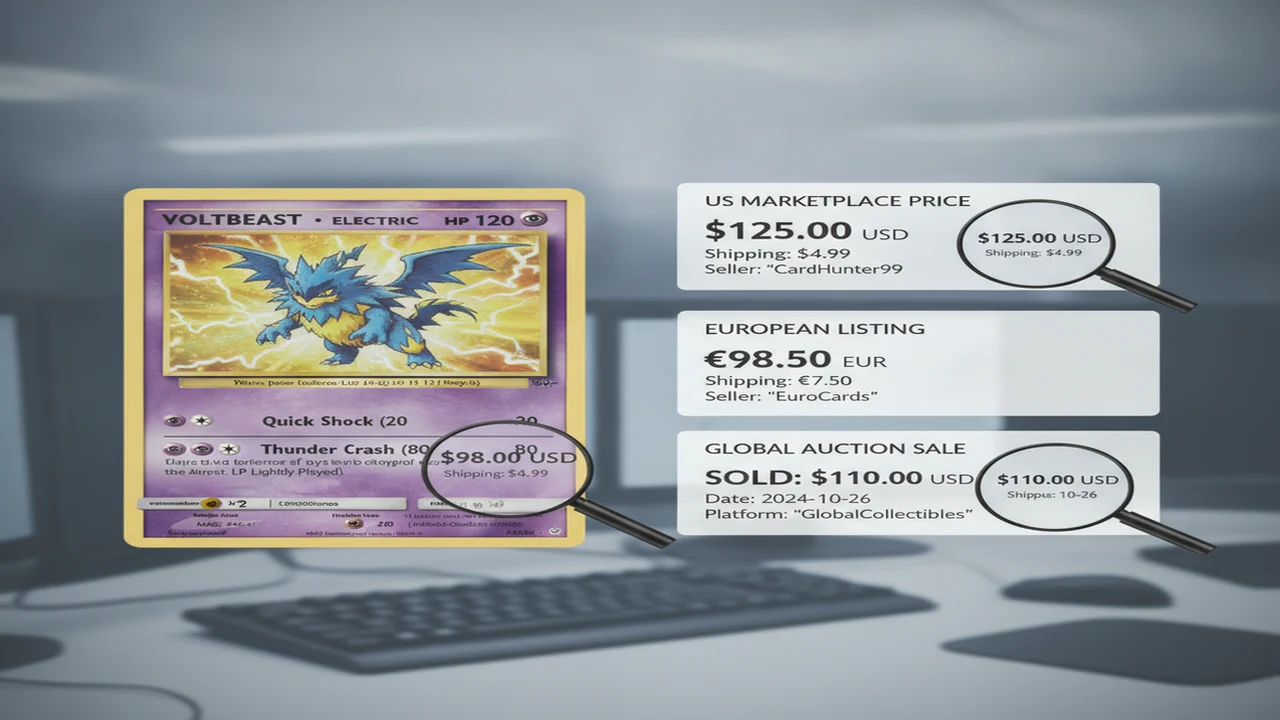
A Pokemon card can appear to have three different values depending on where you search. TCGplayer may show a market price, Cardmarket may display lower European offers, and eBay may contain both ambitious active listings and completed sales at materially different amounts.
The disagreement is usually evidence of different markets, conditions, fees, and data methods rather than a single platform being wrong. The verification task is to identify which records represent the exact card and which price type is relevant to the planned sale.
Quick answer: Use TCGplayer as a structured North American reference, Cardmarket for European market context, and eBay sold results to inspect individual transactions. No source establishes a definitive value alone. Confirm the exact printing, language, condition, sale date, shipping, region, and graded status before pricing or selling a Pokemon card.
What price does each marketplace actually show?
TCGplayer card prices are primarily useful as structured references for the North American singles market. Product pages group cards by set and printing, while market indicators summarize activity on the platform. This structure is efficient for actively traded raw cards, but an aggregate can conceal condition differences and may respond slowly when a thin market moves abruptly.
Cardmarket serves a similar role for European buyers and sellers. Its offers and price trends are denominated in euros and reflect European supply, shipping routes, languages, and buyer demand. A Cardmarket price comparison should therefore be interpreted as regional evidence, not converted into dollars and assumed to represent the same economics as a US sale.
eBay provides global auction and fixed-price records. Active listings show what sellers request, while the Sold Items filter identifies completed records that are closer to transaction evidence. The PSA guide to valuing Pokemon cards likewise emphasizes sold listings, condition, and grading data rather than relying on asking prices.
Tabletop Curation's 2024 pricing review reported about 92% accuracy for TCGplayer and Cardmarket price checkers when a Pokemon card had at least five monthly sales, falling to around 68% for ultra-rare or very low-volume cards. Those figures illustrate why sales depth matters: an organized price feed is less persuasive when only a few transactions support it.
- TCGplayer: structured US marketplace reference, strongest for liquid raw singles.
- Cardmarket: European offers and trends shaped by EU supply, currency, language, and shipping.
- eBay active listings: seller expectations rather than completed-sale evidence.
- eBay sold results: individual transactions that still require photo, condition, and sale-term verification.
How can you confirm that you matched the exact Pokemon card?
Begin with the card name, set name, collector number, and set symbol. Then check the language, first-edition or unlimited designation, promotional status, reverse-holo pattern, stamped treatment, and any parallel foil. Shared artwork does not establish that two cards are the same printing.
A photo tool such as Card Value Scanner can provide a fast identification starting point. Computer vision may narrow the search to a likely database record, but the user still needs to compare the physical collector number, finish, text, and set details with the proposed match.
Condition is a separate matching problem. Whitening, scratches, dents, creases, print lines, centering, and surface wear can move a card away from the marketplace condition selected by a seller. For graded cards, match the grading company, numerical grade, label details, qualifiers, and certification record.
Readers evaluating recognition confidence can review how AI card identification can fail. The key boundary is that identifying artwork is not the same as confirming a variant, condition tier, or realizable sale price.
- Match set and collector number before comparing prices.
- Confirm language, edition, promotional status, and foil treatment.
- Inspect photos rather than accepting condition labels at face value.
- Keep raw and graded comparables in separate groups.
How do TCGplayer, Cardmarket, eBay, and scanner tools compare?
The sources below perform different jobs. Marketplaces provide listing or transaction evidence, while scanner tools primarily accelerate identification, monitoring, or collection organization. A TCG scanner app comparison should not rank camera speed as if it were equivalent to verified sold-price evidence.
Feature descriptions for the scanner tools reflect their public listings as checked on the article date. They do not establish identification accuracy, pricing accuracy, or feature parity.
Why do Pokemon card prices disagree across platforms?
Region is the first divider. A card may be abundant in Europe but scarce in the United States, or demand may favor a particular language. Currency conversion translates the headline amount but does not reproduce local taxes, buyer expectations, or shipping costs.
Marketplace mechanics also differ. Seller fees can influence listing strategy, while auctions may close low when few qualified buyers are watching. Fixed-price listings can remain visible long after market demand has changed. TCGplayer and Cardmarket averages can be useful for liquid products but may lag sudden movements.
Condition creates another source of disagreement. A lightly played card priced on one marketplace is not a valid comparison for a near-mint example elsewhere unless the condition standards and photographs support the labels. Even near-mint cards can differ materially in centering, surface quality, and edge wear.
Graded cards require narrower comparisons. PSA graded card values should be supported by sales in the same PSA grade, while CGC graded card values and BGS graded card values need company-specific comparables. Label generation, subgrades, qualifiers, certification confidence, and population can also affect buyer behavior.
Low volume amplifies every discrepancy. One auction, one stale listing, or one unusually motivated buyer can dominate the apparent range when few cards have sold. In that situation, a range with a low-confidence label is more defensible than a precise single-number estimate.
How should you verify an eBay sold Pokemon card price?
Search using the card name, set, collector number, variant, language, and grade. Select completed sold results, then open each plausible record. Titles are imperfect, so inspect the photographs for the set symbol, foil pattern, certification label, and visible condition.
Separate the displayed item amount from shipping. An apparently cheaper sale can be more expensive after postage, while free shipping may be embedded in the item price. Convert currency using a consistent date and record whether taxes or import costs are relevant to the intended buyer.
Accepted offers create uncertainty because the visible crossed-out price may not reveal the actual amount paid. Relisted items, duplicate photographs, non-paying-buyer outcomes, lots, damaged cards, and mismatched variants should not be mixed into the sample.
Eyevo TCG's 2026 analysis estimates that eBay Buy It Now asking prices can sit roughly 20% to 40% above typical sold prices. The estimate should not be applied as a universal discount, but it explains why active listings are weak substitutes for eBay sold Pokemon card prices.
Use the median of several credible matches rather than selecting the highest sale. Record the date and range as well as the midpoint. The guide on how to check sold listings without mistaking asking prices for sales covers the post-scan verification workflow in more detail.
- Identify the exact set, collector number, variant, language, and finish.
- Inspect the card for condition defects before selecting comparables.
- Separate raw cards from PSA, CGC, and BGS graded examples.
- Check TCGplayer and Cardmarket within the relevant sales region.
- Filter eBay for completed sold results matching the same card.
- Exclude relists, suspicious outliers, mismatched variants, and unclear accepted offers.
- Normalize shipping, currency, sale date, and marketplace fees.
- Confirm the estimate with multiple credible comparables before listing.
When is a scanner better than a manual marketplace lookup?
A scanner is useful for triage. Instant camera card identification can reduce typing, and multi-card scanning can help process a collection before deciding which cards deserve deeper research. A Pokemon card collection tracker can also preserve the proposed identity, quantity, and observed price range.
The listing for Card Value Scanner: TCG App describes real eBay sold card prices, PSA, CGC, and BGS graded context, AI card pre-grading, and collection tracking. Those capabilities can bring research inputs into one workflow, but the displayed result still needs to be traced back to the exact card and credible marketplace records.
Manual lookup is preferable when a card is valuable, unusual, graded, damaged, newly released, or thinly traded. It permits direct inspection of photographs, sale dates, shipping, accepted-offer uncertainty, and certification details that a summary number can omit.
HoloDex, MonPrice Collector & Scanner, Acorn TCG Card Scanner, and other tools emphasize different combinations of recognition, watchlists, portfolio functions, or condition feedback. Readers choosing between them can consult the scanner-app guide focused on verifiable prices, then select based on traceable evidence rather than the promise of one instant value.
What limitations can make a valuation unreliable?
Valuation confidence is limited by both recognition errors and weak market evidence. False-positive matches can feed a correct market price for the wrong printing, while thin sales histories can create false precision around a number that would change after one transaction. These risks should be consolidated into the final confidence assessment rather than hidden behind a single live price.
- Computer vision can confuse parallel foils, reprints, languages, set symbols, promotional cards, and visually similar artwork.
- Marketplace prices can lag current demand or reflect asking prices instead of completed transactions.
- An accepted eBay offer may conceal the final amount, weakening it as a precise comparable.
- Shipping, taxes, seller fees, currency conversion, and buyer location can make identical headline prices economically different.
- Condition labels are subjective unless photographs and defect details support the assigned tier.
- Graded values depend on grading company, grade, label generation, certification confidence, and recent sales volume.
- Thin sales histories can produce unstable estimates that appear to be real-time Pokemon card prices.
- AI card pre-grading cannot replace an official grader or establish the grade a card will receive. See what an AI condition estimate can and cannot confirm before using a predicted grade in a listing.
Which Pokemon price source should you use before selling?
Use TCGplayer when the card is a raw single with active North American trading and you need a structured baseline. Use Cardmarket for European selling context, especially when language availability, euro pricing, and regional shipping shape the likely buyer pool.
Use recent eBay sold records for transaction-level evidence, particularly for graded, vintage, scarce, or high-value cards. Give more weight to records with clear photographs, disclosed condition, visible sale terms, and the same grade or variant.
Use Card Value Scanner for identification and cross-source triage rather than as an automatic final sale price. Before listing, require at least two relevant sources, confirm the physical card match manually, and state a range when the comparable evidence is sparse or inconsistent.
Comparison
| Source or tool | Primary role | Price evidence | Condition or grade context | Regional strength | Main verification check |
|---|---|---|---|---|---|
| TCGplayer | Marketplace reference for raw singles | Structured listings and platform market indicators | Marketplace condition tiers; aggregates may obscure individual defects | North America | Confirm printing, condition tier, sales depth, and indicator recency |
| Cardmarket | European marketplace reference | Offers and platform price trends in euros | Seller-assigned condition with listing-specific details | Europe | Confirm language, seller country, shipping, currency, and condition |
| eBay | Global auction and fixed-price marketplace | Individual sold records plus active asking prices | Photos and slab labels permit sale-by-sale inspection | Global, especially useful for graded and scarce cards | Use sold filters and inspect photos, shipping, dates, offers, and relists |
| Card Value Scanner | Photo identification and research starting point | Market-price and graded-context features described by its publisher | Supports graded context; physical condition still needs confirmation | Cross-source workflow | Verify the proposed card identity and trace the displayed value to comparable evidence |
| HoloDex | Recognition, portfolio tools, and AI condition feedback | Listing describes pricing and collection functions | Includes surface-wear feedback | Multi-game catalog | Confirm the exact variant and validate condition feedback against clear inspection |
| MonPrice Collector & Scanner | Identification, watchlists, and collection data management | Listing emphasizes daily marketplace estimates and TCGPlayer pricing | No graded-value claim identified in the reviewed listing | Marketplace-oriented | Distinguish estimated values from completed sales; review CSV or JSON exports before relying on records |
| Acorn TCG Card Scanner | Fast scanning, set tracking, and portfolio organization | Catalog-linked pricing information | Listing mentions PSA population reports | Pokemon-focused | Check one-second and multi-card scan matches against collector numbers and variants |
| Card Value Scanner for Pokemon by App All Day | Pokemon lookup, market trends, and personal watchlist | Market trend lookup and selling-price research | No graded-value claim identified in the reviewed listing | Pokemon sets from early releases through modern sets | Confirm that the selected record and trend correspond to the exact card |
Limitations
Frequently Asked Questions
Which marketplace has the most accurate Pokemon card prices?
No marketplace is consistently most accurate for every card. TCGplayer is useful for liquid North American raw singles, Cardmarket reflects European activity, and eBay sold records provide transaction-level evidence for graded or scarce cards. Accuracy depends on matching the exact card and finding enough recent comparable sales.
Are eBay sold Pokemon card prices better than active listings?
Usually, sold records are stronger evidence because they represent completed listings rather than seller expectations. They still require checks for accepted offers, shipping, relists, lots, condition, variants, and whether the transaction was recent enough to remain relevant.
Why is a Pokemon card cheaper on Cardmarket than on TCGplayer?
The markets reflect different currencies, regional supply, buyer demand, shipping routes, taxes, and seller costs. A euro-to-dollar conversion does not remove those differences, so the two headline prices should not be expected to match.
Can Card Value Scanner identify the exact Pokemon card variant?
It can propose an identity from a photograph, but visually similar reprints, promotional cards, languages, and foil treatments can cause false positives. Confirm the collector number, set symbol, language, edition, and finish on the physical card.
Does Card Value Scanner: TCG App show PSA, CGC, and BGS graded card values?
Its public listing describes PSA, CGC, and BGS graded context alongside eBay sold-price information. Users should still match the grading company, numerical grade, label details, certification, sale date, and card variant before using a comparable.
Can an AI card grading app predict a professional grade?
An AI card grading app can provide a condition estimate from visible characteristics, but image quality, hidden damage, surface defects, and professional grading standards limit the prediction. It cannot establish the grade an official grading company will assign.
How many sold listings should I check before pricing a card?
Use several recent, credible matches and prefer a median over the highest sale. Five or more close comparables can provide a useful starting sample when available, but exact matching matters more than reaching an arbitrary count. If only one or two valid sales exist, report a wider range and lower confidence.
Should I include shipping and seller fees in a Pokemon card valuation?
Yes. Normalize shipping, currency, marketplace fees, taxes where relevant, and likely buyer location. A card with a lower item price can produce a higher total cost, while the seller's net proceeds can differ substantially from the displayed sale amount.