
Best Pokemon Card Scanner Apps for Verifiable Prices
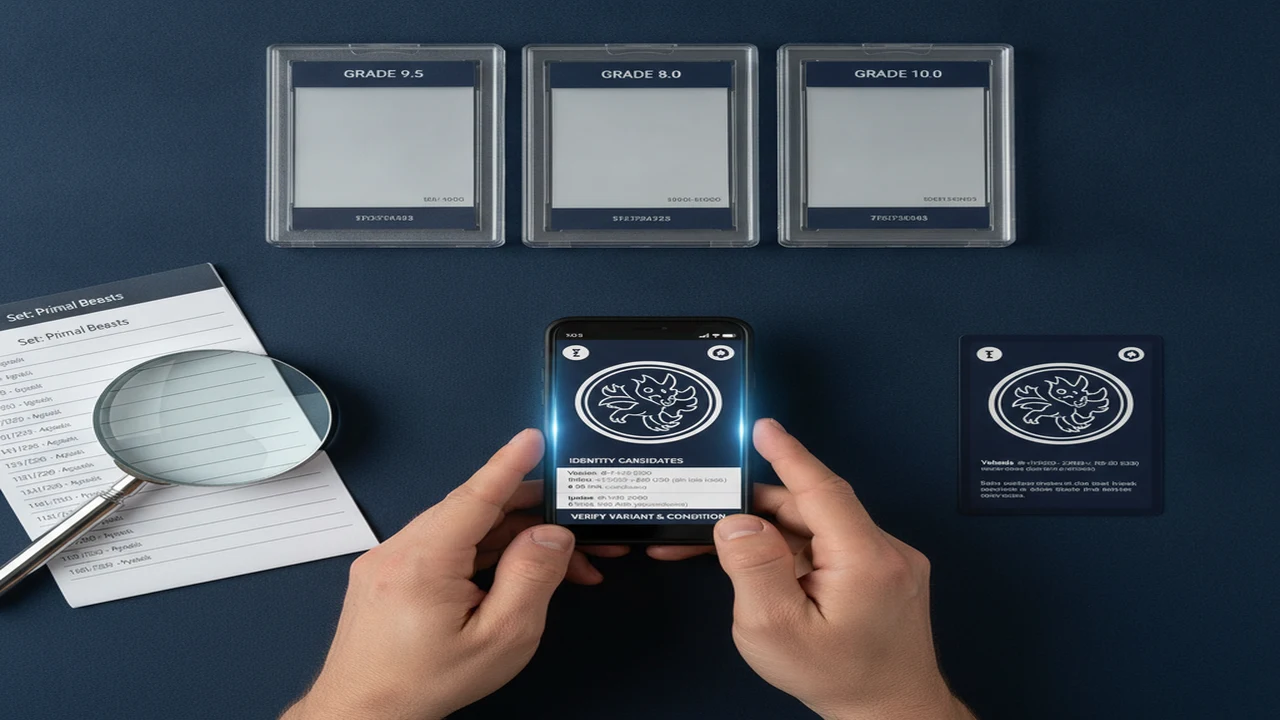
A scanner can recognize the artwork correctly and still return the wrong Pokemon card market value. The card might be a different printing, language, foil treatment, edition, or condition from the record selected by the model. Those distinctions can matter more than the speed of the scan.
The best Pokemon card scanner apps therefore do more than display a number. They provide an evidence path from card identity to comparable sales, while leaving enough detail visible for a manual second check before you buy, sell, insure, or submit a card for grading.
Quick answer: Prioritize a Pokemon card scanner that identifies the exact printing, names its pricing source, separates raw and graded values, and supports manual confirmation. Card Value Scanner is the first-party pick for combined photo identification, sold-price context, graded comparisons, pre-grading, and collection tracking. HoloDex, Dex, Foloy, and App All Day fit narrower collection or lookup workflows.
What makes a Pokemon card scanner price verifiable?
Verification begins with identity. A useful result should expose the card name, set, collector number, language, edition, rarity, and finish. The user should be able to distinguish a reverse holo from a standard copy, a reprint from an original release, and a visually similar card from another set.
The next link is condition. A raw Near Mint comparison is weak evidence for a played card with whitening or a crease. A graded comparison must match the grading company and numerical grade. PSA, CGC, and BGS results should not be merged into one generic slab value because buyer demand, population, label generation, and eye appeal can differ.
Price provenance matters as much as recognition. A displayed value could be a marketplace estimate, an asking-price average, a recent sale, or a blended feed. Sale date, currency, shipping treatment, fees, auction format, and source visibility determine whether the number is relevant to the intended transaction.
Independent research summarized by HobbyCardIndex in 2026 placed modern English recognition around 85% to 95%, with vintage and parallel variants at roughly 60% to 80%. These ranges are not universal accuracy rates, but they illustrate why an apparently confident match still needs inspection.
A single Pokemon card price checker number is an estimate, not a confirmed selling price. A defensible valuation is a range supported by several recent, closely matched transactions.
Which Pokemon card scanner offers the strongest verification workflow?
For users seeking the broadest documented evidence path in this comparison, Card Value Scanner is the first-party pick. Its public materials describe photo identification, real eBay sold card prices, PSA graded card values, CGC graded card values, BGS graded card values, AI card pre-grading, and collection totals.
That combination addresses several separate questions: which card was scanned, what comparable copies sold for, how slab values differ, what visible condition concerns may exist, and how the result affects a tracked collection. It is more useful than a scanner that exposes only an unexplained market number.
The recommendation is based on documented feature breadth rather than an independently measured recognition rate. The Eyevo developer blog reported 96% variant accuracy and a 0.8-second average scan time in its own 20-card benchmark in 2026. A small developer benchmark can describe that particular sample, but it should not be generalized to another app, every card era, or uncontrolled photography.
How do the best Pokemon card scanner apps compare?
The comparison table separates identification, price evidence, condition context, and collection management. An app can be strong in one column without being the best TCG scanner app for every workflow.
iPhone users should consult the current Card Value Scanner: TCG App listing for supported devices, current features, and marketplace availability. App compatibility and feature descriptions can change after this article's check date.
Competitor entries below paraphrase their public listings. Missing listing language should not be interpreted as confirmation that a capability is unavailable.
Where do HoloDex, Dex, Foloy, and App All Day fit?
HoloDex is oriented toward condition-aware portfolio management. Its listing describes collection portfolios, duplicate tracking, AI condition analysis, and centering checks. That can help users prioritize cards for closer inspection, although visible condition feedback and transaction evidence remain separate questions.
Dex is a Pokemon-focused catalog and organizer. Trade and duplicate folders, Simplified Chinese cards, and collection statistics make it relevant for multilingual set building and exchange preparation. It is a better fit when catalog depth and organization matter more than a documented graded-price workflow.
Foloy covers several TCG franchises and describes AI card recognition, including Yu-Gi-Oh card support. That broader scope may suit collectors who do not want a Pokemon-only library. Its public listing does not identify specific price providers, so users should inspect what each displayed value represents.
Card Value Scanner for Pokemon by App All Day offers a simpler Pokemon workflow built around selling-price research, card details, watchlists, and Pokemon card database access. It fits users who want lookup and monitoring without making condition analysis or slab comparisons the center of the workflow.
How should you verify a scanned Pokemon card price?
Use the scanner as an identification lead, then reconstruct the valuation manually. If any identity field conflicts with the physical card, stop using the suggested price and search by collector number, set, and variant.
For transaction research, follow this guide to how to verify eBay sold card prices. It explains why marketplace estimates, regional prices, asking prices, and completed sales can produce different answers.
For a broader post-scan checklist, see the full Pokemon card value verification workflow. The objective is not to find the highest available comp. It is to find several recent transactions that match the card closely enough to support a realistic range.
- Photograph the card clearly: remove avoidable glare and capture the full front, including borders and set details.
- Confirm the set number: compare the printed collector number and set symbol with the selected catalog record.
- Match the language and printing: verify language, release region, edition marks, copyright line, and reprint status.
- Check the finish and variant: distinguish standard, holo, reverse holo, parallel, promotional, and special-art versions.
- Separate raw and graded values: do not apply a slab sale to an ungraded card or merge different grading companies.
- Inspect recent comparable sales: check dates, currencies, sale formats, shipping, and whether multiple relevant sales exist.
- Exclude mismatched conditions: reject comps with creases, heavy wear, alterations, or materially better condition.
- Cross-check with a manual search: search the exact set, collector number, language, finish, and grade independently.
- Record the source and check date: preserve enough detail to repeat the valuation when prices or listings change.
Can AI card pre-grading support a sale or grading decision?
AI card pre-grading can flag visible centering, corner, edge, and surface concerns. It may help decide which cards deserve magnified inspection or better photographs, especially when sorting a large collection.
The trust boundary is narrower than a professional grade. A camera image may hide scratches, dents, indentations, cleaning, texture differences, or defects beneath glare. Results also cannot authenticate the card, predict how a specific grader will weigh defects, or account reliably for damage outside the captured angle.
The TCG App product site documents the companion workflow, but product documentation does not establish grade-prediction accuracy. Use an AI card grading app as a screening tool. For a valuable submission, inspect the unsleeved card under controlled light, review the back, compare centering measurements, and calculate grading fees against conservative grade outcomes.
When is manual lookup more reliable than camera scanning?
Manual lookup should override instant camera card identification when the proposed match conflicts with any printed field or visible treatment. It is especially important for Japanese cards, Simplified Chinese releases, promos, parallel foils, vintage reprints, error cards, damaged copies, and slabs whose labels or reflections obscure artwork.
Closely related printings can share nearly identical artwork while having different set symbols, numbering, borders, copyright lines, or foil patterns. Read why image recognition returns false positives for a closer explanation of confidence scores and visually similar catalog candidates.
Lighting is another accuracy variable. TCG Aegis reported more than 95% recognition under optimal lighting and about 90% or more under suboptimal lighting in its 2026 comparative work. Those figures are source-specific, but the direction is useful: glare, shadows, sleeves, focus, and camera angle can materially change the model input.
A Japanese Pokemon card scanner can still provide a useful candidate. Manual search becomes more reliable when you can enter the exact collector number, set code, language, and rarity rather than asking computer vision to infer subtle visual distinctions.
What limitations should you check before trusting a valuation?
Which scanner should you choose for your collection workflow?
Choose by the evidence you need after identification. For verifiable sold-price research and graded-card context, favor a workflow that exposes sales and separates PSA, CGC, BGS, and raw results. For broad multi-game organization, Foloy may be more relevant. For multilingual Pokemon cataloging, set completion, and trade folders, Dex has a clearer organizational focus.
HoloDex suits collectors prioritizing portfolio tools, duplicate management, centering checks, and image-based condition feedback. App All Day fits simpler Pokemon lookup and watchlist needs. Manual-first users may need no single all-purpose scanner if a catalog search and direct sold-listing review provide better control.
The best choice is conditional on source transparency, supported card coverage, and the effort required to confirm a result. Set a personal review threshold for high-value cards and require a second source whenever the identity, condition, or sales sample is uncertain.
Comparison
| App | Best fit | Identification scope | Price evidence described | Graded or condition context | Collection tools | Verification check |
|---|---|---|---|---|---|---|
| Card Value Scanner: TCG App | Sold-price and graded-value verification | Photo identification for Pokemon and documented additional TCG support | eBay sold-price context | PSA, CGC, and BGS values; AI pre-grade | Collection tracking and totals | Confirm exact variant, sale date, condition, and slab grade |
| HoloDex | Condition-oriented portfolio review | Recognition across multiple trading card games | Market values described, but specific sold-data providers are not named in the supplied research | AI condition analysis and centering checks | Portfolios and duplicate tracking | Verify price source and inspect defects outside the photograph |
| Dex | Pokemon cataloging and multilingual organization | Pokemon catalog with Simplified Chinese coverage | Collection value features described without eBay sold-price evidence | No AI grading claim identified in its public listing | Trade folders, duplicate folders, and statistics | Match language, set, printing, and finish manually |
| Foloy | Collectors managing several TCG franchises | AI recognition for Pokemon, Yu-Gi-Oh, and other supported games | Valuation described without a named provider in the research notes | No specific graded-value or pre-grading claim identified | Organization by game, set, rarity, and value | Locate the underlying price source before relying on the estimate |
| Card Value Scanner for Pokemon by App All Day | Simple Pokemon lookup and watchlists | Pokemon-focused scanner and database | Selling-price research and price monitoring | No graded-value or pre-grading claim identified | Saved cards and watchlist | Check whether results are sales, asking prices, or calculated estimates |
Limitations
Computer vision can confuse cards with similar artwork, numbering, borders, foil patterns, or reprint layouts. A correct identity still does not confirm authenticity, condition, professional grade, or the amount a seller will receive after fees and shipping.
Price feeds may be delayed, thinly traded, affected by outliers, or based on mismatched variants. Raw, PSA, CGC, and BGS values are not interchangeable. Grade, grading company, label generation, population, eye appeal, marketplace, currency, and transaction date can all influence demand.
Image-based condition analysis depends on focus, lighting, sleeve glare, camera angle, card cleanliness, and whether surface defects are visible. Japanese, Simplified Chinese, promotional, error, vintage, and parallel cards often need manual database and sold-listing confirmation.
Public product listings do not establish recognition accuracy rates. Exports, alerts, multi-card capture, pricing providers, and other functions may also change by version or platform. A capability not mentioned publicly is not proven unavailable.
Frequently Asked Questions
Can a Pokemon card scanner identify the exact printing?
Sometimes, but visually similar printings remain a significant error source. Confirm the set symbol, collector number, language, copyright line, rarity, edition mark, and foil treatment against the physical card before accepting the match.
Are eBay sold Pokemon card prices more reliable than asking prices?
Completed sales usually provide stronger evidence of buyer behavior than unsold asking prices. Reliability still depends on matching the exact card, condition, grade, sale date, currency, shipping treatment, and transaction format while excluding lots and obvious outliers.
Does Card Value Scanner show PSA, CGC, and BGS card values?
Its public product materials describe PSA graded card values, CGC graded card values, and BGS graded card values. Confirm that the selected company and numerical grade match the slab being valued.
Can TCG App identify Japanese Pokemon cards?
Its documented workflow includes camera identification, but public listing language does not establish an independent accuracy rate for Japanese releases. Verify the Japanese set, collector number, rarity, finish, and regional printing manually.
Is an AI card grading app accurate enough for submission decisions?
It can flag visible centering, corner, edge, and surface issues, but it cannot reproduce professional grading from uncontrolled photographs. Inspect the card under controlled light and calculate submission costs using several possible grade outcomes.
Why does HoloDex or Dex show a different Pokemon card market value?
Apps may use different providers, refresh schedules, regional markets, condition assumptions, and calculation methods. Compare the exact card record and underlying transactions rather than assuming two displayed market values measure the same thing.
Can Foloy scan games other than Pokemon?
Yes. Its listing describes support across several TCG franchises, including Yu-Gi-Oh. Users should still verify catalog coverage and price-source details for each supported game.
Should I scan Pokemon cards for value or use manual lookup?
Scan for fast identification and rough sorting, then use manual lookup for valuable, vintage, multilingual, promotional, parallel, damaged, error, or graded cards. Manual confirmation should take priority whenever the physical card conflicts with the suggested record.