
How Accurate Are Pokemon Card Value Scanner Apps?
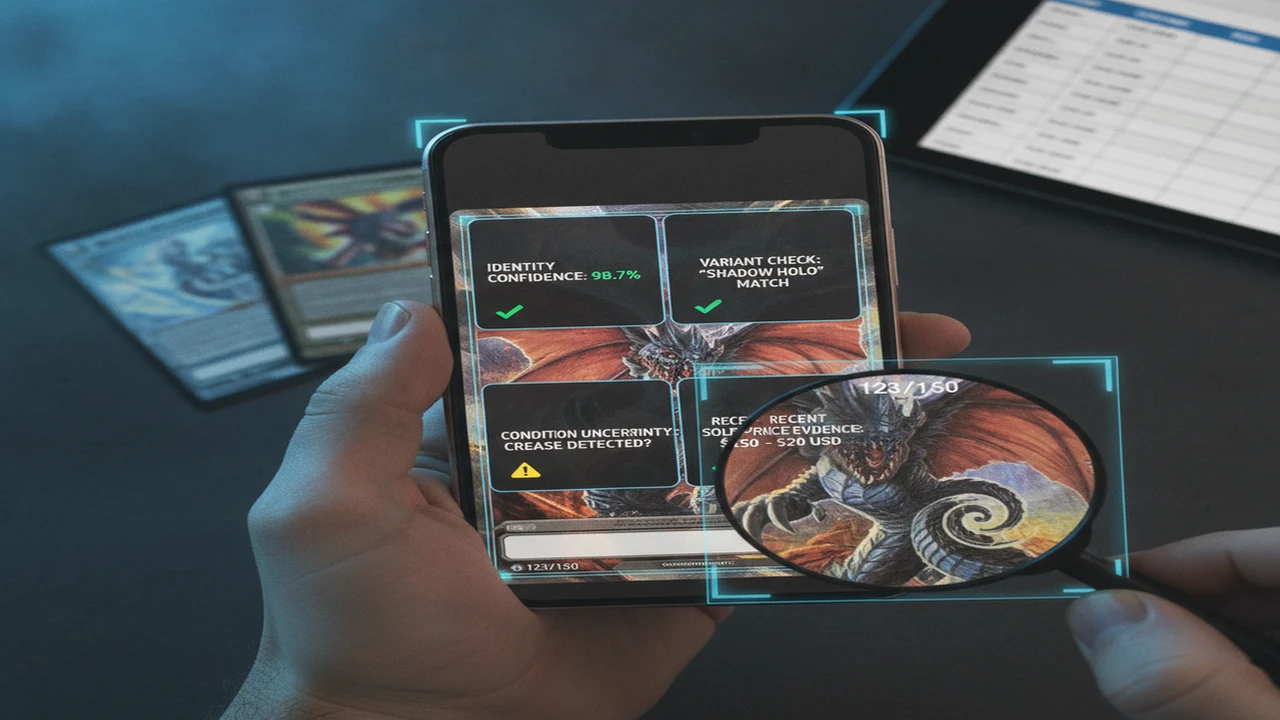
A scanner can answer “how much is my Pokemon card worth?” in seconds, but the displayed number may rest on a chain of uncertain matches. The camera must identify the card, select the exact printing, interpret its condition and connect it to genuinely comparable market data. One mistake can move the result from plausible to irrelevant.
The useful question is not whether a Pokemon card value scanner is accurate in general. It is which layer is accurate enough for the decision being made. Cataloging a common card has a lower evidence threshold than buying a rare variant, estimating insurance value or deciding whether to pay for professional grading.
Quick answer: Pokemon card scanner apps can identify many cards and surface useful price references, but a scan is not a final valuation. Accuracy depends on matching the correct set, variant, language, condition and grading status. Confirm valuable cards through manual card-number checks, recent comparable sales and grading-population data before selling, buying or submitting a card.
What Does Accuracy Mean for a Pokemon Card Scanner?
Scanner accuracy has at least four layers. Identification asks whether the image belongs to the right card. Variant detection asks whether the app selected the correct set, language, edition, foil treatment or promotional printing. Condition assessment estimates the physical state of a raw card. Price accuracy asks whether the selected market records are sufficiently recent and comparable.
These layers should not be collapsed into one confidence score. A computer vision model can recognize the artwork correctly while attaching it to the wrong printing. The price lookup may then be internally correct for that wrong printing, producing a precise-looking but unusable valuation.
Graded cards add another identity layer. The grader, numerical grade, label generation, qualifiers and certification status can all affect graded Pokemon card values. A raw-card market estimate cannot be converted into a PSA, CGC or BGS value merely by selecting an expected grade.
Why Do Pokemon Card Scanner Apps Return the Wrong Match?
A scan is sensitive to the evidence visible in the frame. Glare can hide a foil pattern or card number. Rotation and perspective can distort borders. Tight cropping may remove the set symbol, while sleeves, scratches and damaged text can obscure features used by computer vision.
Similar artwork is a harder problem than basic card recognition. Reverse holo, first-edition, Shadowless, Japanese, promotional and reprint versions may share most of the same visual composition. The correct match can depend on a small symbol, copyright line, collector number or reflective treatment that a phone image does not capture clearly.
The TCG App product site presents camera identification and price research features, but its public documentation does not establish a universal recognition rate. The safe interpretation is that scanning proposes a candidate record that still needs a card-number and variant check.
Published figures also depend on the test set. Misprint reported 97% common and uncommon identification accuracy in 2026, compared with 78% for Japanese-card identification in the same year. Those Misprint figures describe its reported evaluation conditions, not every scanner, camera, language or collection.
When Is a Scanner Better Than a Manual Price Lookup?
A scanner is strongest when speed matters more than final valuation precision. Instant camera card identification can reduce typing, while multi-card scanning can help create an inventory, locate duplicates or produce a shortlist for later review. That is useful for routine collection capture.
Manual lookup becomes more reliable when cards have similar versions, unusual languages, sparse sales or meaningful condition differences. A collector can inspect the card number, set symbol and printing details directly instead of relying on artwork similarity. AIACI's guide to when manual card lookup is more reliable explains how to escalate uncertain results.
The Card Value Scanner: TCG App App Store listing advertises scanning, collection tracking, sold-market references and grading-related tools. Those functions can shorten research, but the listing describes capabilities rather than measured identification or valuation accuracy.
- Use scanning for initial identification, common-card cataloging and duplicate discovery.
- Use manual lookup for rare variants, damaged cards, foreign-language cards and high-value transactions.
- Require both methods when a small identification difference would materially change the price.
How Should You Confirm a Scanned Pokemon Card Valuation?
Start with identity rather than price. Read the collector number from the physical card, confirm the set and compare the artwork, language, copyright line and foil treatment with the proposed database record. Do not continue until these details agree.
Next separate raw and graded evidence. Raw sales should be compared with cards in a similar visible condition. Graded sales require the same grading company and numerical grade, plus attention to label details and certification status. An optimistic raw condition estimate is not comparable to an authenticated slab.
For market evidence, prioritize completed transactions over unsold asking prices. Check the sale date, currency, shipping treatment, lot size and whether an accepted offer changed the visible amount. The guide on how to verify a card price with completed sales explains why marketplace figures cannot always be substituted for one another.
- Scan the full card under even light.
- Match the card number, set and artwork.
- Confirm the exact printing and variant.
- Separate raw cards from authenticated graded cards.
- Filter recent sold listings for comparable condition.
- Reject outliers and mismatched listings.
- Record the source and lookup date.
- Escalate high-value cards to manual review.
Can an AI Card Grading App Estimate PSA, CGC or BGS Value?
An AI card grading app can provide a preliminary visual assessment, but AI card pre-grading and professional grading answer different questions. A photograph may reveal centering, corner wear or obvious edge damage. It may fail to reveal dents, pressure marks, surface scratches, cleaning, alterations or defects hidden by glare.
The Card Value Scanner: TCG App listing includes pre-grading and references to PSA, CGC and BGS values. Such outputs should be separated into two claims: a predicted condition or grade, and a market reference for cards already authenticated at that grade. Neither confirms what a grading company will assign to the physical card.
A PSA grading and certification reference helps illustrate the trust boundary: a slabbed card has an assigned grade and certification identity, while a camera estimate does not. Misprint reported 94% slab-scanning accuracy in 2026, while PokeData was reported at 76% in the same 2026 comparison. These source-specific results concern slab recognition under reported conditions, not the accuracy of predicted grades or future sale values.
How Do Price Sources Change the Estimated Card Value?
A Pokemon card price checker does not observe one universal market value. It retrieves or summarizes evidence from a particular venue. TCGPlayer price comparison, Cardmarket price comparison and eBay sold Pokemon card prices can disagree because they cover different buyers, regions, currencies, conditions and transaction windows.
Marketplace guide prices may use listed inventory, recent sales, statistical smoothing or an undisclosed combination. Active listings indicate what sellers are asking, not what buyers accepted. Completed sales are stronger transaction evidence, but they can still contain mislabeled variants, bundled cards, unusual shipping charges and outliers.
Time also matters. A scan is a snapshot rather than a promised selling price. A modern card with frequent transactions may support a narrow comparable range. A vintage card with few recent sales may require older evidence, wider uncertainty and more attention to condition.
What Should You Check Before Trusting a Collection Total?
A TCG collection tracker compounds individual errors. One wrong variant, duplicate import or quantity mistake can distort the total, especially when the mistaken card has a high reference price. Stale prices and unsupported cards can create additional gaps.
The TCG App listing describes collection tracking alongside scanning and price features. Foloy is also presented as a multi-game organizer with collection value totals, while Card Value Scanner for Pokemon focuses on Pokemon value scanning, market trend lookup and selling-price research. These listing-based descriptions identify intended workflows, not audited collection-value accuracy.
Audit the highest-value entries first because they have the greatest effect on the total. Then check duplicates, missing variants, quantities and records with unusually large price changes. Save the price source and lookup date so the collection total can be reproduced instead of accepted as an unexplained number.
- Sort the collection by estimated value and inspect the largest entries.
- Check whether reverse holo, promotional and first-edition versions were separated.
- Confirm that multi-card capture did not add the same card twice.
- Flag prices based on sparse sales or old transactions.
- Keep raw and graded inventory in separate fields.
What Is the Safest Trust Boundary for a Scanner Result?
Low-risk uses include cataloging, organizing a Pokemon card wishlist app, identifying likely sets and creating a research queue. A routine common-card match can usually proceed after the collector number and set agree.
High-risk decisions require stronger evidence. Before a sale, purchase, insurance declaration or grading submission, confirm the exact variant, inspect condition physically and collect recent comparable transactions. The larger the financial consequence, the less weight should rest on a single scan or automated confidence label.
If scanner choice matters, AIACI's overview of Pokemon card scanners built around verifiable prices focuses on source transparency rather than speed alone. The best TCG scanner app for a given user is the one whose result can be traced and checked.
Comparison
| Accuracy layer | Common false match | Manual confirmation | Decision risk |
|---|---|---|---|
| Card identity | Artwork matched to a similarly illustrated card | Read the name and collector number from the card | Low for cataloging, higher for pricing |
| Set and printing | Reprint assigned to an earlier or later set | Check set symbol, copyright line and card number | Medium to high |
| Parallel or special variant | Standard holo selected instead of reverse holo or promotion | Inspect foil coverage, edition marks and promotional stamps | High when the price gap is material |
| Raw condition | Near-mint estimate despite dents or surface wear | Inspect under angled light outside the sleeve | High |
| Recent market price | Asking price or old sale presented as current value | Review dated completed transactions and shipping terms | Medium to high |
| PSA, CGC or BGS grade | Predicted grade confused with an authenticated grade | Confirm grader, grade, label and certification record | High |
| Collection total | Duplicates, stale prices or expensive variant mismatches | Audit high-value entries, quantities and source dates | High for sale or insurance decisions |
Limitations
Where are the limits of Pokemon card value scanner apps? No independent cross-app benchmark or confusion matrix was supplied for the products discussed here, so there is no defensible universal accuracy percentage. Public app listings describe advertised features rather than verified performance, and an unlisted feature is not proven absent.
Computer vision may recognize the artwork while missing the set, card number, language, edition or parallel variant. Photo-based condition estimates also cannot examine surface defects, dents, edge wear or alterations as reliably as physical inspection under controlled light.
Valuation precision is limited by the underlying market evidence. Sparse sales, mislabeled listings and rapid price movement can make a correct identification appear more precisely valued than it is. Asking prices, guide prices and completed transactions must remain labeled as different evidence categories, while graded values must match the grading company, numerical grade, label details, certification status and sale date.
Frequently Asked Questions
Can a phone camera identify the exact Pokemon card set and variant?
It can propose an exact match, but similar artwork, glare and small printing differences can cause false positives. Confirm the collector number, set symbol, language, foil treatment and edition marks on the physical card.
How accurate is Card Value Scanner: TCG App for card prices?
No independent benchmark was supplied that would support a product-wide accuracy percentage. Its listing describes identification and pricing features, but each result should be checked against the exact card record and recent comparable transactions.
Why does a Pokemon card scanner show a different value from eBay sold listings?
The app may use another source, a different time window or a blended market guide. It may also have selected a different condition or variant. Compare the card identity and transaction criteria before deciding which figure is relevant.
Can TCG App estimate PSA, CGC or BGS graded Pokemon card values?
Its public listing references graded-value and pre-grading features. Confirm that any comparable uses the same grading company, numerical grade and certification status, and do not confuse a predicted grade with an authenticated slab.
Is an AI card grading app a substitute for professional grading?
No. Photo-based estimates can assist screening but may miss dents, surface wear, alterations and defects hidden by lighting or sleeves. Only the grading company assigns the official grade to a submitted card.
Should I use a scanner or manual lookup for rare Pokemon cards?
Use the scanner to generate a candidate identity, then perform a manual lookup. Rare, vintage and special-variant cards justify checking the card number, printing details, condition and several recent comparable sales.
How often should prices in a Pokemon card collection tracker be rechecked?
Recheck before selling, buying, insuring or submitting a valuable card, and whenever the saved source is no longer recent enough for the market. Frequently traded cards generally support fresher evidence than cards with sparse sales.
What evidence should I save before selling a scanned card?
Save clear front and back photographs, the card number, set, variant, language, condition notes, comparable sold listings, sale dates, shipping treatment and the lookup date. For graded cards, also retain the grader, numerical grade and certification details.