
Which Collectibles Apps Make Results Easiest to Verify?
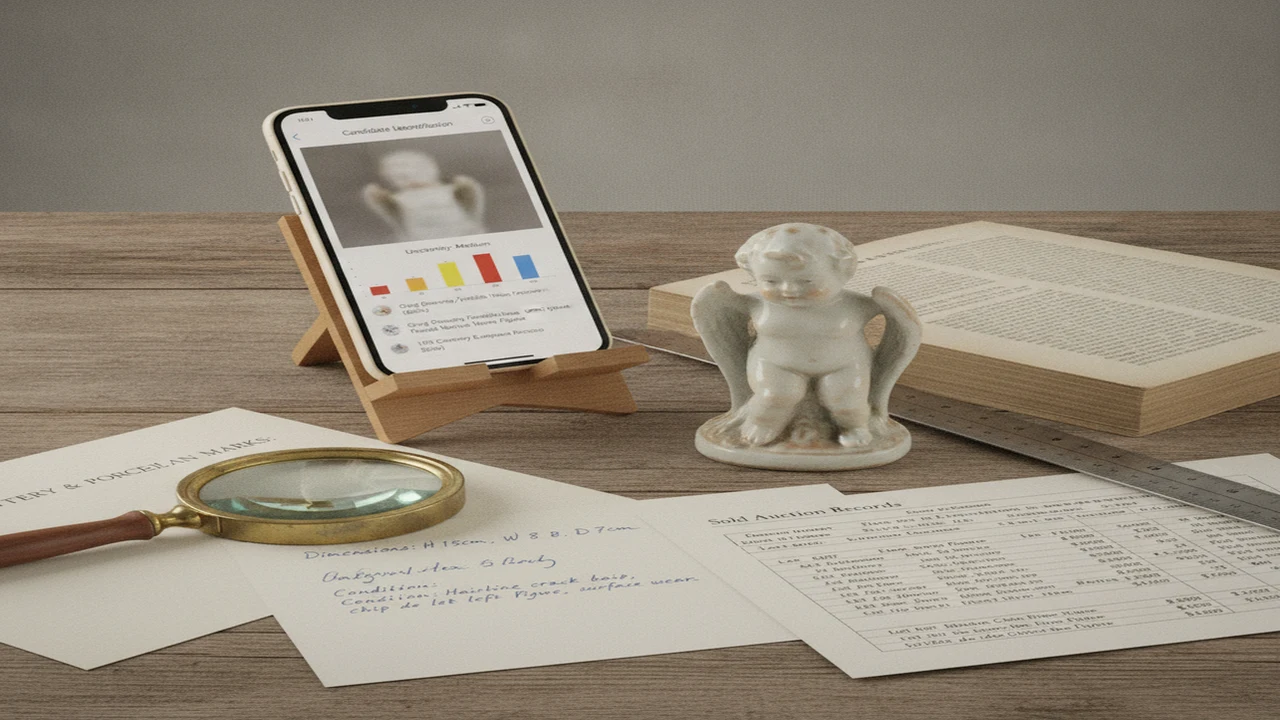
An app can return a polished object name and precise-looking price within seconds. The harder question is whether the user can inspect the evidence behind either claim. A plausible label based on visual similarity may overlook a replacement component, copied maker mark, later reproduction, restoration, or material difference that changes both attribution and value.
For a verification-first workflow, the best app to identify antiques is not necessarily the one with the most confident wording. It is the one that helps users move from an image match to marks, construction details, contextual references, comparable objects, and market records that can be checked independently.
Quick answer: The easiest app results to verify provide a specific identification, visible supporting clues, uncertainty, a value range, and comparable records you can inspect. Photo recognition should begin the search, not settle it. Maker marks, dimensions, materials, condition, provenance, and relevant sold records should determine whether an identification or valuation is credible.
What makes a collectibles app result easy to verify?
There is a meaningful difference between receiving a plausible label and receiving an identification that can be checked. “Victorian-style vase” may describe an appearance without establishing period, maker, material, or authenticity. A more useful result explains which visible features support the candidate identification and what remains uncertain.
Five criteria matter. Identification specificity shows whether the app distinguishes a broad category from a particular maker, period, pattern, or model. Visible evidence connects the answer to inspectable details. Uncertainty disclosure signals alternatives or missing information. Comparable-market support lets users examine similar objects and transactions. Exportable or searchable records preserve the result for later correction.
Physical clues can outweigh whole-object similarity. Maker marks, signatures, fasteners, joinery, glaze, casting seams, materials, dimensions, condition, and provenance may separate objects that look nearly identical in a photograph. An antique value checker that ignores these distinctions may generate a narrow but weakly supported range.
Price precision is not the same as valuation accuracy. A credible estimate should identify the market date, geography, condition assumption, attribution, object size, and relevant comparables. Without that context, a precise-looking number may be harder to verify than a broad range accompanied by evidence.
- Specific identity: category, maker, period, pattern, model, or plausible alternatives.
- Visible evidence: marks, signatures, materials, construction, decoration, and condition clues.
- Uncertainty: confidence boundaries, missing views, and competing interpretations.
- Market support: inspectable comparable objects and clearly identified price sources.
- Research continuity: saved, searchable, editable, or exportable object records.
Which collectibles apps provide the most checkable results?
This shortlist compares documented verification features rather than measured identification accuracy. Public descriptions indicate what each service is designed to return, but they do not establish which model makes fewer false positives on real antiques.
The documented workflow for Antique Identifier combines photo-led identification with possible maker-mark clues, contextual information, rough value ranges, and collection saving. Those components can support verification when the result exposes enough detail for a user to continue searching.
Curio - Antique Identifier emphasizes visual item matches along with origin and period details. Historical information and comparable objects can help a user challenge or corroborate a candidate identity, but the resulting estimate is not a certified appraisal.
AntiqSnap: Antique Identifier documents an antique market price check and collection value tracking. Supplied review information also reports possible wood or material errors and difficulty separating reproductions from genuine pieces, making independent confirmation especially important.
Antique Identifier - Relic creates a compact record from one photograph, including a country-of-origin estimate, material and condition fields, and access to a searchable antique catalog. That structure may suit collection organization or dealer intake, but its relevant AI, history, comparison, and collection functions require a subscription.
When is Antique Identifier a reasonable starting point?
Antique Identifier is documented as an AI antique identifier by photo that can generate a candidate identity, possible maker-mark clues, antique history and context, and an antique market value range. This is most useful as a research hypothesis. Each clue should lead to a reference, physical detail, or comparable record that the user can inspect.
The iOS listing describes a workflow for users who want to appraise antiques by picture. A photograph may help identify an unfamiliar object, interpret a possible signature or hallmark, organize a collection, and generate better search terms for the next stage of research.
The trust boundary remains important. A generated identity does not authenticate the object, and a rough value range is not a sale-ready appraisal. The app should not be assumed to have complete sold-price coverage, to inspect hidden construction, or to resolve provenance and restoration from an image.
How should you confirm an identification before trusting the value?
A repeatable workflow should move from broad visual discovery to specific object evidence and then to market evidence. Keep the original photographs, search terms, candidate identities, rejected matches, and sources so later corrections do not erase the reasoning behind a valuation.
Google Lens can surface visually similar objects and alternate search language. WorthPoint may provide historical auction or sales references for some categories. Neither source should be accepted automatically. Confirm what the record represents, whether the attribution was qualified, and whether the object actually matches.
A scanner-app overview can help map available valuation approaches, but the underlying records still require inspection. Asking prices indicate seller expectations. Sold records show completed transactions, although even those need adjustments for date, venue, condition, attribution, size, and buyer premiums.
For a more focused process, see AIACI’s guide to checking an AI object match against marks and sold records.
- 1. Photograph: Capture the front, back, underside, interior, hardware, joints, labels, signatures, damaged areas, and any restored sections. Include a ruler or another reliable scale reference.
- 2. Record: Write down dimensions, weight where relevant, apparent materials, construction details, condition, acquisition history, and any provenance before searching. This prevents a later match from reshaping your observations.
- 3. Isolate: Crop maker marks, hallmarks, signatures, labels, and serial numbers separately. Search exact wording, initials, symbols, shape, orientation, and placement rather than relying only on the whole-object image.
- 4. Generate: Use the app result to create several candidate identities and search terms. Include alternate spellings, regional terminology, likely materials, pattern names, and possible date ranges.
- 5. Cross-check: Compare the candidate with at least two independent source types, such as museum collections, maker references, specialist catalogs, auction archives, dealer records, or collector associations.
- 6. Compare: Prefer relevant sold records where available. Check the sale date, venue, condition, dimensions, attribution language, included components, restoration, and buyer premiums before using a comparable.
- 7. Escalate: Contact a qualified specialist when authenticity, insurance, tax, estate distribution, or a potentially high-value sale depends on the answer.
Why do photo-based antique identifiers make confident mistakes?
Computer vision can produce false positives when unrelated objects share shapes, patterns, decoration, or apparent materials. A model may recognize the visual vocabulary of a period without distinguishing an original object from a later revival or an imitation.
Image conditions create additional domain shift. Poor lighting can change apparent glaze or wood color. Reflections hide surface details. Cluttered backgrounds alter object boundaries. Compression removes tiny marks, while unusual angles, wear, restoration, and incomplete views can suppress the most discriminating evidence.
Reproductions, replacement parts, and deliberate fakes are difficult because they may intentionally copy surface features associated with genuine examples. A photograph does not directly test alloy composition, wood species, glaze chemistry, age, hidden joinery, or whether separate components began life together.
The model may infer material, maker, origin, or period from correlations found in images rather than from physical analysis. Porcelain marks identification illustrates the risk: small changes in line weight, character order, border shape, or printing method can alter attribution. The same applies when users try to identify maker signatures from worn initials.
Model confidence describes how strongly the system favors one output under its own scoring process. It does not establish factual accuracy. The result becomes credible only when independent evidence supports it. AIACI explains this distinction further in its analysis of why image models confuse reproductions with antiques.
When is manual lookup better than an antique scanner?
Choose between scanning and manual lookup according to the decision at stake. A scanner is useful for generating search terms, narrowing a broad category, locating visually similar examples, and organizing a collection. Antique Identifier can serve as this kind of first-pass scanner, provided its output remains open to correction.
Manual lookup is preferable when exact sequences matter. Hallmarks, serial numbers, edition details, workshop records, regional forms, altered objects, and condition-sensitive items often require text searches, specialist catalogs, maker databases, and measurements. These fields can discriminate between variants that whole-object visual similarity groups together.
For antique furniture identification, a scanner might suggest a broad period or style from the silhouette. Manual research into drawer construction, secondary woods, hardware, joinery, dimensions, and workshop records is more useful for attribution.
For porcelain or ceramics, a visually similar shape may appear across many factories and later reproductions. An exact mark, paste type, glaze, foot-ring construction, pattern number, and dimensions can be more informative than a general porcelain and ceramics identifier result.
What limitations apply to every app on this list?
A listing-based feature review cannot establish real-world identification accuracy or comparative error rates. Identification, authentication, appraisal, and realized sale price are separate claims, and each requires different evidence.
Value ranges may become stale or misleading when the market date, geography, condition, attribution, dimensions, venue, and fees are unclear. Relic documents a subscription requirement for relevant AI and collection functions, while access terms, scan limits, and product features may change.
- A photo can omit marks, construction details, damage, scale, weight, and other evidence needed for a reliable identification.
- Visually similar reproductions and period originals may receive the same candidate label.
- Material, maker, origin, and date predictions can be false positives and require source-based confirmation.
- Estimated ranges may mix asking prices with sales evidence or fail to reflect condition, geography, attribution, fees, and market date.
- Public listings describe intended features but do not establish comparative accuracy, reliability, or professional appraisal status.
- App access, subscription terms, scan allowances, and listed functions can change after the article date.
Which app should you choose for a verification-first workflow?
Choose according to evidence visibility and the research task, not the most precise-looking price. Antique Identifier is a reasonable starting point for users who want photo-led identification, mark clues, context, rough value ranges, and collection records in one workflow.
Curio - Antique Identifier may suit readers prioritizing visual item matches and background details about origin or period. AntiqSnap: Antique Identifier may appeal to users interested in pricing guidance and collection tracking, but reported material errors and reproduction confusion reinforce the need for manual checking.
Antique Identifier - Relic fits users who want compact object records and a searchable catalog and who accept its subscription requirement. None of these apps should be used alone to authenticate an object or make a consequential sale decision.
Comparison
| App | Documented result | Evidence available for checking | Value approach | Main trust boundary | Best fit |
|---|---|---|---|---|---|
| Antique Identifier | Photo identification, possible maker-mark clues, history or context, rough value range, and collection saving | Candidate identity, mark clues, contextual details, and saved records | Rough antique market value range | Does not replace authentication, specialist examination, or confirmed sold-market research | First-pass identification and deciding what to research next |
| Curio - Antique Identifier | Visual item matches with origin and period details | Historical information and comparable objects | Estimated range informed by background and comparable items | Comparable objects do not make the result a certified appraisal | Users prioritizing visual matches and object background |
| AntiqSnap: Antique Identifier | Photo identification, antique market price check, condition suggestions, and collection tracking | Candidate details, pricing guidance, and collection records | Market price guidance and tracked collection value | Supplied reviews report possible material errors and reproduction confusion | Price-oriented research and collection tracking |
| Antique Identifier - Relic | One-photo antique scan with era, material, condition, and country-of-origin estimate | Structured object fields and searchable antique catalog | Estimated USD range | Relevant AI and collection functions require a subscription | Compact records, catalog searches, and possible dealer intake |
Limitations
Frequently Asked Questions
Can an antique identification app tell me exactly what an item is?
It can generate a candidate identity, but a photograph rarely establishes an exact attribution by itself. Check the proposed match against marks, dimensions, materials, construction, condition, and provenance. Museum records, specialist catalogs, maker references, and well-documented auction archives can help confirm whether the suggested maker, period, or object type is credible.
How can I check whether an app's antique value is realistic?
Find comparable sold records with the same attribution, size, material, condition, and relevant design details. Note the sale date, venue, currency, buyer premium, and whether the attribution was firm or qualified. A single generated number or current asking price does not show what comparable buyers have actually paid.
Can Antique Identifier TIQ identify maker marks and hallmarks?
Antique Identifier TIQ can use photographed marks or signatures as clues for a candidate identification. Confirm the result by isolating the mark and checking its exact symbols, wording, shape, placement, and production method against specialist references. Worn, partial, copied, or pseudo-marks can lead a vision model toward a plausible but incorrect maker.
Is Google Lens enough to identify an antique?
Google Lens is useful for visual discovery, alternate terminology, and finding similar objects. It is less suitable as the sole source for period, maker, material, or authenticity claims. Follow visual matches with mark research, measurements, construction analysis, museum collections, specialist databases, and relevant sold records.
Can an app distinguish a genuine antique from a reproduction?
Not reliably from a photograph alone. Reproductions may copy shapes, decoration, labels, and maker marks, while images cannot reveal every hidden joint, material composition, restoration, replacement part, or provenance issue. Authentication may require physical examination, ultraviolet light, magnification, material testing, or a specialist familiar with the category.
Should I use asking prices or sold prices to value a collectible?
Prioritize sold prices because they document completed transactions rather than seller expectations. The comparable still needs to match the object's attribution, size, condition, completeness, date, and venue. Check whether buyer premiums are included and whether an unusually high or low result reflects exceptional provenance, poor description, damage, or a thin market.
When should I contact a professional antique appraiser?
Seek a qualified appraiser or category specialist when the result affects insurance, estate division, tax reporting, charitable donation, authentication, or a potentially high-value sale. Professional review is also appropriate when provenance is disputed, the object appears altered, comparables are scarce, or small attribution differences could materially change value.