
AI Price Estimate vs Sold Comps: Which Should You Trust?
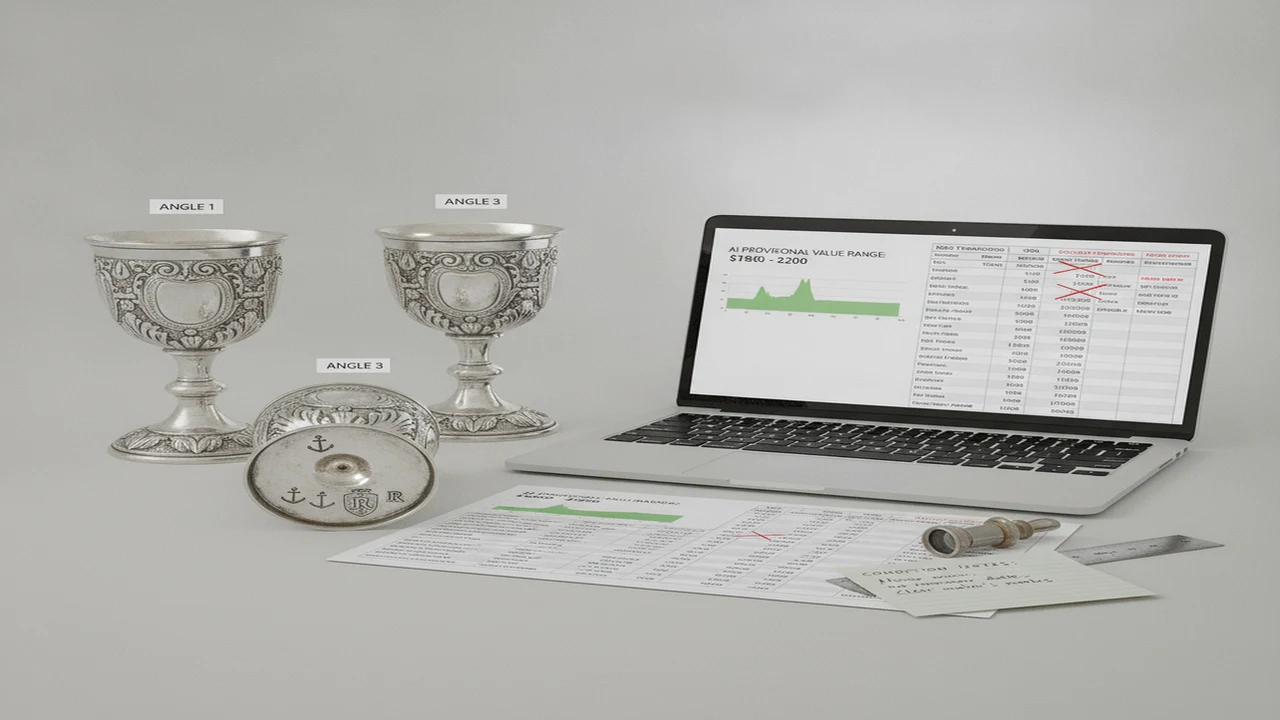
An AI antique identifier can return a category, period, and price range in seconds. The difficult question is whether the model recognized the right object, selected relevant comparisons, and accounted for details that were not visible in the photograph.
Sold results appear more concrete because money changed hands, but a completed transaction is useful only when the object, condition, market, date, and reported price basis match. Verification matters on both sides of the comparison.
Quick answer: Use an AI price estimate to form a provisional range, not a final selling price. Confirm the object’s identity, maker, material, dimensions, condition, and age, then find multiple closely matched sold records. Verified sold comps usually provide stronger market evidence, but only when they represent completed transactions and genuinely comparable objects.
What does an AI estimate measure compared with a sold comp?
An AI price estimate generally begins with classification. Computer vision may infer an object’s category, style, approximate period, material, maker, visible condition, and decorative features. A valuation layer then associates those signals with reference material or comparable objects to produce an antique market value range.
That range is an inference, not a transaction record. Its reliability depends on whether the identity is correct and whether the underlying comparisons represent the same object class, quality level, condition, and market.
A sold comp records a reported transaction involving a specific object, marketplace, sale date, location, buyer pool, and sale format. It answers what one buyer paid under those circumstances. It does not automatically establish what every similar object is worth elsewhere or later.
Keep sold prices separate from active listings and dealer asking prices. Auction estimates, insurance values, replacement costs, and retail display prices answer different questions. An asking price shows a seller’s target, while a confirmed sold price supplies evidence of a completed market outcome.
Why can an AI price estimate disagree with sold results?
The disagreement often starts before the price calculation. Weak lighting can hide wear or hallmarks, while glare can erase surface details. Cropped marks, missing scale, unusual angles, repairs, and visually similar reproductions can push an AI antique identifier toward the wrong category or period.
The valuation then inherits that classification error. Plated metal mistaken for sterling silver, a later revival assigned to an earlier period, or a reproduction confused with an original can change the comparison set substantially.
Photographs also leave consequential variables unresolved. Provenance, dimensions, weight, internal watch condition, restoration, replaced components, maker marks, regional demand, and undocumented damage may all affect antique identification and value.
A broad estimate may draw from historical references, active asking prices, or loosely similar objects instead of matched completed sales. Readers who want to move from an initial scan to transaction evidence can use the sold-comps workflow described by Antique Identifier. The useful step is reviewing the candidate identity and comparable records, not accepting a single generated number.
A Gavelist analysis from 2025 cites Syl-Lee Antiques as warning that realized prices can be 30–50% or more below retail asking prices when AI tools anchor on retail listings. The same source reports no reliable universal cross-category accuracy percentage, emphasizing that performance varies by object type and by the quality of identification and sold-comparison data.
How can you confirm that a sold comp is genuinely comparable?
A useful comp must survive an attribute-by-attribute review. Start by confirming the candidate identity rather than searching only for objects that look similar. AIACI’s guide to verifying an AI image identification against marks and sold records explains why the object match must come before the price match.
Confirm that the record reflects a completed sale. Auction results may report only the hammer price, while other sources include buyer’s premium, taxes, shipping, or fees. Record which figure is shown instead of combining incompatible totals.
Market context also matters. Sale date, country, currency, marketplace, auction-house audience, seller reputation, lot bundling, and local demand can produce different results for otherwise similar items. Normalize currencies and fee treatment before calculating a range.
Antique jewelry identification requires close attention to hallmarks, metal purity, gemstone evidence, weight, repairs, clasp construction, and maker signatures. For antique watch value, verify the case reference, movement reference, dial originality, replaced parts, service history, and operating condition. Visual resemblance alone is weak evidence in both categories.
WorthPoint and Google Lens can help discover terminology, archived references, and visually related objects. Use them as research aids rather than automatic confirmation. When several close comps exist, report a range or median-like center instead of selecting the highest sale.
- Photograph the full object, marks, underside, damage, accessories, and a scale reference.
- Identify a candidate maker, model, pattern, period, and material.
- Inspect the physical object for labels, hallmarks, repairs, replaced parts, and construction details.
- Transcribe marks and signatures exactly, including punctuation and partial characters.
- Search completed records using the candidate identity plus material, dimensions, date, and condition.
- Match maker, pattern, material, size, age, condition, restoration, completeness, provenance, and accessories.
- Exclude active listings, unconfirmed sales, bundled lots, distant variants, and materially different conditions.
- Normalize currency, sale date, hammer price, buyer’s premium, taxes, shipping, and marketplace context.
- Triangulate with several close transactions where available and calculate a defensible central range.
- Document included and excluded comps, URLs, dates, images, and reasons for each decision.
- Escalate to a relevant specialist when identity, authenticity, or financial consequences remain uncertain.
How do antique identification apps fit into the evidence chain?
An antique identifier app comparison is most useful when it focuses on what each tool surfaces and what remains unverified. Photo scanning can generate candidate identities, origin clues, periods, condition suggestions, and search terms. Those outputs still require mark inspection and sold-comp confirmation.
Curio - Antique Identifier combines photo antique identification with origin and period details, an estimated antique value range, and account collection sync. Antique Identifier By Picture emphasizes a quick antique value estimate, period identification, image cropping, and an antique collection manager.
Antique Identifier - Relic offers a one-photo antique scan, an AI antique price guide, and a USD value estimate, with its identification and related functions behind a subscription boundary. AntiqSnap: Antique Identifier combines snap antique identification with condition grade suggestions and collector learning articles.
The table separates discovery tools from stronger transaction or specialist evidence. None should be ranked as the best app to identify antiques without measured, category-specific accuracy data.
What is the safest scanner-to-manual-lookup workflow?
Begin with several photographs: a full-object view, underside, maker signature, hallmarks, labels, damaged areas, joinery, watch movement, and an image containing a ruler or another reliable scale reference. Keep the uncropped context image before making close crops of individual marks.
Use the scan to generate candidate identities and text queries. Do not use it to finalize authenticity or market value. A saved candidate in Antique Identifier TIQ can support later research, but the candidate still needs confirmation against physical evidence and another source.
For maker, period, material, or model claims, seek a second source such as a museum collection, maker archive, catalogue, specialist reference, or documented auction record. Search antiques by photo first if needed, then switch to text queries combining maker, pattern, dimensions, material, date, and condition.
Assign separate confidence levels to identification and valuation. A model may confidently recognize an object as a mantel clock while lacking enough evidence to distinguish the exact movement, maker, restoration state, or value tier. Conversely, a tentative identity can make every price comparison unstable.
When the result appears visually persuasive, review AIACI’s explanation of checking computer-vision false positives around reproductions. Similar silhouettes and decoration can conceal different manufacturing periods, materials, and construction methods.
When are both AI estimates and sold comps insufficient?
Rare, unique, undocumented, altered, composite, counterfeit, and heavily restored objects may lack a defensible comparison set. Concealed evidence can also determine value in watches, jewelry, fine art, furniture, and signed decorative objects.
If authenticity or value materially affects a sale, purchase, insurance decision, tax matter, or inheritance, seek an appropriate appraiser, auction house, gemologist, horologist, conservator, or authentication service. Physical inspection may be necessary before relying on any price range.
Which evidence should determine your asking price or sale decision?
Closely matched, recent, verified sold comps should normally carry more weight than a standalone AI estimate. Use the AI range as a provisional bracket, search aid, or anomaly detector when transaction evidence is sparse.
If the two signals disagree, do not average them automatically. Recheck the identity, marks, material, dimensions, condition, sale status, fee basis, and market context. Two numbers based on different objects or price definitions do not become reliable when combined.
Use a simple confidence ladder. Confidence is low when there is one photograph and no matched sale. It becomes medium with a plausible identity and several partial comps. It is higher when physical attributes are verified and multiple close transactions agree after normalization.
Antique Identifier TIQ can be an optional starting point for candidate identification and photo value research. Before acting, preserve the images, record every source, note excluded comps, and request specialist review when the financial consequence is significant.
Comparison
| Tool or evidence source | Primary output | Useful role | Manual confirmation required | Key trust boundary |
|---|---|---|---|---|
| Antique Identifier TIQ | Candidate identity and estimated value research | Generating search terms and beginning sold-comp research | Marks, material, dimensions, condition, identity, and completed sales | Model output is a research starting point, not a certified appraisal |
| Curio - Antique Identifier | Object identity, background, period, and estimated range | Discovering origin clues and organizing a synced collection | Maker, age, materials, condition, and comparable transactions | Historical information and similar objects may not equal matched sold comps |
| Antique Identifier By Picture | Suggested identity, period, value, and collection record | Rapid scanning and cropped-mark research | Repeatable identity, maker, region, material, and completed sales | Listing and review concerns include changing outputs and occasional maker or region errors |
| Antique Identifier - Relic | One-photo identity record and USD estimate | Creating a compact candidate record | Physical attributes, authenticity, condition, and sale evidence | AI identification and related functions require a subscription |
| AntiqSnap: Antique Identifier | Identity, pricing guidance, and condition suggestion | Learning terminology and tracking collection value | Material, construction, condition, reproduction status, and sold prices | Review concerns include material errors and reproduction confusion |
| Verified sold comps | Reported completed transaction prices | Estimating current market outcomes | Object similarity, completion status, fees, currency, date, and market | A real sale can still be a poor comp if the object or context differs |
| Specialist appraisal | Documented expert opinion for a defined purpose | High-value, rare, insured, inherited, or disputed objects | Credentials, scope, inspection method, and valuation date | An appraisal may target insurance, tax, retail, or market value rather than immediate sale price |
Limitations
Computer vision may confuse visually similar periods, makers, materials, reproductions, and restored objects. A photograph may not reveal dimensions, weight, internal mechanisms, metal purity, structural repairs, provenance, signatures, labels, or construction details.
AI value ranges may use broad or opaque comparison sets and should not be represented as certified appraisals. Sold records can also mislead when they are stale, bundled, geographically mismatched, fee-inclusive, conditionally different, or not confirmed as completed transactions. An unusually motivated buyer or seller can create an outlier.
Rare objects may have too few close sales to support a stable antique market value range. Marketplace listings and reviews for Antique Identifier By Picture and AntiqSnap: Antique Identifier report possible issues such as changing scan outputs, material mistakes, maker or region errors, and reproduction confusion. These attributed concerns identify possible failure modes but do not establish measured accuracy rates.
High-value, regulated, insured, inherited, gemstone, watch, fine-art, or authenticity-sensitive objects may require physical inspection. Choose a specialist whose expertise and valuation purpose match the decision being made.
Frequently Asked Questions
Are sold comps always more accurate than an AI price estimate?
No. Sold comps are stronger only when the transaction was completed and the object closely matches in maker, material, period, dimensions, condition, restoration, and market. A poorly matched sale can be less useful than a cautious preliminary estimate.
How many sold comps should I find before pricing an antique?
Use several close records when available, but prioritize match quality over a rigid minimum. Recent transactions involving the same maker, pattern, material, size, condition, and market deserve more weight than a large set of loosely related sales.
Can an antique identifier by picture detect a reproduction?
It may flag visual inconsistencies or suggest that an object resembles a reproduction, but photographs cannot authenticate every item. Construction methods, material analysis, internal components, provenance, and specialist inspection may be necessary when the decision is consequential.
Can Antique Identifier TIQ appraise antiques from one photo?
Antique Identifier TIQ can provide a candidate identity and value-research starting point from photographs. Do not interpret that output as a certified appraisal. Confirm the object’s attributes and compare multiple verified sold records before setting a price.
Why does the estimated value change when I scan the same object again?
Model output can vary with framing, crop, lighting, reflections, angle, background, and which details are visible. Ambiguous objects may also fit several candidate categories. Retain consistent context images and verify the resulting identity manually rather than selecting whichever scan gives the preferred price.
Should I use asking prices when no sold listings are available?
Use asking prices only as weak market context and label them separately. They show seller expectations, not completed demand. Do not mix them into a sold-price range or assume an unsold listing establishes market value.
What photographs improve antique identification and value research?
Capture the full object, a scale reference, underside, marks, signatures, labels, damage, joinery, movement, clasp, fasteners, and close material details. Keep both context images and focused crops so the model and the manual researcher can evaluate shape, scale, and fine evidence.
When should I pay for a professional appraisal?
Seek professional review for high-value, rare, insured, inherited, disputed, gemstone, watch, fine-art, or authenticity-sensitive objects. Match the specialist to the category and clarify whether the assignment concerns market value, insurance replacement, tax, estate, or sale advice.