
How to Verify an AI Detector Result Step by Step
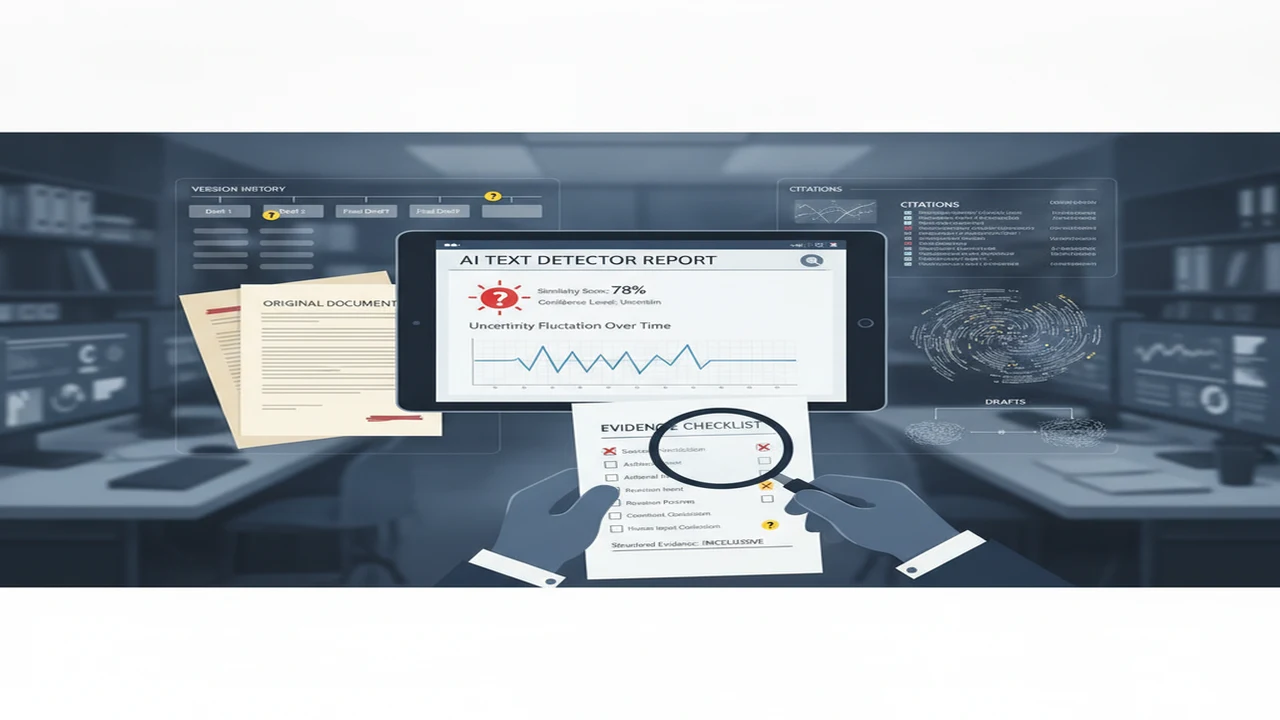
A detector can display a decisive-looking percentage while leaving the central question unanswered: who actually produced the text? Its output reflects patterns found in the submitted sample, not direct observation of the writing process.
Verification therefore starts outside the score. The defensible workflow preserves the evidence, controls subsequent checks, examines possible linguistic triggers, and gives greater weight to drafts, sources, timestamps, and revision history.
Quick answer: An AI detector score is a probabilistic signal, not proof of authorship. Preserve the original text, record the tool and settings, inspect flagged passages, check drafts and source history, compare a second detector cautiously, and document the evidence. Base any decision on the combined record rather than a single percentage or label.
What does an AI detector result actually tell you?
An AI content detector classifies linguistic patterns. Depending on the service, the result may appear as a label, score, highlighted passage, or confidence-like indicator. Unless the provider defines and validates a score as a probability, do not read an output such as “likely AI” as a verified probability that a particular person used a generator.
The classification can be influenced by formulaic prose, short samples, repetitive syntax, multilingual writing, translation, extensive editing, or specialized language. Reporting from Polygon on detector reliability describes cases in which human work was misclassified, reinforcing the need for evidence beyond the detector.
The question “how accurate are AI detectors?” has no single answer for every document. A BestColleges analysis from 2024 reported that Turnitin flagged 7.7% of fully human student essays in its sample as AI-generated. A detector comparison published by Is It AI? in 2025 reported false-positive rates ranging from under 5% to over 25% across tools and writing styles. These figures describe particular evaluations, not a universal error rate.
How should you preserve the text before checking it again?
Save the exact submitted text before making corrections. Retain formatting, headings, quotations, references, footnotes, document metadata, the original prompt or assignment, and the submission timestamp where available. If the text came from a document platform, preserve a read-only copy rather than relying only on pasted text.
Record the detector name, access date, displayed version if any, language setting, input method, full score, classification, and highlighted passages. Save screenshots or an exported report. These artifacts help distinguish the original result from a later scan made after a model or threshold changed.
Do not first paste the disputed material into an AI text rewriter, grammar checker, paraphraser, or editor. Anyone evaluating an AI Humanizer should retain an untouched copy before requesting a rewrite. Otherwise, the revised wording can erase useful comparisons with drafts and source records.
- Preserve an original file with a timestamp or checksum where feasible.
- Save the detector report alongside the exact input submitted.
- Write down any formatting removed by the detector interface.
- Keep revised versions separate from the evidentiary copy.
How can you isolate what triggered the detector?
Keep the full document intact, then create separate copies divided by logical boundaries such as introduction, methods, analysis, and references. Use the same boundaries for later comparisons. Avoid repeatedly changing sentence lengths merely to see whether the label moves.
Compare flagged passages with repeated sentence structures, generic transitions, templated introductions, quotations, citations, and reference lists. An AI writing assistant may influence some wording, but its possible use cannot be inferred from a highlighted sentence alone. The flag is a lead for review, not direct evidence of generation.
Record each rescan date and input boundary. Results can shift if a service changes preprocessing, its underlying model, or classification thresholds. A changed result may therefore reflect the detector rather than a meaningful change in the evidence.
How should you perform a controlled second check?
Submit the same untouched text to a second detector. Keep the language, formatting policy, sample boundaries, and removal of references consistent. If one tool excludes citations, either apply that policy to both checks or record the difference explicitly.
GPTZero, ZeroGPT, Originality AI, and Undetectable AI are examples of services that may classify the same material differently. Undetectable AI combines an AI detection check with natural-language revision, but both its detector judgment and revision output remain probabilistic.
Matching labels are not automatically independent confirmation because tools can respond to related linguistic signals. Conflicting labels also do not reveal which service is correct. Searching for the best AI detector cannot resolve a specific disputed document without provenance and process evidence.
What manual evidence can confirm or challenge the result?
Start with provenance: document version history, tracked changes, drafts, notes, source files, citation records, and timestamped collaboration history. Voluntarily supplied browser or research records may add context when relevant. Gradual revisions linked to identifiable sources can support a writing-process account, while missing history does not prove AI use.
For more detail on weighing detector claims against evidence, see AIACI’s guide to what counts as proof when checking AI detection. The objective is to reconstruct the process, not to infer intent from polished language.
Compare vocabulary, sentence patterns, factual mistakes, and citation habits with known samples, but use stylistic judgments cautiously. Writers alter tone by subject, audience, editing, disability accommodation, and language context.
Legitimate assistance can include an AI chatbot, grammar correction, translation, an AI cover letter writer, or guidance on how to write an email with AI. Write.info is one example of a broader writing-platform category. Such use should be evaluated against the applicable policy rather than equated automatically with full-text generation.
- Check whether drafts develop gradually rather than appearing only as a finished file.
- Match citations and notes to claims in the submitted text.
- Confirm collaboration timestamps and named contributors where relevant.
- Ask the author to explain sources, revisions, and disputed passages.
How should you interpret detector disagreement?
Classify the record into one of three states. Detectors may broadly agree on the same passages, they may conflict, or the sample may be too short or unstable to interpret. Agreement justifies closer review, not an automatic authorship finding.
Do not average percentages from different tools. Their labels may use incompatible thresholds, calibration methods, and preprocessing. Give greater weight to verifiable provenance than to a small score difference.
For example, a high detector score with no available drafts may remain inconclusive because the score does not identify an author or process. A lower score also cannot establish human authorship. Attempts to humanize AI text can change surface patterns while leaving the origin of the ideas unresolved.
What limitations must remain in the final judgment?
Detector scores are probabilistic classifications, not direct evidence of who authored text. False positives can wrongly implicate a human writer, while false negatives can allow generated material to pass without scrutiny. Both errors matter in education, employment, and publishing.
Short, formulaic, translated, multilingual, heavily edited, accessibility-assisted, or domain-specific samples can produce unstable or misleading classifications. Polished human prose can be misclassified, particularly when it contains predictable structures or standardized terminology.
Agreement among tools may reflect shared signals rather than independent confirmation. Model updates, hidden thresholds, preprocessing, and unavailable version information can also prevent exact reproduction of an earlier result.
An AI humanizer or another rewriting system may alter a detector score without establishing whether the underlying work was human-written or AI-generated. No policy decision should assume that a rewritten passage passing a detector resolves authorship.
How do you document a responsible final decision?
Create a compact decision record containing the untouched text, original and secondary detector reports, passage analysis, provenance evidence, alternative explanations, reviewer notes, and unresolved uncertainty. Record which evidence was available and which evidence could not be obtained.
Use findings such as supported, inconclusive, or contradicted. “Supported” should mean that multiple forms of evidence support the stated process, not merely that detectors agree. “Contradicted” should likewise rest on process evidence rather than a percentage.
Before consequential action, ask the author for clarification and permit human review or appeal. AIACI’s verification-focused detector review provides additional context for selecting tools without confusing selection with proof.
Keep any AI Humanizer output separate from the authorship record. A rewrite documents that text was transformed; it does not identify who created the original material.
- Finding: supported, inconclusive, or contradicted.
- Evidence relied upon: files, reports, drafts, sources, and explanations.
- Alternative explanations considered: editing, translation, templates, or permitted assistance.
- Reviewer and date: who made the judgment and when.
- Review path: how the author can respond or appeal.
What is the final verification checklist?
Complete the following sequence without overwriting earlier artifacts. Detector output informs review, but it does not establish authorship by itself.
- Save the untouched text: preserve the exact document, formatting, metadata, prompt, and timestamp.
- Record the detector output: save the tool name, date, settings, score, highlights, and report.
- Isolate flagged passages: create section-level copies while retaining the full original.
- Compare a controlled second check: use identical text, boundaries, language, and formatting rules.
- Inspect linguistic triggers: note templates, repetition, quotations, citations, and specialized phrasing.
- Trace drafts and sources: review version history, notes, references, and collaboration records.
- Recheck alternative explanations: consider editing, translation, accessibility support, and permitted tools.
- Decide and document: issue a supported, inconclusive, or contradicted finding with a saved evidence note.
Comparison
| Verification check | What to keep constant | Evidence produced | What it cannot prove |
|---|---|---|---|
| Original detector report | Exact submitted text and documented settings | Baseline score, label, highlights, and timestamp | Who authored the text |
| Passage-level rescan | Section boundaries and formatting policy | Location of recurring flags | That a flagged sentence was generated |
| Second detector | Untouched input, language, and sample length | Agreement or disagreement between classifiers | Independent confirmation of authorship |
| Version-history review | Original account and document chronology | Draft sequence, edits, and collaborator timestamps | That missing history indicates AI use |
| Source and citation audit | Claims, references, notes, and source files | Links between research and written assertions | Whether every sentence was drafted manually |
| Author clarification | Specific passages and neutral questions | Process explanation and possible supporting files | Accuracy without corroborating evidence |
Limitations
Frequently Asked Questions
Can an AI detector prove that someone used AI?
No. A detector estimates whether text resembles patterns associated with generated writing. Authorship requires corroborating evidence such as drafts, source records, version history, and an explanation of the writing process.
Why do two AI detectors give different results?
Tools may use different model signals, thresholds, preprocessing rules, sample-length requirements, or updated versions. Compare them with identical input, but do not assume either result is authoritative.
Can human-written text receive a high AI score?
Yes. Formulaic, polished, translated, short, or domain-specific human writing can trigger a false positive. A high score warrants review but does not establish authorship.
Does an AI humanizer prove that revised text is human-written?
No. Surface rewriting can change word choice, rhythm, and detector output without resolving who created the underlying ideas or original draft. Preserve both versions and keep transformation evidence separate from provenance.
Can Write.info help revise text after the original has been preserved?
Write.info can be considered for revision after an untouched evidentiary copy has been saved. Its revised output should be assessed as transformed text, not as verification that the original was human-authored.
Should detector scores be used for school or workplace decisions?
A detector score should not stand alone in a consequential decision. Require corroborating evidence, human review, author clarification, a proportionate response, and a meaningful appeal path.
What evidence is stronger than an AI detector score?
Version history, timestamped drafts, source-linked notes, tracked changes, citation records, and consistent collaboration logs provide more direct evidence of process. No single artifact is conclusive, so reviewers should consider the combined record.