
AI Writing Verification: How to Check Detector Scores, Drafts, and Claims
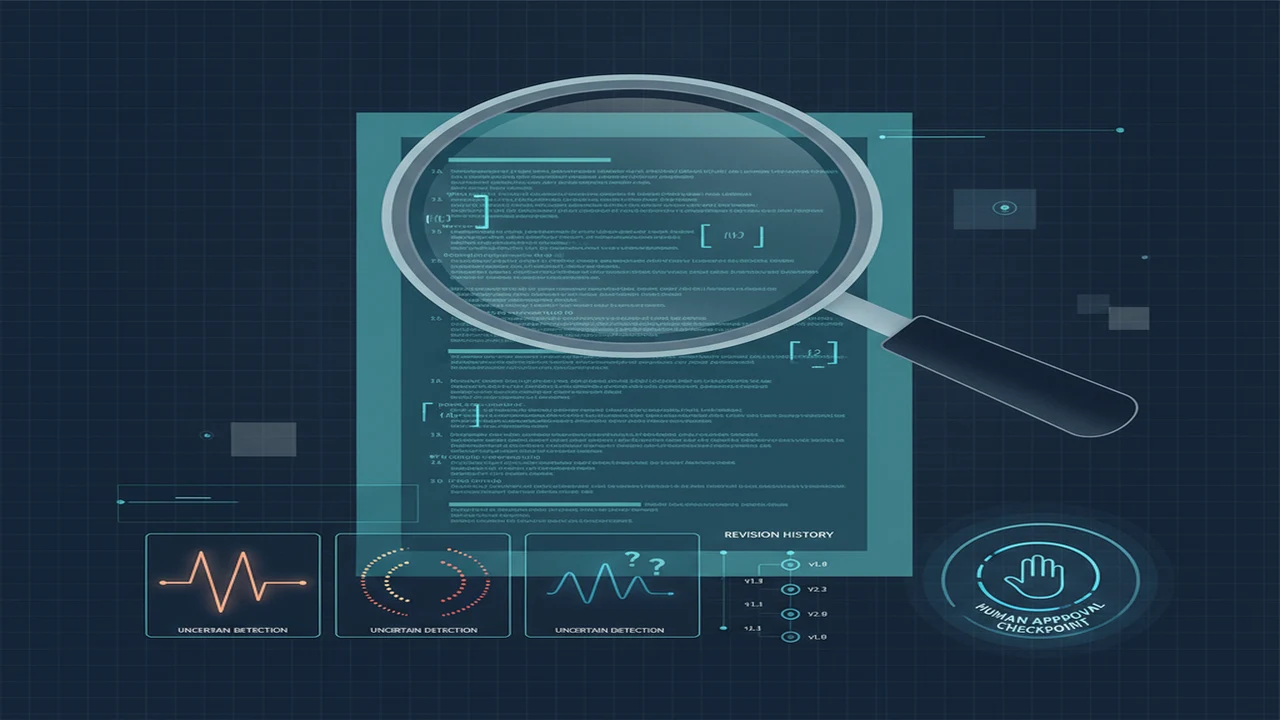
AI writing tools can generate a polished answer in seconds, while AI detectors can assign an equally fast probability or label. Neither output settles whether a document is accurate, original, appropriate, or written by a particular person. Verification requires separating what a system observed from what its interface merely implies.
Detector scores are especially easy to overread. A percentage may represent a model's classification confidence, the estimated share of flagged sentences, or an internal score that is not comparable with another service. Our guide to AI detector accuracy and standards of proof explains why a numerical result should not be treated as an authorship finding without corroborating evidence.
This category organizes verification workflows for articles, assignments, business messages, and other AI-assisted writing. The aim is not to presume that all generated text is unreliable. It is to identify the claim being made, inspect the available evidence, and confirm important details through sources that do not depend on the same model output.
Quick answer: Use AI writing and detection tools as screening systems, not final authorities. Confirm detector flags with revision history, source records, document metadata, and direct discussion with the author. For generated drafts, verify factual claims, citations, recipients, attachments, tone, and requested actions before publishing or sending anything consequential.
What does this mean?
Definition: AI writing verification is the process of checking detector scores, generated text, authorship claims, citations, and draft quality against independent evidence before accepting or acting on an AI system's output.
Guides in this category
What does an AI detector score actually tell you?
An AI detector estimates whether patterns in a submitted passage resemble patterns associated with machine-generated or human-written text. It does not observe who typed the document, which editor was used, or whether a person substantially revised a generated draft. The output is therefore a classification signal, not a direct record of authorship.
Score meanings vary by provider. One interface may show a probability that the complete text belongs to a class, while another highlights sentences or reports a proportion of text as likely generated. Before interpreting a number, locate the provider's definition, identify the model version if disclosed, and check whether the score applies to the whole document or only selected passages.
False positives deserve particular attention when a decision could affect a student's grade, an employee's reputation, or a writer's contract. Formulaic prose, short passages, edited text, technical language, and writing by people using a second language can complicate classification. A low-confidence or unsupported flag should trigger review rather than punishment.
- Record the exact text submitted, detector name, date, model or version if shown, and complete output.
- Distinguish probability, confidence, and percentage of flagged text instead of using the terms interchangeably.
- Repeat the analysis only to investigate instability, not to shop for a preferred accusation.
- Seek independent evidence such as drafts, notes, tracked changes, source history, and an author interview.
- Escalate high-impact decisions to a qualified human reviewer who can consider context.
How should you verify a detector result?
Begin by preserving the original document and detector report. Copying text into another editor, correcting punctuation, or removing citations can change the input and make later review difficult. The step-by-step detector verification workflow covers evidence preservation, score interpretation, repeat checks, and human review in a reproducible order.
Next, investigate evidence that is independent of the detector. Revision history may show a document developing over time, while research notes and source records can support the author's account of how it was produced. Metadata can add context, but it can be incomplete or altered, so it should not carry the decision by itself.
A second detector can reveal disagreement, but agreement between classifiers is still not direct authorship evidence. If you need an additional screening result, the AI Detector offers another checker interface. Document why it was selected and compare how each service defines its output before combining or contrasting the results.
Can rewriting or humanizing text prove human authorship?
No. Rewriting can change the linguistic features a detector uses, but a changed score does not establish who created the original or revised version. It may only show that the classifier responds differently to the new wording. This is why attempts to optimize text for a favorable detector label weaken the evidentiary value of later scans.
Tools such as Free AI Chat and AI Humanizer can assist with drafting or revision, but their output still needs factual and editorial review. Keep the original prompt, generated response, revision history, and final text when provenance matters. Those records provide more useful context than presenting a single detector result after several undocumented transformations.
Detector brands also differ in scope, policies, and score presentation. The comparison of GPTZero, ZeroGPT, and Originality focuses on what users can verify from each service rather than declaring one score definitive. Other names encountered in this category include Copyleaks and Turnitin, but no brand should be selected solely because it produces the most confident label.
What should you check before sending an AI-written email?
Email verification is broader than grammar. Confirm every recipient, name, date, price, deadline, link, attachment, and promised action. Check whether the draft reveals confidential information, invents prior conversations, overstates authority, or uses a tone that could be interpreted differently once the recipient sees it.
EmailAI and FlyMail are examples of products positioned around AI-assisted email drafting. Their generated messages should remain drafts until a person verifies the claims and sending context. For sensitive financial, employment, health, or contractual messages, compare the text with the underlying record and obtain appropriate review before transmission.
A detector adds little to this task because the central question is whether the email is correct and authorized, not whether its phrasing resembles AI output. Use the broader shortlist in Best AI Detectors for Verified Content Review in 2026 when classification is genuinely relevant, while keeping factual review as a separate step.
Where should the trust boundary sit in an AI writing workflow?
The trust boundary should sit before publication, submission, or delivery. An AI system may propose language, summarize material, or identify text for review, but a responsible person should confirm the underlying facts and approve the final action. The higher the potential harm, the stronger and more independent that confirmation should be.
Low-risk uses, such as brainstorming subject lines, may need a quick relevance and tone check. Public claims require source verification. Academic misconduct allegations, hiring decisions, disciplinary actions, and legal or financial communications require documented evidence and review procedures that do not reduce the case to one opaque score.
Verification also includes knowing when evidence is insufficient. If provenance records are unavailable and detectors disagree, the accurate conclusion may be that authorship cannot be determined from the available material. Reporting uncertainty is preferable to converting a weak signal into a confident accusation.
Why this category
- AI writing verification combines several questions that are often confused: whether a statement is factually accurate, whether a citation exists, whether text resembles model output, and whether a named person authored it. Each question requires different evidence. A detector cannot replace source checking, and a correct factual statement cannot by itself establish authorship.
- The guides in this category move from interpretation to procedure. They explain detector limitations, provide a repeatable verification sequence, compare what major services disclose, and organize a shortlist for content review. Readers can choose the relevant guide without assuming that every writing problem needs another classifier.
- AIACI's editorial position is verification-first. Preserve inputs, understand score definitions, seek independent records, and record uncertainty. This produces a defensible workflow even when models change, interfaces disappear, or different tools return conflicting answers.
Frequently Asked Questions
Can an AI detector prove that a person used AI?
No. A detector classifies patterns in text and does not directly observe the document's author or creation process. Use its result as a screening signal and seek revision history, notes, source records, metadata, and the author's explanation before reaching a conclusion.
What evidence is stronger than an AI detector score?
Contemporaneous evidence is generally more informative, including version history, tracked changes, research notes, source records, timestamps, and drafts that show how the document developed. No single item is necessarily decisive, so reviewers should assess whether multiple records support a consistent account.
Can the Write.info AI Detector identify every AI-written passage?
No detector should be assumed to identify every generated or edited passage. The Write.info AI Detector can provide a classification result, but users should read its current score definition and confirm consequential findings with independent evidence.
Should I use multiple AI detectors on the same document?
Multiple detectors can reveal whether a result is stable across services, but agreement does not prove authorship. Preserve identical input text, note each provider's scoring method, and avoid averaging numbers that represent different concepts.
Does AI Humanizer make text verifiably human-written?
No. AI Humanizer can revise wording, but the resulting style or detector score cannot verify who authored the text. If provenance matters, retain prompts, original outputs, edits, and document history rather than relying on the final classification.
What is Free AI Chat useful for in a verification workflow?
Free AI Chat can help generate questions, outline checks, or suggest alternative phrasing. Its answers should be verified against reliable sources, particularly when they contain names, quotations, dates, technical instructions, or citations.
Are EmailAI drafts ready to send without review?
AI-generated email drafts should be reviewed before sending. Confirm the recipient, factual claims, dates, attachments, requested actions, confidentiality, and tone, especially when the message could create a financial or professional commitment.
How should I review a FlyMail email draft?
Compare the FlyMail draft with the source information and the purpose of the message. Remove invented context, verify every commitment, and make sure the wording reflects the sender's actual authority and intent before sending.
Can AI Writer & AI Chat: ACI replace source verification?
No. A drafting application can assist with composition, but factual claims and citations still require confirmation from appropriate sources. The user remains responsible for deciding whether the final text is accurate and suitable for its audience.
Why do two AI detectors return different scores?
Detectors may use different models, training data, thresholds, passage limits, and definitions of generated text. They may also update without producing directly comparable historical results. Record the service, date, input, and displayed explanation whenever a score matters.
What should a school do with a positive detector result?
A school should follow a documented review process rather than treating the result as an automatic finding. The student should have an opportunity to provide drafts, notes, sources, and an explanation, while the reviewer considers detector limitations and other evidence.
How often should published AI-assisted writing be rechecked?
Recheck content when important facts change, sources are corrected, links break, or the text supports a consequential decision. Repeated detector scans are less useful than maintaining citations, revision records, named reviewers, and scheduled factual updates.