
How Accurate Are AI Detectors, and What Counts as Proof?
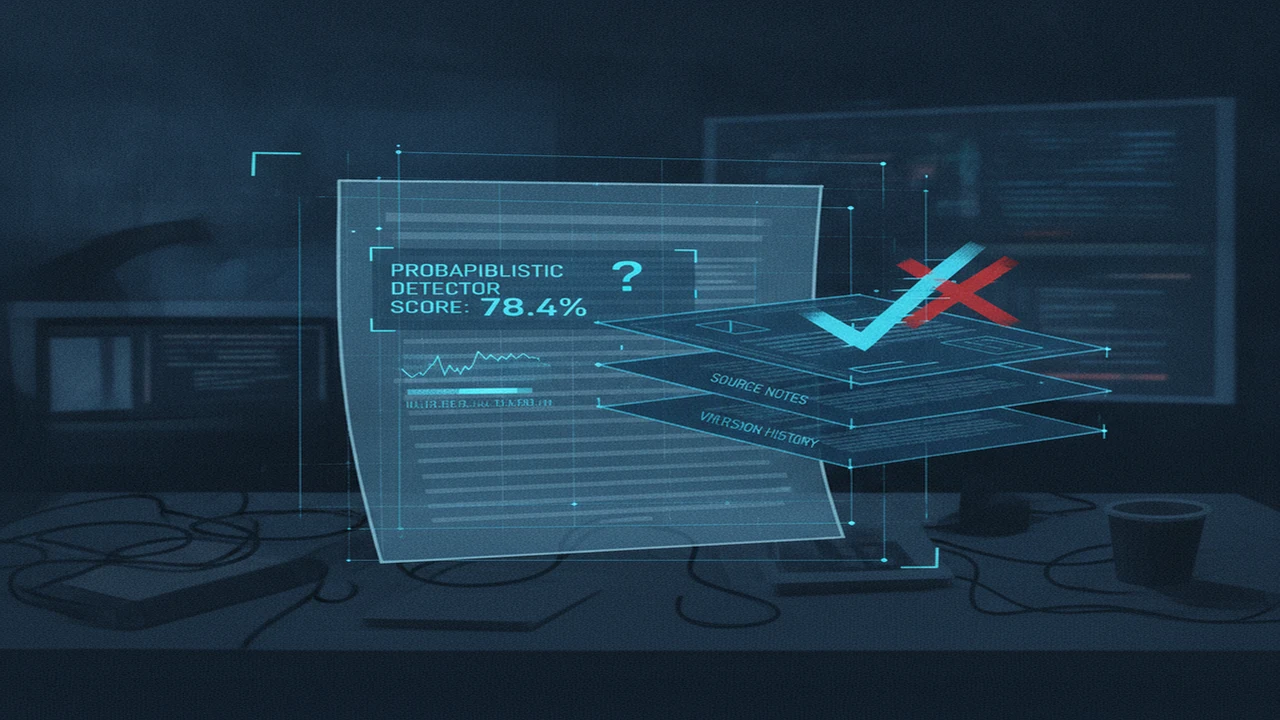
An AI detector can produce an authoritative-looking percentage in seconds. The difficult question is what that percentage represents. It might describe confidence in a label, the portion of a document flagged, or another tool-specific measurement. None of those readings directly records who wrote the text.
This distinction matters when a false positive could affect a grade, job, or publication. Detector output can support triage and passage-level review, but the reviewer still needs contextual and process evidence before drawing an authorship conclusion.
Quick answer: AI detectors estimate whether text resembles machine-generated writing, but a score does not prove authorship. Accuracy changes with the model, text length, editing, language, genre, and decision threshold. Use results to identify passages for review, then confirm the score definition, inspect context, examine drafts and sources, and seek corroborating evidence before making academic, employment, or publishing decisions.
What does an AI detector actually measure?
AI detection is pattern classification, not direct observation of authorship or intent. A detector analyzes the submitted content and estimates whether its linguistic features resemble material associated with generative models.
Depending on the system, those features may include token predictability, sentence variation, repetition, vocabulary distribution, structural regularity, or relationships among phrases. The exact features and weighting are often model-specific.
A displayed percentage is particularly easy to misread. One tool may use it as confidence in a document-level classification. Another may report an estimated probability, while a third may indicate how much text was flagged. The reviewer must confirm the tool's documentation and label definition before interpreting the number.
Consider a human-written policy summary that follows a required template and uses conventional transitions. Its predictable structure could resemble generated prose. Conversely, an AI-produced draft that receives substantial human revision may no longer retain the surface patterns a detector expects. In both cases, the classification concerns textual resemblance, not a verified account of the writing process.
Why do AI detectors produce false positives and false negatives?
A false positive occurs when a detector flags human-written material as AI-generated. A false negative occurs when generated or AI-assisted material is classified as human. Both errors arise because the tool must infer origin from imperfect linguistic signals.
Short samples provide little evidence and can make routine phrases disproportionately influential. Constrained assignments, technical reports, translated passages, and formulaic workplace documents may also have limited stylistic variation. Writing by non-native English speakers can be misclassified when its patterns differ from the detector's training data.
False negatives become more likely after extensive editing, paraphrasing, translation, or blending of human and generated passages. An AI text rewriter or AI paraphrasing tool can alter the surface features used by a detector without settling the authorship question. Requests to humanize AI text expose the same trust boundary: lower detectability does not verify human authorship, factual accuracy, or permitted use.
Mixed-origin documents are especially difficult because the detector may be forced to reduce a complicated production history to one label. Outputs from unfamiliar generation models, genres, or languages can create additional errors through domain shift.
Decision thresholds add another trade-off. A lower threshold may catch more generated material but flag more human writing. A higher threshold may reduce false alarms while missing more AI-assisted text. The appropriate balance depends on the review context, not a universal cutoff.
How should detector accuracy claims be read?
Start by identifying what was measured. Precision asks how often flagged documents were actually AI-generated within the evaluation dataset. Recall asks how much of the known AI-generated material the detector found. False-positive and false-negative rates describe the two major error paths. A single accuracy percentage can conceal poor performance on one of them.
Class balance also matters. If AI-written documents are rare in the reviewed population, even a classifier that looks strong in a balanced benchmark can generate a substantial number of incorrect accusations. Sample size, language coverage, text length, genre, model coverage, detector version, and decision threshold all affect whether a result transfers to another setting.
The supplied research illustrates the gap between controlled and realistic evaluation. Eyesift's 2026 summary of a meta-analysis covering 14 independent studies reported commercial tools performing 15 to 35 percentage points below vendor claims in realistic deployment conditions. Loudscale's 2026 account of an educational-integrity study reported 84 to 100 percent accuracy on raw AI text, falling to 4 to 63 percent after paraphrasing, translation, or light editing. ProofreaderPro's 2026 independent comparison reported that none of five detectors exceeded 80 percent overall accuracy on mixed, realistic samples.
Those findings should not be collapsed into a universal accuracy rate. Ask whether the evaluation came from a vendor or an independent source, and whether its documents resemble the material under review. Known, unedited model outputs are a narrower task than identifying unknown, translated, revised, or mixed-origin writing. For more on evaluating competing claims, see AIACI's guide to verified detector review.
What counts as evidence beyond a detector score?
A screening signal identifies material for closer inspection. Corroborating evidence supports or challenges an explanation of how the material was created. Conclusive proof would require evidence strong enough to resolve competing explanations, which a detector label rarely supplies by itself.
An evidence hierarchy can move from weak to stronger support: an isolated document-level label; consistent passage-level concerns or agreement among tools; process records such as drafts, notes, citations, version history, or repository commits; and contextual corroboration such as assignment-specific knowledge and a documented conversation with the author.
Drafts and revision timestamps may show how a document developed. Source notes can connect claims to research. Repository history can reveal incremental changes to technical work. An author's explanation can clarify why a passage follows a template or differs from earlier writing. File metadata may help establish timing or software use.
Every source still needs its own confidence assessment. Metadata can be altered or stripped, cloud revision histories can be incomplete, and a polished draft sequence does not automatically establish who made each edit. Evidence is strongest when independent records support the same account and plausible alternatives have been considered.
Authorship and factual accuracy must also remain separate. Human-written text can contain false claims, while AI-assisted text can include claims confirmed against reliable sources. An authorship review should not replace citation checking, plagiarism review, or factual verification.
- Weak: one detector label without passage or score context.
- Moderate: repeated passage-level concerns or cross-tool agreement.
- Stronger: drafts, revision history, notes, citations, or repository records.
- Strongest available: process evidence supported by context and a documented explanation.
How can you verify a detector result before acting on it?
Use a repeatable process that preserves the original evidence and raises the level of corroboration with the stakes. AIACI's step-by-step detector verification guide covers the workflow in greater procedural detail.
- Preserve the submitted text in its original form. Keep the file, formatting, submission time, and any available version history so later edits do not overwrite the material under review.
- Document the detector name, version if available, review date, settings, displayed score, highlighted passages, and decision threshold. Record whether the percentage means confidence, estimated probability, or proportion flagged.
- Confirm the tool's public documentation. Check supported languages, minimum text length, score definitions, known exclusions, and whether document-level and passage-level results use different rules.
- Inspect the flagged passages manually. Look for templates, quotations, citations, technical terminology, repeated assignment language, or conventional phrasing that could explain the signal. Consider the writer's language background, subject, and required genre.
- Cross-check the passages against drafts, source material, earlier work, and assignment instructions. A second detector can serve as a sensitivity check, but agreement is not independent proof because tools may respond to overlapping linguistic signals. AIACI's comparison of GPTZero, ZeroGPT, and Originality explains why divergent and matching scores both require interpretation.
- Request process evidence proportionate to the stakes. Drafts, notes, revision history, source records, or a conversation about the work may clarify conflicting signals. Give the author a fair opportunity to explain the evidence.
- Decide using a documented action threshold. A low-stakes editorial query may require only clarification or citation review. Disciplinary, employment, or similarly consequential action requires substantially stronger corroboration and the applicable institutional procedure.
How do common AI detection tools fit into a review workflow?
GPTZero is commonly presented as an authorship-screening and document-analysis tool that can identify passages for closer inspection. Grammarly, QuillBot, ZeroGPT, and Originality are other names readers may encounter when checking or editing text. Their labels and feature boundaries differ, so scores should not be assumed to have equivalent meanings.
StealthGPT, Undetectable AI, and NaturalWrite appear in discussions of rewriting or detection-evasion claims. Such services complicate surface-pattern analysis because a changed detector result does not establish who created the original draft or whether its claims are correct.
The source text may also come from a professional email generator, AI email generator, email reply generator, AI cover letter writer, or general AI writing assistant. Formulaic output can receive substantial human editing, while fully human business correspondence may follow equally predictable templates.
Agreement among several tools can justify further review, but it does not establish authorship. Detectors may share training assumptions, benchmark sources, or sensitivity to the same linguistic features. A balanced shortlist is useful for sensitivity checking, not for declaring a best AI writer or a detector whose output overrides process evidence.
What are the limits of AI detection as proof?
The limitations below define the trust boundary for detector output. Detection can prioritize material for review, but it cannot substitute for that review.
Comparison
| Signal or evidence | What it can indicate | What it cannot prove | Recommended next check |
|---|---|---|---|
| Single detector score | The document crossed one tool's threshold | Who wrote it or what the percentage universally means | Confirm the score definition and settings |
| Highlighted passage | Specific wording influenced the classification | That the passage was generated | Inspect genre, template, quotation, and source context |
| Agreement between detectors | Several systems found similar surface patterns | Independent confirmation of authorship | Check whether passage-level reasons and assumptions overlap |
| Draft and revision history | How the document changed over time | Who made every revision or whether the record is complete | Compare timestamps, edits, and related notes |
| Source notes and citations | A traceable research process | Sole human authorship or factual correctness | Open and verify the underlying sources |
| Author explanation | Context for style, process, and disputed passages | Accuracy without supporting records | Compare the account with drafts and assignment details |
| File or repository metadata | Timing, software, or incremental changes | Intent, account control, or complete provenance | Corroborate with version history and contextual evidence |
Limitations
False positives can flag fully human writing, especially when the material is short, formulaic, translated, technical, or written by a non-native speaker. Detectors infer from content and generally cannot observe the writing process, account ownership, or intent.
False negatives can miss edited, paraphrased, mixed-origin, translated, or unfamiliar model output. Evolving generation systems and domain shift mean performance on a known benchmark may not transfer to a new model, language, or genre.
Vendor confidence labels are not standardized. Similar-looking percentages can represent different measurements, while results may shift with document length, detector version, language, threshold, and model coverage.
Several tools agreeing does not automatically produce independent evidence. An ensemble can repeat the same mistake when its components rely on correlated patterns, assumptions, or datasets.
Authorship detection cannot establish factual truth, plagiarism, intent, policy compliance, or whether permitted assistance was disclosed. MIT Sloan's guidance on AI detector limitations similarly cautions against using automated detection as definitive evidence.
The appropriate trust boundary is narrow: use an AI content detector to prioritize review, not to skip review. Higher-stakes conclusions require stronger process records, contextual corroboration, and human consideration of alternative explanations.
Frequently Asked Questions
Can an AI detector prove that a student or employee used AI?
No. A detector score alone cannot prove authorship or intent. Review drafts, version history, source notes, document context, and the author's explanation. Any academic or workplace response should follow fair procedures and distinguish a screening signal from corroborated process evidence.
What does a 90 percent AI detector score mean?
It depends on the tool. The number could mean classification confidence, an estimated probability, or the share of submitted text flagged. Check the detector's documentation, threshold, and passage-level output before interpreting it. Do not convert the number into a universal 90 percent chance of AI authorship.
Can human-written text be flagged as AI-generated?
Yes. Short, formulaic, technical, translated, or non-native-language writing can resemble patterns associated with generated text. Required templates and conventional business phrasing can have the same effect. Preserve the original work and inspect the passages that influenced the classification.
Does checking the same text with several detectors make the result reliable?
Multiple checks can show whether a result is sensitive to the selected tool, but agreement is not automatically independent confirmation. Detectors may rely on overlapping signals or similar training assumptions. Use cross-tool agreement to justify closer review, then seek drafts, sources, metadata, and contextual evidence.
Can an AI writing assistant create text that detectors miss?
Yes. Generated text may be missed after editing, paraphrasing, translation, or blending with human writing. The reverse also occurs when human text is flagged. Detectability is separate from authorship, disclosure, factual accuracy, and whether the assistance complied with a particular policy.
Can Write.info tell me whether text is AI-generated?
Check Write.info's current public documentation to determine whether it offers detection, what its score represents, and which languages or text lengths it supports. Any detection result should remain a screening signal rather than a verified statement about who wrote the document.
Should I use Write.info to rewrite text that a detector flags?
Editing with Write.info or another writing-related service for clarity is different from rewriting to evade review. A changed score does not establish who wrote the original text or correct unsupported claims. Preserve the original, address the substantive writing issue, and disclose assistance when policy requires it.
What should I do if my original writing is falsely flagged?
Preserve drafts, notes, source records, timestamps, and version history. Ask which passages were flagged, what threshold was used, and what the percentage means. Provide process evidence, explain relevant templates or language factors, and request a human review before any consequential decision is made.