
How to Cross-Check Conflicting AI Detector Results
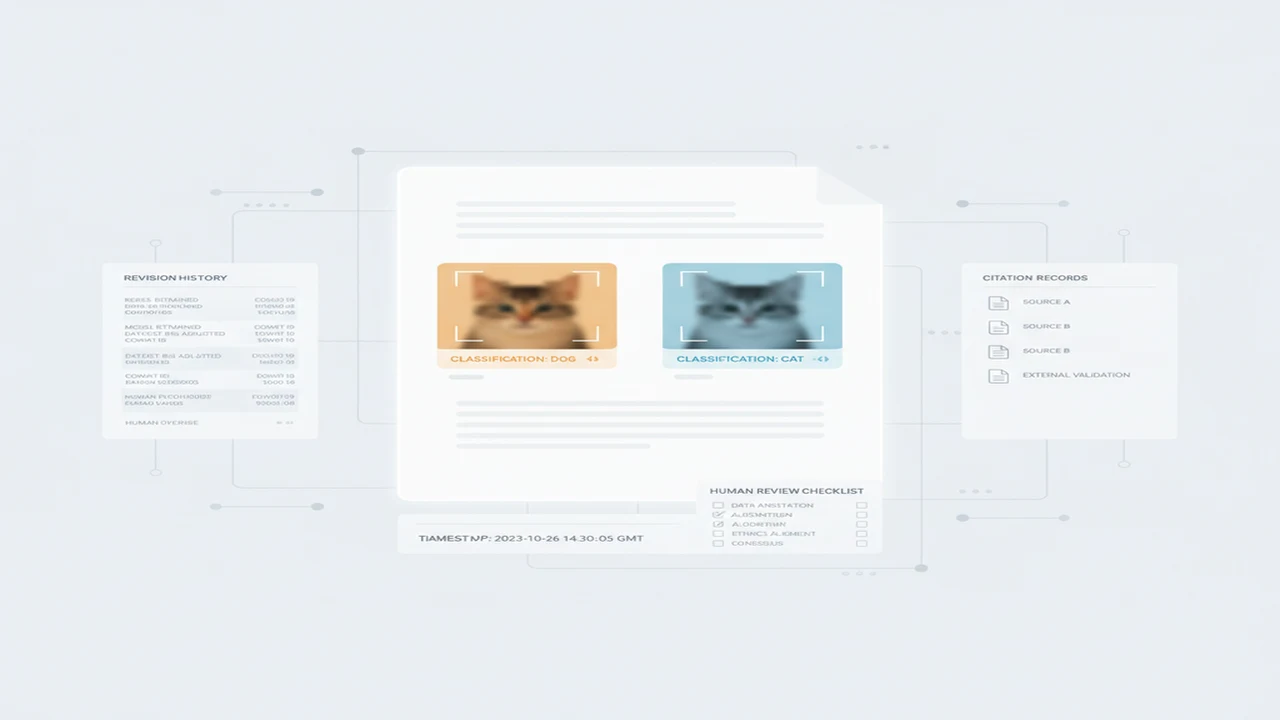
Two detectors can inspect identical text and return opposite labels. That conflict does not reveal which tool is correct. It shows that the classification depends on model design, thresholds, training data, text length, genre, and preprocessing choices that may not be visible to the reviewer.
A defensible response starts by preserving evidence, not by submitting edited versions until a preferred score appears. Detector output belongs in an evidence record alongside drafts, timestamps, citations, revision history, and an explanation from the author. The higher the consequence, the less authority any automated label should carry on its own.
Quick answer: Preserve the original text, rerun each detector under consistent conditions, and record every score, label, highlight, and error. Then inspect revision history, drafts, citations, source files, and author explanations. Conflicting results should reduce confidence rather than trigger a majority vote. Escalate academic, employment, publishing, or disciplinary decisions to documented human review.
Why can AI detectors disagree on the same text?
An AI content detector estimates whether linguistic patterns resemble material in its training or reference data. Different tools may measure predictability, sentence variation, token patterns, or model-specific signals. They can also apply different thresholds when converting those measurements into labels such as human, mixed, or AI-generated.
Passage length and genre matter. Short answers provide less evidence, while technical, formulaic, translated, or heavily edited writing may resemble patterns associated with an AI Writer or AI Chat system. Grammar and paraphrasing tools can also alter the statistical features a detector evaluates. This creates a risk of an AI detector false positive without establishing what process produced the text.
Turnitin reported a false-positive rate below 1% on controlled test data and identification of over 98% of fully AI-generated papers in benchmark datasets. Those figures came from Turnitin in 2023, and its documentation warns that partial documents and mixed authorship are harder to interpret. The Turnitin AI writing detection model guidance illustrates why benchmark performance should not be transferred automatically to an individual dispute. For a deeper explanation of this boundary, see AIACI's guide to AI detector false positives and score interpretation.
- Different models may use different training examples and linguistic features.
- Thresholds can convert similar underlying measurements into opposite labels.
- Formatting, language, passage length, and document genre can change the output.
- Editing by a person, AI Assistant, or grammar tool may blur the classification boundary.
What should you preserve before running another check?
Create an evidence baseline before copying the text into another service. Save the exact document, original formatting, file name, creation and modification timestamps, available revision history, prompt context, and any detector settings. Record where the text came from and who had access to it.
If AI Detector is included in the cross-check, preserve its full result rather than recording only the headline label. Capture the submission time, text length, score presentation, highlighted passages, warnings, and errors. Its output is one signal in the record, not an authorship authority.
Do not overwrite the source document or replace it with a cleaned version. Work from copies identified by version so that later reviewers can reconstruct what each checker received. Hashes or read-only storage can strengthen this chain of custody when the decision is sensitive.
- Exact submitted text and formatting
- Original file and source location
- Creation, modification, and submission timestamps
- Revision history, drafts, notes, and prompt records
- Detector name, version information if shown, and settings
- Screenshots or exports of complete results
How should you rerun conflicting detector checks?
Normalize the conditions before comparing tools. Submit identical text without silently fixing punctuation, deleting headings, or changing line breaks. First check the complete document, then test meaningful sections only when you need to locate disagreement. Avoid tiny fragments that lack enough context for a stable assessment.
An additional result from AI Humanizer, AI Checker: ACI can expand the comparison, but keep checking and rewriting functions separate. Never humanize AI writing before preserving and scanning the original. A rewritten version answers a different question because its linguistic evidence has changed.
- Preserve the original text and metadata in an unchanged evidence copy.
- Record each detector result exactly, including labels, scores, highlights, limits, warnings, and errors.
- Normalize the input conditions so every checker receives the same characters and document scope.
- Rerun full-text and section-level checks without substituting fragments for the complete document.
- Compare labels, scores, and highlighted passages in a single matrix.
- Inspect drafts, sources, citations, and revision history for independent process evidence.
- Classify the evidence as supported, inconclusive, or contradicted.
- Escalate high-stakes cases to documented human review with an opportunity to respond.
How do you compare detector outputs without taking a majority vote?
Place the outputs side by side using the same fields. The table below separates detector observations from provenance evidence. Record whether each service analyzed the entire submission, reached a text limit, rejected a language, or displayed an error. A polished percentage should not receive more weight merely because it looks precise.
If AI Detector App and two other checkers agree, that is score agreement, not necessarily independent confirmation. The systems may rely on related assumptions or react to the same formulaic passages. Compare highlighted regions to see whether they identify the same text, but look outside the detectors for corroboration.
Do not average percentages from different tools. Their scales may represent different concepts, calibration methods, and thresholds. A score from one service may not be mathematically comparable with a score from another. Preserve each result in its native form and explain the disagreement.
- Separate the headline label from the underlying score or confidence display.
- Mark passages highlighted by several tools without assuming shared highlighting proves origin.
- Note unsupported languages, text limits, processing errors, and omitted sections.
- Distinguish agreement among classifiers from evidence about how the document was created.
Which manual checks can confirm or challenge an AI score?
Start with document provenance. Version history can show gradual composition, pasted blocks, restructuring, corrections, and source insertion. Drafts, notes, commit logs, tracked changes, browser history supplied voluntarily, and timestamped research files may establish a process that a detector cannot observe.
Retrieve every citation and compare it with the claim it supposedly supports. Fabricated references or factual inconsistencies may justify further review, but neither feature establishes AI authorship by itself. Human writers make errors, while AI-generated text can contain valid sources after careful editing.
Ask the author to explain the argument, sources, terminology, and revision choices. An oral explanation is more useful when evaluated against existing drafts than when used as an improvised style test. Judgments such as “this sounds too polished” are vulnerable to bias. AIACI's comparison of how to verify AI-generated writing with detector and manual review covers where both methods can fail.
- Check whether revision history matches the claimed writing process.
- Compare drafts and notes with the final structure and wording.
- Open citations and verify that sources exist and support the relevant claims.
- Review factual consistency, copied passages, and unexplained changes in voice.
- Give the author a documented opportunity to explain and provide records.
How should you classify the result after cross-checking?
Use outcome categories tied to evidence rather than detector percentages. “Supported” means multiple independent records align with the interpretation, such as detector concerns plus unexplained pasted text and missing process records. It should not mean that several automated tools displayed similar labels.
“Inconclusive” is appropriate when tools disagree, records are incomplete, or plausible explanations remain. “Contradicted” means stronger provenance evidence conflicts with the automated classification, such as a detailed revision trail and contemporaneous notes that account for the submitted text.
Output from AI Humanizer, AI Checker: ACI or any other AI Checker remains subordinate to provenance. Record which evidence changed the classification, who reviewed it, and what uncertainty remains. Avoid converting an inconclusive case into a negative finding merely because a policy requires a binary answer.
- Supported: independent process evidence substantially aligns with the concern.
- Inconclusive: evidence is mixed, incomplete, or dependent mainly on classifiers.
- Contradicted: reliable provenance records account for the text despite the automated flag.
What are the trust boundaries of AI content detectors?
Detector output has defined trust boundaries. The consolidated limitations note below sets out the relevant sources of uncertainty once, rather than attaching the same warning to every procedural step.
What action should you take when the evidence remains mixed?
For low-stakes screening, document the discrepancy and request context rather than accusing the author. A publisher might ask for sources or drafts. An instructor might discuss the work and request an explanation of its reasoning. The purpose is to resolve uncertainty, not pressure someone into validating an automated label.
Academic penalties, employment action, publication rejection, compliance findings, and disciplinary measures require a higher threshold. Assign a human reviewer who did not generate the initial accusation, provide notice of the evidence, and allow the affected person to submit drafts, metadata, or other provenance. Record the final rationale and preserve an appeal route.
If the evidence remains mixed after review, classify it as inconclusive. Choosing whichever tool gives the preferred answer creates confirmation bias. Teams selecting tools for a broader workflow can consult AIACI's guide to detectors with verifiable results, but product selection does not remove the need for procedural safeguards.
Comparison
| Evidence source | What to record | What it can support | What it cannot prove | Confidence weight |
|---|---|---|---|---|
| Detector label | Exact wording, date, tool, and document scope | What the classifier concluded | Who wrote the text or which system produced it | Low |
| Detector confidence or score | Native scale, warnings, and threshold explanation | Strength of the tool's own classification | Comparability with another tool's percentage | Low |
| Highlighted passage | Exact spans and surrounding context | Where the model found relevant patterns | Why those patterns appeared | Low |
| Second detector result | Label, score, scope, and errors | Whether automated signals align or diverge | Independent authorship confirmation | Low |
| Document revision history | Timestamps, edits, pasted blocks, and contributors | How the document developed over time | Intent behind every change | High when authentic and complete |
| Drafts and notes | Dated outlines, research notes, and intermediate files | A sustained creation process | That no undisclosed tool was ever used | Moderate to high |
| Citation and source check | Retrieved sources and claim alignment | Research quality and factual support | Authorship by itself | Moderate |
| Author explanation | Account of sources, argument, and revisions | Whether the explanation matches available records | Authorship without corroborating evidence | Moderate |
Limitations
AI content detectors produce probabilistic classifications, not direct observations of authorship. False positives and false negatives remain possible, and agreement may reflect shared assumptions rather than independent evidence. Short, formulaic, translated, edited, mixed-origin, or highly polished text can be unstable. A model or threshold update may also change a result even when the submitted text is unchanged.
Opaque scoring systems limit comparison across tools. Manual style judgments introduce a separate bias risk, particularly for multilingual writers, technical genres, and writers who use accessibility or grammar tools. No detector result alone should determine a high-stakes accusation or penalty. These limitations do not make detectors useless, but they confine them to screening and review support rather than final adjudication.
Frequently Asked Questions
Can two AI detectors give opposite results for the same text?
Yes. Different models, training data, thresholds, supported languages, and preprocessing rules can produce opposite labels for identical text. Preserve both outputs and investigate provenance rather than assuming one detector must be correct.
Does a high AI score prove that text was generated by an AI Chatbot?
No. A high score expresses a classifier's assessment under its own model and scale. It does not directly observe whether an AI Chatbot, AI Assistant, human writer, or editing tool produced the passage.
How many AI content detectors should I use to cross-check a result?
There is no defensible fixed number. One additional checker can reveal disagreement, but adding more similar classifiers does not create authorship evidence. Prioritize controlled inputs and independent records over a majority count.
Can AI Detector App confirm who wrote a document?
No detector can confirm a person's identity from linguistic patterns alone. AI Detector App can contribute a recorded classification, but authorship requires provenance such as drafts, account records, revision history, and corroborated explanations.
Should I use AI Humanizer, AI Checker: ACI before checking the original text?
Preserve and check the original first. Rewriting changes the evidence, so a humanized version should be stored separately and labeled clearly. It cannot substitute for the initial document in a disputed review.
Can revision history overturn an AI Checker result?
Reliable, complete revision history can strongly challenge an automated flag by showing how the text developed. Reviewers should still check whether the history is authentic, whether large pasted blocks are explained, and whether it covers the relevant document.
What should a school or employer do with conflicting detector results?
Classify the automated evidence as inconclusive, notify the affected person, request relevant provenance, and assign a documented human review. Penalties or employment decisions should not rest on a detector majority vote.
Can an AI Humanizer make detector evidence unreliable?
A rewriting tool can substantially change the patterns a detector measures. Results from the rewritten text describe that version, not the original. Keep both versions separate, record the transformation, and avoid inferring the original authorship from the later score.