
Why an AI Detection Score Is Not Proof
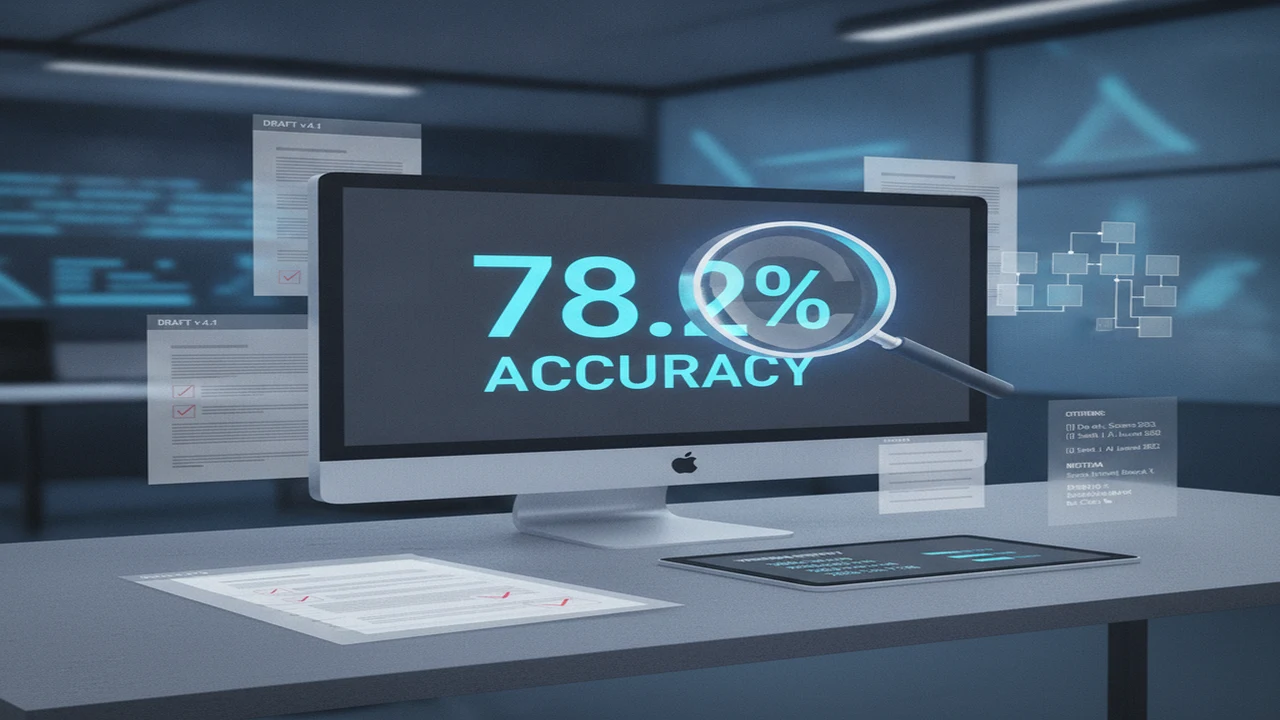
A detector percentage looks precise, but precision in presentation is not the same as certainty about authorship. The number comes from a classification model deciding how closely submitted text matches patterns learned from examples labeled as human or AI-generated.
That distinction matters when a score could affect a grade, job, publication, account, or reputation. The responsible question is not simply whether software flagged the text. It is whether independent evidence confirms the interpretation strongly enough to justify the proposed action.
Quick answer: An AI detection score is a model-generated estimate, not verified evidence of authorship. Results can change with the detector, text length, editing, language, and classification threshold. Use a score to identify material for review, then confirm the concern through drafts, revision history, sources, metadata, context, and direct questions before making academic, employment, publishing, or moderation decisions.
What does an AI detection score actually measure?
An AI content detector usually breaks text into features or token patterns and estimates which learned category provides the closer match. Relevant patterns may include predictability, sentence variation, vocabulary distribution, repetition, and relationships between words. The detector does not observe the writing process.
A displayed percentage may represent model confidence, the share of text classified a certain way, or a product-specific transformation of several signals. Those meanings are not interchangeable. Unless the documentation defines the number, a reader should not assume it means the literal probability that a named person used an AI Writer, AI Chat system, or AI Assistant.
The final label also depends on a decision threshold. Moving that threshold can reduce one type of error while increasing another. This is why two products can analyze identical text and return different labels without either one directly measuring authorship.
Why can a high AI score still be wrong?
Model confidence describes the classifier’s output under its own assumptions. It does not establish factual certainty. A false positive occurs when human writing is classified as AI-like, while a false negative occurs when AI-generated writing is classified as human-like.
Calibration and base rates matter. If AI use is uncommon in the reviewed population, even a detector with favorable evaluation results can generate a meaningful number of incorrect accusations. Repeated scans from the same system may reproduce the same underlying mistake rather than provide independent confirmation.
A Springer study published in 2023 reported overall accuracy of 27.9% for detecting AI-generated text across the evaluated detectors. The best tool reached 50% accuracy on that task, while human-written content was identified at almost 83%. These results came from a particular evaluation and should not be generalized to every current detector, but they illustrate why task, dataset, and error type must be examined separately.
Turnitin’s model documentation also describes AI writing detection as probabilistic and acknowledges false-positive and false-negative trade-offs. A high score can justify closer review, but it cannot close the authorship question.
Which text characteristics can distort an AI detector result?
Short passages give a classifier less evidence and can produce unstable results. Bullet lists, templates, policy language, technical definitions, and formulaic academic prose may also have limited stylistic variation. That regularity can resemble machine-generated text even when a person wrote every sentence.
Translation and non-native English writing create another risk. A writer following learned grammatical structures may use predictable wording, while translation software can normalize variation. Quotations, citations, boilerplate, and standard methods sections can further distort a document-level score.
Edited AI text creates the opposite problem. Rewriting, rearranging, adding personal examples, or combining output from an AI Chatbot with human passages can weaken detectable patterns. An AI Detector can screen text for those patterns, but the AI Detector App cannot observe who drafted each sentence or which tools were involved.
When results appear surprising, consult an accuracy-focused guide to detector results you can verify rather than selecting whichever score confirms an initial suspicion.
- Very short or fragmented submissions
- Templates, rubrics, forms, and repeated institutional language
- Translated or non-native English prose
- Technical, legal, scientific, or highly structured writing
- Documents containing quotations or copied source material
- Mixed documents combining human writing and AI-assisted revisions
How should you verify a suspicious score?
Preserve the submitted document before editing, reformatting, or rescanning it. Record which detector was used, when the scan occurred, what settings applied, and how the product defined its score. Without that record, later reviewers may be unable to reproduce or interpret the result.
Repeat the scan consistently rather than deleting disputed sentences until the score moves. Sentence-level flags deserve inspection for quotations, references, headings, templates, and formulaic language. A second detector may reveal disagreement, but agreement still does not identify the author.
The stronger review happens outside the classifier. Compare drafts, notes, timestamps, version history, citation records, and earlier writing samples. Ask the author to explain source choices, unusual phrases, revisions, and the development of the argument. For a fuller process, use this guide to cross-check conflicting AI detector results.
- Preserve the original document and context
- Record the detector, date, settings, and displayed score
- Repeat the scan without selectively removing disputed passages
- Inspect sentence-level flags for quotations and formulaic language
- Compare drafts, notes, timestamps, and revision history
- Verify citations and source material manually
- Ask the author to explain choices and revisions
- Escalate only when independent evidence supports the concern
When is an automated scan useful compared with manual review?
Automated scanning is useful for triage. It can process many documents consistently, highlight passages for attention, and create a repeatable starting point. That makes a detector suitable for prioritizing review when the reviewer understands the possibility of false positives and false negatives.
Manual review adds context the classifier lacks. A reviewer can distinguish quoted language from original prose, inspect citation quality, compare writing samples, and determine whether a shift in style has an ordinary explanation. Manual judgment can also fail through bias or incomplete records, so it should rely on documented evidence rather than intuition alone.
The iOS AI Checker can provide a screening result, but AI Detector, AI Humanizer: ACI should not be presented as an authorship authority. The useful division of labor is automated prioritization followed by contextual human verification.
What evidence is stronger than a detector percentage?
Evidence becomes stronger when it records how the document developed. Timestamped drafts, cloud version history, research notes, source files, and citation trails connect the finished text to an observable process. They can still be incomplete or manipulated, so reviewers should examine whether the records are coherent with one another.
An author’s explanation can also help. Someone who can describe why a source was selected, how an argument changed, and what prompted specific revisions provides information a classifier cannot access. The explanation should be assessed alongside records, not used as a forced confession exercise.
No single item settles every case. The aim is convergence among independent signals: provenance, content knowledge, source verification, drafting records, and a fair opportunity for correction.
Where should the trust boundary be drawn?
For low-stakes use, a detector can help a writer inspect repetitive prose or help an editor prioritize documents. At the next level, a suspicious score can trigger review, provided it is recorded accurately and the reviewer checks other explanations.
The trust boundary should stop before consequential action based on the score alone. Academic penalties, employment measures, publication rejections, account restrictions, and misconduct findings require independent evidence. Organizations should define who reviews the evidence and how the affected person can challenge an error.
A documented appeal or correction path is part of accuracy control, not an administrative extra. The comparison of AI detection and manual review failure modes explains why neither automation nor unaided judgment should become the sole authority.
What are the limitations of AI text detection?
AI writing detection changes as generators, detectors, datasets, and product thresholds change. Opaque training data makes it difficult to know which genres, languages, educational levels, and writing styles are represented. Results may also shift after a detector update even when the submitted text is unchanged.
Document length, translation, structured prose, mixed authorship, and adversarial editing can all alter classification. Human writing can be flagged, while generated writing can pass. Multiple detectors may agree because they use similar linguistic assumptions, so agreement is not necessarily independent corroboration.
Most importantly, a detector evaluates text patterns rather than identity, intent, provenance, factual accuracy, citation quality, or the actual drafting process. Product documentation can explain intended operation, but it cannot replace independent validation on the relevant language, genre, and population.
Comparison
| Signal | What it may indicate | What it cannot establish | Best confirmation step |
|---|---|---|---|
| Overall detector score | The document matches patterns classified as AI-like | Who wrote it or which tool was used | Preserve the result and inspect provenance |
| Sentence-level highlighting | Specific passages influenced the classification | Whether each highlighted sentence came from AI | Check quotations, templates, and source overlap |
| Repeated results from one detector | The product returns a consistent classification | Independent confirmation | Record settings and review external evidence |
| Results from multiple detectors | Several models identify similar patterns | That their assumptions or training signals are independent | Investigate disagreement and shared limitations |
| Document metadata | Creation times, editors, or software history | A complete or unaltered writing history | Compare metadata with platform records |
| Draft and version history | How ideas and wording developed over time | That every revision was manually written | Check timestamps, continuity, and substantive changes |
| Citation and source trail | Whether claims connect to identifiable research | Who composed the surrounding prose | Open sources and verify claim support |
| Author explanation | Understanding of choices, sources, and revisions | Authorship without corroborating records | Compare the explanation with drafts and evidence |
Limitations
Detector scores remain conditional on the model version, threshold, training data, language, genre, editing level, and amount of text. Because these conditions vary, a percentage should not be transferred from one product or context to another as if it used a universal scale.
Frequently Asked Questions
Can an AI detector prove that a person used AI?
No. A detector classifies linguistic patterns and does not observe the person, drafting process, account activity, or tool use. Authorship claims require independent evidence such as drafts, version history, sources, and a contextual review.
What does an 80 percent AI score mean?
Its meaning depends on the product. It may describe classifier confidence, a proportion of flagged text, or another product-specific metric. Read the detector’s documentation before interpreting the number, and do not translate it directly into an 80 percent probability of misconduct.
Can human writing receive a false positive?
Yes. Formulaic, technical, translated, concise, or highly structured human writing may resemble patterns associated with generated text. A false positive should be investigated through provenance and context rather than assumed to be deception.
Can an AI Humanizer make detection results unreliable?
Rewriting tools and manual editing can change the patterns a detector uses, potentially lowering or shifting a score. A changed result does not reveal who performed the edits or whether the original material came from an AI system.
Should I use more than one AI Checker?
A second checker can expose disagreement and discourage reliance on one model. However, matching results may reflect similar assumptions rather than independent proof. Use multiple scans as screening signals and verify the document history separately.
Can the AI Detector App identify mixed human and AI writing?
It may flag passages that resemble generated writing, but mixed documents are difficult to classify reliably. The result cannot assign authorship sentence by sentence without corroborating records from the drafting process.
Does AI Detector, AI Humanizer: ACI verify who wrote a document?
No. Its listing presents detection and rewriting functions, not identity or authorship verification. Any result should be checked against drafts, metadata, citations, revision history, and the author’s explanation.
What should I do before reporting suspected AI-generated writing?
Save the original document, record the detector and settings, inspect flagged passages, verify citations, review drafts and version history, and ask neutral questions about the writing process. Report a definitive concern only when independent evidence supports it.