
Best AI Detectors for Results You Can Verify
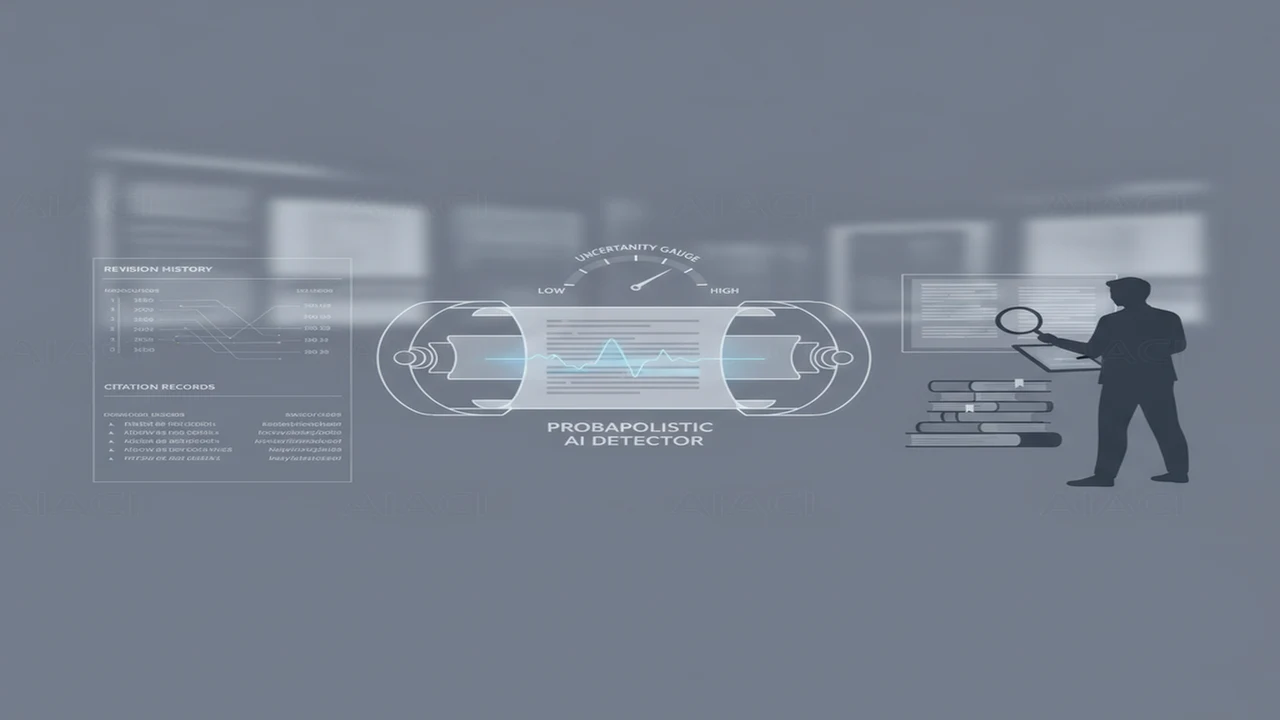
An AI content detector can return a precise-looking percentage while leaving the most important question unanswered: what evidence would confirm the classification? A score without passage-level context, provenance, or drafting history may be useful for screening, but it cannot establish who wrote the text.
This guide ranks workflows rather than unsupported accuracy promises. The strongest option depends on whether you need a browser check, an iPhone writing toolkit, institutional review, or manual evidence suitable for a consequential decision.
Quick answer: The best AI detector is the one that supports a second check rather than demanding trust in a single score. Favor passage-level evidence, clear confidence labels, documented input limits, and privacy information. Use the result for triage, then confirm suspicious wording through sources, citations, revision history, drafting evidence, and a focused discussion with the author.
What makes an AI detector result verifiable?
A verifiable result exposes enough information for a reviewer to challenge it. At minimum, look for highlighted passages, confidence context, input requirements, supported languages, and an explanation of what the label represents. A bare percentage gives little direction for the next review step.
Input limits matter because very short samples provide fewer linguistic patterns to classify. The tool should disclose minimum length or explain when the sample is too limited. Reviewers should also record the date and settings because detectors, thresholds, and underlying language models can change.
Privacy is part of accuracy governance. Before uploading student work, client material, unpublished reporting, or confidential business documents, confirm retention, training, deletion, and access policies from the current provider documentation.
Independent benchmarks illustrate why verification matters. CheckThat.ai's 2026 benchmark summary reported accuracy ranging from 52% to 94% across major detectors depending on text type and source model. The same source reported false-positive rates on human text ranging from about 1% to 67%. DigitalApplied reported 82% overall accuracy and a 5% human-text false-positive rate for Originality.ai in 2026. These figures come from different methods and should not be read as a single comparable leaderboard.
- Interpretable labels rather than an unexplained pass or fail
- Passage-level evidence that can be reviewed in context
- Documented text-length, language, and file-format limits
- A way to preserve the score, settings, highlighted spans, and date
- Current privacy and retention information
- A repeatable path from automated screening to manual confirmation
Which AI detector is best for a browser-based first check?
For a browser-based starting point, the AI Detector can fit a paste, scan, inspect, and confirm workflow without requiring an institutional platform. Its appropriate trust boundary is initial triage: use the output to identify wording that deserves review, not to make an authorship finding.
Run the complete passage where possible. Selectively pasting only polished or suspicious sentences removes context and can distort the signal. Save the original text before changing anything, then record the returned label and any highlighted areas.
A useful browser workflow adds at least one independent signal. That signal might be a second detector, but provenance is stronger when available: source files, version history, notes, citations, or an author's explanation of how a specific paragraph developed.
Which option combines AI detection with writing tools on iPhone?
The US App Store listing for AI Writer presents AI Writer and AI Chat: ACI as a mobile chatbot assistant and image-making toolkit. This is a fit for users who want generation and review functions in one iPhone workflow, subject to the features and terms shown in their regional listing.
Generation functions and detection evidence have different jobs. An AI Chat or AI Assistant can draft, summarize, and revise text. A detector estimates whether textual patterns resemble generated writing. The presence of both functions in one interface does not make the detector an audit record of which function created a passage.
Preserve the pre-edit version when checking text produced or revised inside a writing tool. Comparing versions, prompts, source notes, and citations can reveal the actual process more clearly than scanning only the final polished copy.
Which iPhone option pairs an AI Detector with an AI Humanizer?
The Canadian App Store listing for AI Humanizer presents AI Detector, AI Humanizer: ACI as a mobile option for checking and rewriting text. Regional availability, feature descriptions, subscriptions, and privacy details should be confirmed in the current store listing.
A humanizer changes wording and statistical patterns. A lower detector score after rewriting shows that the classifier responded differently to the revised text. It does not establish human authorship, improve factual accuracy, or validate citations.
Keep both versions if the text will be reviewed later. Deleting the original erases useful provenance and can make a responsible assessment harder. For editorial work, factual and source checks should follow any rewrite regardless of the new detector score.
How do leading AI content detectors differ?
The comparison should start with use case and evidence exposed, not a universal accuracy rank. GPTZero is commonly positioned for education and sentence-level review. Originality.ai targets publishing workflows and combines detection with related content checks. Copyleaks emphasizes organizational and learning-platform use, while Turnitin operates within established academic integrity systems.
Winston AI markets text and image detection for verification workflows. Image detection is a separate classification problem from detecting AI-generated writing, so results should be tied to the correct media type and checked against originals and metadata.
Public descriptions and independent benchmark methods vary. A tool evaluated on untouched model output may perform differently on translated, edited, quoted, technical, or mixed-authorship documents. Scores from different providers are not interchangeable because labels, thresholds, training sets, and calibration can differ.
How should you verify a flagged passage?
Verification begins before the first scan. Preserve the submitted document, timestamps, available metadata, and surrounding context. If the text changes during review, retain each version so later decisions can be reconstructed.
A second detector is useful only as corroboration. Agreement can justify closer review, while disagreement shows uncertainty that must be resolved through stronger evidence. Neither outcome identifies an author by itself.
Ask narrow questions instead of demanding a general defense. A writer may be able to explain why a phrase was chosen, locate the cited source, provide an earlier draft, or reconstruct an argument. Those answers are more informative than asking whether the entire document is human-written.
- Preserve the original text and available metadata before scanning or editing.
- Check the minimum supported text length, language, and format in current documentation.
- Scan the complete passage without selective trimming that removes relevant context.
- Record the score, highlighted spans, settings, and date so the result can be reviewed.
- Isolate the passages driving the result while retaining their surrounding paragraphs.
- Trace claims, quotations, and citations to primary sources and confirm that each source supports the wording.
- Inspect revision history or drafting evidence when authorized and proportionate to the decision.
- Run one independent detector as a secondary signal, not as a deciding vote.
- Ask the author targeted questions about flagged wording, sources, and drafting choices.
- Decide using the combined evidence rather than the detector label.
When is manual review more reliable than an AI Checker?
Manual review is usually more informative when a document is short, heavily edited, translated, formulaic, citation-dense, or assembled from both human and generated passages. These conditions reduce the value of broad stylistic classification while increasing the importance of context.
Quotations and templates can also confuse interpretation. A policy statement, product description, laboratory format, or standard academic structure may repeat predictable language for legitimate reasons. A reviewer can separate quoted, required, and original material before assessing the remaining prose.
Revision history is especially useful for mixed documents. It may show incremental drafting, pasted sections, source integration, and later editing. For a closer account of the distinct failure modes, see where AI detectors and manual review can each fail.
Automated screening retains an advantage in speed and consistency across large queues. Manual review contributes source interpretation, process evidence, and proportional judgment. The reliable workflow assigns each method the job it can support.
What are the limits of detecting AI-generated writing?
Detector outputs are probabilistic classifications, not proof of who wrote a passage. False positives may affect concise, formulaic, translated, accessibility-edited, or non-native writing. False negatives can follow paraphrasing, human editing, prompt variation, or changes in the models producing the text.
Short samples and mixed human-AI documents can generate unstable or misleading labels. Different services also use different thresholds, training data, terminology, and reporting formats, so a 70% result from one provider does not necessarily represent the same confidence or decision boundary as 70% elsewhere.
Model drift creates another trust boundary. Detectors and generators both change, which means an old result may not be reproducible under a later version. Keep the scan date and available settings with any review record.
Rewriting designed to humanize AI writing may alter detectable patterns without establishing genuine human authorship, reliable sourcing, or factual correctness. Separately, uploading confidential or unpublished text may introduce retention and access risks. Confirm current privacy terms before submission.
- A classification cannot establish the identity, intent, or process of the author.
- False positives and false negatives vary by text type and population.
- Short, edited, translated, and mixed-authorship samples require extra caution.
- Provider scores cannot be directly converted into one shared scale.
- Privacy review is required separately from accuracy review.
Which detector workflow should you choose?
For low-stakes screening, one detector followed by a quick passage review may be proportionate. If the result merely determines what an editor reads first, the cost of an error is limited and the label can remain a triage signal.
Editorial review should add citation tracing, source quality checks, and retained drafts. Education requires assignment context, authorized process evidence, a chance for the student to respond, and safeguards against acting on an isolated false positive. Hiring decisions should not infer honesty or competence from a detector label.
Compliance and disciplinary decisions require the strongest boundary: preserve evidence, document uncertainty, obtain human review, and use established organizational procedures. When provenance matters, follow a structured process for cross-checking conflicting detector results rather than selecting whichever score supports the preferred outcome.
The best overall choice is therefore a verification stack. Use automation to locate potential concerns, inspect the text behind the score, and confirm material claims through primary sources, revision records, and author context.
- Low stakes: one scan plus a contextual read
- Publishing: scan, passage review, citation tracing, and draft comparison
- Education: multiple signals, assignment context, process evidence, and student response
- Hiring: source and work-sample review without authorship assumptions from a score
- Compliance: preserved records, human escalation, documented uncertainty, and formal policy
Comparison
| Tool or workflow | Primary use | Evidence exposed | Manual confirmation needed | Best-fit trust boundary |
|---|---|---|---|---|
| AI Detector App | Browser-based text screening | Detector output as an initial signal | Passage review, sources, drafts, and author context | First check and low-stakes triage |
| AI Writer and AI Chat: ACI | Mobile generation and assistant workflow | App output and retained versions where available | Separate generated, revised, and sourced material | Personal mobile drafting and review |
| AI Detector and AI Humanizer: ACI | Mobile detection and rewriting | Before-and-after text plus detector response | Confirm provenance, facts, citations, and edit history | Mobile screening with version preservation |
| GPTZero | Education-oriented screening | Document and sentence-level indicators described publicly | Assignment context, drafts, and author response | Classroom triage within a review process |
| Originality.ai | Publishing and content operations | AI and related content-checking reports | Editorial source and revision review | Publisher workflow, below the threshold of proof |
| Copyleaks | Enterprise and learning workflows | Detection reports within supported integrations | Policy-based human review and provenance checks | Organizational screening |
| Winston AI | Text and image screening | Media-specific classification reports | Original files, metadata, and contextual examination | Initial multimodal review |
| Turnitin | Institutional academic review | AI indicators alongside academic-integrity tooling | Assignment evidence, drafts, policy, and student response | Institutional triage, not automatic discipline |
| Manual source and revision review | Provenance and factual verification | Primary sources, timestamps, drafts, and explanations | Independent corroboration may still be appropriate | Consequential authorship or integrity decisions |
Limitations
Frequently Asked Questions
Can an AI detector prove that a person used AI?
No. It classifies textual patterns and cannot establish the identity, intent, or complete drafting process of an author. Consequential decisions need provenance, contextual review, source checks, and an opportunity for the author to explain the work.
How can I check if text is AI-generated without relying on one score?
Preserve the original, scan the full passage, inspect highlighted wording, trace citations, review authorized revision history, and ask targeted drafting questions. A second detector can provide another signal, but process evidence is generally more informative than agreement between two classifiers.
What does a high AI content detector score actually mean?
It means the tool found patterns that crossed its classification threshold. The percentage may represent confidence, predicted composition, or another provider-specific measure. Read the provider's label definition before interpreting it, and do not compare percentages across tools as if they used one scale.
Can an AI Humanizer make detector results unreliable?
Rewriting can change sentence structure, predictability, and word choice, which may change a detector score. That change does not verify human authorship or factual quality. Keep the original and revised versions when provenance matters.
Does AI Detector App identify mixed human and AI writing?
Its current public documentation should be checked for how it describes mixed-text analysis and passage-level output. Mixed documents are difficult for detectors generally, so inspect individual passages and confirm them through drafts, sources, and author context.
What is the difference between AI Writer, AI Chat, and AI detection features?
AI Writer and AI Chat functions generate, revise, or respond to prompts. Detection functions classify existing text. Using both in one app does not create an independent authorship record, so preserve versions and source material when the writing process matters.
Why do GPTZero, Originality.ai, Copyleaks, and Turnitin return different results?
They can use different training data, thresholds, preprocessing, labels, supported lengths, and model versions. Conflicting outputs indicate uncertainty rather than a need to choose the most severe label.
Should schools or employers act on an AI Checker result alone?
No. A false positive can carry serious academic or employment consequences. Reviewers should use proportionate procedures, examine authorized process evidence, consider language and accessibility factors, and allow the affected person to respond.