
AI Detector vs Manual Review: Where Each Can Fail
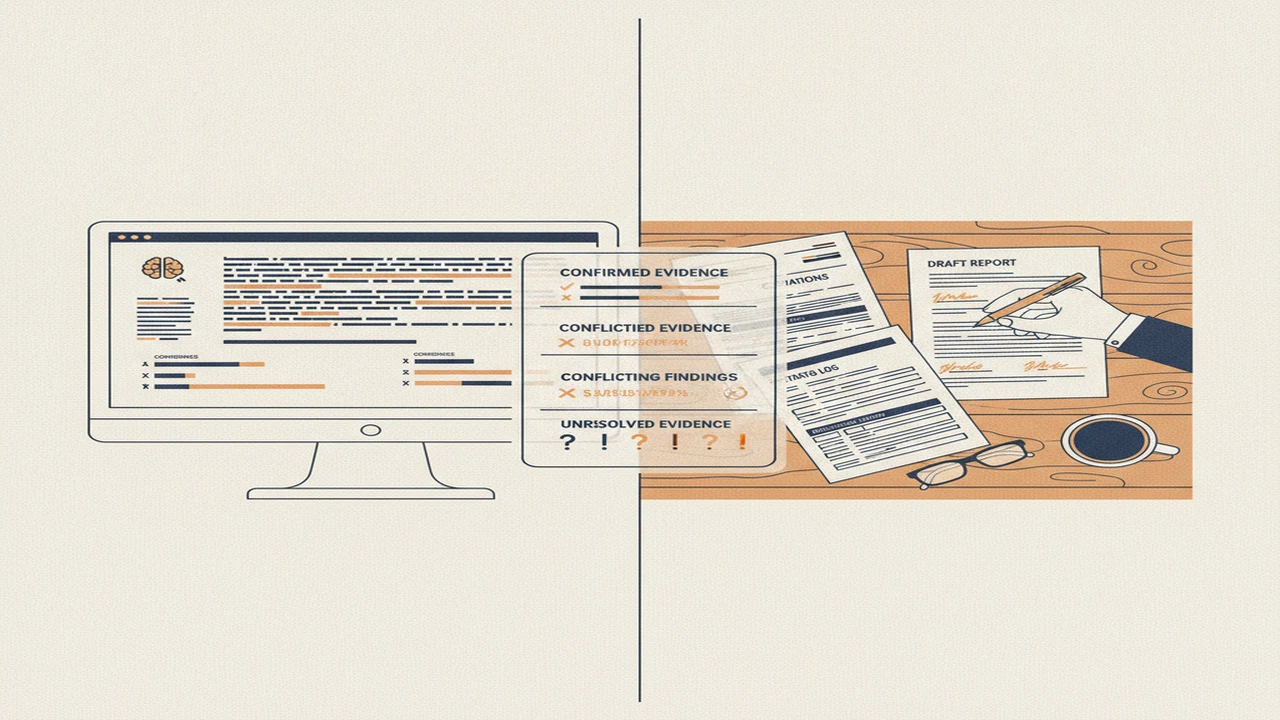
A detector and a human reviewer can examine the same document and reach opposite conclusions. The detector measures resemblance to patterns in its training data. The reviewer interprets style, context, sources, and the presumed writing process. Neither view directly observes who pressed the keys.
The relevant question is not which method always wins. It is which evidence each method can supply, which errors it can introduce, and where the decision must stop when the record remains incomplete.
Quick answer: AI detectors can flag statistical patterns, but a score cannot establish authorship by itself. Manual review adds context, source checking, and reasoning, yet reviewers can misread polished or formulaic prose. For consequential decisions, use detection as a screening signal, inspect the underlying text, confirm provenance, and document conflicting evidence before acting.
What does an AI detector score actually measure?
An AI content detector classifies linguistic patterns. Depending on the system, those patterns may include predictability, sentence variation, token choices, repetition, syntax, and similarities to known machine output. Some products provide a document score, sentence-level flags, or both.
A confidence score expresses the classifier's estimate under its own model and threshold. It is not a measured percentage of sentences written by a machine, and it does not identify an author. Changing the threshold can trade fewer missed detections for more false positives, or the reverse.
Text length also affects the available signal. A short paragraph gives a classifier less evidence than a complete article, while combining passages from different authors or editing stages can obscure local differences. For a deeper explanation, see why an AI detection score is not proof.
- Classification answers how closely text matches learned patterns.
- Authorship verification asks who created or changed the document.
- Those questions overlap, but they are not interchangeable.
Where can automated AI detection produce false results?
False positives occur when human writing resembles patterns associated with generated text. Formulaic assignments, technical explanations, translated passages, heavily corrected prose, and writing by non-native English speakers can all appear statistically regular. A false negative can occur after paraphrasing, translation, manual editing, or a change in the writing model.
Secondary summaries illustrate why published percentages need context. An APSENSE overview from 2025 reported an accuracy range of 60% to 95% depending on the detector and text type. A Casper Larsen market summary from 2025 reported that over 61% of essays by non-native English speakers were falsely flagged in one referenced analysis. These are secondary reports, not a universal benchmark.
An EyeSift summary from 2026 reported real-world accuracy 15 to 35 percentage points below vendor claims in its meta-analysis overview. Differences in datasets, thresholds, text length, language, and editing make a single headline rate unsuitable for every document.
The AI Detector can be used as a screening option to locate passages that deserve inspection. Its result should enter an evidence record alongside the unchanged sample, settings, date, and relevant context. An AI Humanizer or ordinary manual rewrite can alter detectable patterns without resolving who contributed which ideas.
- Short samples may not contain enough stable signal.
- Model drift can make an older benchmark irrelevant to a newer classifier.
- Domain-specific templates may resemble generated prose.
- Threshold selection changes the balance between false positives and false negatives.
Where can manual review reach the wrong conclusion?
Human reviewers can examine citations, argument quality, factual consistency, assignment context, and revision history. They can also ask whether a sudden style change has an ordinary explanation, such as tutoring, translation, accessibility software, or extensive editing.
That contextual ability does not remove bias. A reviewer who expects misconduct may interpret polished grammar, neutral tone, or structured headings as evidence of AI use. Another reviewer may overlook generated material because it contains personal details or a few deliberate errors.
Criteria also vary between reviewers. One person may focus on repetitive sentence openings, while another prioritizes unsupported citations. Limited subject knowledge can make accurate technical language appear suspicious or allow fabricated but fluent claims to pass. Manual review needs written criteria, access to source evidence, and separation between initial screening and final judgment.
How should you investigate disagreement between a detector and a reviewer?
Preserve the exact document before investigating. Reformatting, correcting punctuation, or extracting only selected paragraphs can change the input and prevent later reproduction. Record which version was scored and which passages influenced the reviewer.
Next, move from pattern evidence toward provenance. Drafts, version history, notes, citation records, file metadata, and process explanations can show how a document developed. None is automatically decisive, but together they can support or contradict an authorship claim.
If results still conflict, record the outcome as unresolved rather than forcing a binary label. The guide to cross-checking conflicting detector results explains how to preserve comparable inputs and avoid turning repeated scores into false certainty.
- Collect the complete text and relevant context.
- Check whether the sample is long enough for meaningful analysis.
- Run the same unchanged sample through the selected AI content detector.
- Inspect the passages responsible for the strongest flags.
- Compare citations, drafts, metadata, and revision history.
- Ask the author for process evidence when stakes justify it.
- Record agreements, conflicts, and unresolved uncertainty.
- Escalate consequential decisions to a second reviewer.
How do AI writing tools complicate authorship labels?
AI assistance is not a single writing process. A person might request an outline, rewrite one sentence, translate a draft, correct grammar, generate an entire section, or combine generated material with original research. A binary human-or-AI label discards those distinctions.
The AI Writer listing includes AI Chat, chatbot assistance, and content-generation functions. These categories illustrate why access to a tool does not reveal how much of a particular document came from it. The relevant evidence is the documented workflow, including prompts, drafts, revisions, disclosures, and source use.
Policies should define whether they regulate generated wording, AI-assisted editing, undisclosed use, unsupported claims, or some combination. Without that definition, two reviewers can agree on the facts and still apply incompatible labels.
Which review method fits each level of risk?
Low-stakes moderation can use an AI Checker to prioritize a queue, provided no penalty follows automatically. Editorial review should add citation checks and passage-level inspection. Education, hiring, compliance, and publication disputes require stronger process evidence because a false accusation can materially affect a person.
Using multiple detectors, including products such as GPTZero, Turnitin, Originality.ai, Copyleaks, ZeroGPT, Winston AI, or QuillBot AI Checker, may reveal disagreement. It does not convert correlated classifiers into independent proof. The value lies in identifying unstable cases that require more investigation.
Teams choosing a screening product can consult AI detectors designed around verifiable results. Selection should prioritize exportable findings, sentence-level context, reproducible inputs, and clear threshold explanations over a bare percentage.
Where should the final trust boundary sit?
The trust boundary should move with the consequence of error. A detector score may decide which document receives attention. It should not, by itself, decide who is penalized, rejected, or publicly accused.
Manual judgment supplies context but remains an interpretation. Provenance and revision evidence provide a stronger confirmation layer because they address process rather than style alone. When those records are missing or contradictory, abstaining from an authorship claim is more accurate than selecting the most confident-looking output.
Comparison
| Method | Useful signal | Common false positive | Common false negative | Best confirmation source | Suitable decision role |
|---|---|---|---|---|---|
| AI detector alone | Pattern resemblance and flagged passages | Formulaic or translated human writing | Edited or unfamiliar model output | Unchanged text plus provenance records | Low-stakes triage only |
| Manual review alone | Context, reasoning, citations, and inconsistencies | Style stereotypes interpreted as AI use | Fluent generated text accepted as human | Drafts, sources, and revision history | Contextual assessment |
| Detector plus manual review | Pattern signal evaluated with context | Reviewer overweights the score | Both methods share the same mistaken assumption | Independent process evidence | Prioritization and preliminary findings |
| Provenance and revision-history review | Document development over time | Routine editing interpreted as generation | Missing or altered records conceal the process | Native version history and source files | Stronger confirmation layer |
| Second-reviewer escalation | Independent application of written criteria | Second reviewer sees the first conclusion | Shared policy gaps reproduce the error | Blind review plus documented evidence | Consequential or disputed decisions |
Limitations
Detector confidence remains a model estimate rather than verified authorship evidence. Short, translated, highly edited, technical, or formulaic text can be difficult to classify. Detection behavior can also change with new writing models, classifier updates, product versions, and threshold settings.
Human reviewers may overvalue detector output, rely on style stereotypes, or lack the subject knowledge needed to evaluate a passage. AI-assisted writing also covers generation, outlining, rewriting, translation, and correction, so a binary label may conceal the actual workflow.
Provenance is stronger only when reliable records exist. Draft history, metadata, prompts, and source files may be incomplete, altered, or unavailable. A lack of records cannot identify whether text came from a person, an AI system, or both. High-stakes policies therefore need disclosure rules, second review, documented uncertainty, and an appeal route instead of automatic penalties.
Frequently Asked Questions
Can writing style alone show whether text was generated by AI?
No. Repetition, polished grammar, predictable structure, and neutral tone can appear in both human and generated writing. Style can justify closer inspection, but authorship requires contextual and process evidence.
Can an AI content detector prove who wrote a document?
No. A detector estimates whether text resembles patterns associated with machine output. It does not observe the drafting process, identify the typist, or distinguish every form of editing and collaboration.
Why might human-written text receive a high AI score?
Formulaic structure, technical vocabulary, translation, grammar correction, short samples, and predictable academic phrasing can resemble a detector's learned AI patterns. The original document and surrounding context should be reviewed before drawing a conclusion.
Can an AI Humanizer prevent detection reliably?
No reliable prevention claim follows from rewriting text. Paraphrasing may change a classifier score, but different detectors use different features and can change over time. It also does not establish honest authorship or accurate sourcing.
How should AI Detector App results be confirmed?
Preserve the unchanged input, inspect flagged passages, and compare the result with drafts, citations, metadata, and revision history. For consequential decisions, use a second reviewer and document any conflict or missing evidence.
Does using AI Writer or AI Chat make an entire document AI-generated?
Not necessarily. The tool might have been used for brainstorming, translation, correction, rewriting, or full generation. Determine the extent of assistance from the workflow and applicable disclosure policy rather than tool access alone.
What evidence should be required before penalizing someone for suspected AI writing?
Require more than a score or stylistic impression. Relevant evidence can include version history, drafts, source notes, citation verification, process questions, a second review, and an opportunity for the author to respond.
Should organizations use more than one detector?
Multiple detectors can expose unstable classifications, but agreement does not establish authorship. Systems may share training assumptions or react similarly to the same writing features. Use additional results to guide review, not to multiply confidence mechanically.